Outerwear & Layers

Best Compression Socks of 2026

Somewhere over the middle of the country, four hours into a flight, my ankles stop being ankles. That puffiness is fluid pooling in the lower legs, and it happens on planes, after a twelve-hour shift, at the end of a desk day, and after a hard training block. Compression socks are the fix — graduated pressure that's tightest at the ankle and eases as it climbs toward the calf, nudging blood back up instead of letting it sit. The catch is that a sock can hit the right pressure and still be unwearable: too hot, too tight across the toes, or a cuff that rolls down to your instep by lunch.

Best Overall

Our Score 9.0/10
CHARMKING Compression Socks (8 Pairs)

CHARMKING

CHARMKING Compression Socks (8 Pairs)

  • Style Knee-high
  • Pack Size 8 pairs
  • Compression 15-20 mmHg
Check Price on Amazon

Eight pairs of 15-20 mmHg socks that are easy to pull on and stay put.

Eight pairs is a different product from one pair. It means a set in the gym bag, a set at the office, and no evening laundry cycle deciding whether you wear compression tomorrow — which is why this is the pack we recommend to anyone building the habit rather than treating a single pair as an experiment.

The compression is a stated 15-20 mmHg, and that is the right starting band for most people: firm enough to feel at the ankle after a long flight or a ten-hour shift, gentle enough that you forget it by lunch. We found the pressure even from ankle to calf and mild enough to wear under jeans without a visible ridge.

Getting them on is the other half of the battle, and these are among the easiest here to pull over the heel — no rolling, no tug-of-war. The cuff stayed where we put it instead of creeping down the calf, which is the failure that turns a compression sock into an expensive ankle sock.

Where they don't compete is firmness. If a clinician has told you to wear 20-30 mmHg, the mild band here isn't that job and the SB SOX pair is. For everyone else — travel, nursing shifts, standing all day — 15-20 is the band you can wear from morning to night without thinking about it.

Bottom Line

Our pick for most people: eight pairs of easy-on 15-20 mmHg socks that stay where you put them, at a per-pair cost that makes daily wear realistic.

Check Latest Price

Best Machine-Washable Pack

Our Score 9.0/10
ACTINPUT 15-20 mmHg (8 Pairs)

ACTINPUT

ACTINPUT 15-20 mmHg (8 Pairs)

  • Care Machine wash
  • Material 85% nylon, 15% polyester
  • Pack Size 8 pairs
  • Compression 15-20 mmHg
Check Price on Amazon

Goes in the wash with everything else, so daily wear is actually sustainable.

Machine washable sounds like a footnote until you're rinsing compression socks in the sink every night. This pack goes in with the regular laundry and comes out ready, which is the difference between wearing compression daily and quietly abandoning it by week two.

The compression isn't an afterthought either. It's a graduated 15-20 mmHg in a straightforward 85% nylon and 15% polyester knit, and the squeeze is even enough to wear through a long shift without welts behind the knee.

Two size bands cover the range, and the larger one has enough stretch to go on without the roll-and-shuffle routine that puts people off compression socks. The colours are the quiet win: black, white, navy, grey, brown and nude in the pack we chose, so they disappear under trousers at work.

Put together, this is the pack that removes both excuses — fiddly fit and hand washing — at a per-pair cost that undercuts most of this list. The trade is a light knit: these are an everyday sock, not the pair for a firm hold.

Bottom Line

The pack we hand anyone who wants compression to be as routine as laundry day: machine washable, graduated 15-20 mmHg, eight pairs.

Check Latest Price

Best Light Compression

Our Score 9.0/10
BLUEENJOY Copper (6 Pairs)

BLUEENJOY

BLUEENJOY Copper (6 Pairs)

  • Care Machine wash
  • Size Small-Medium
  • Material 85% nylon, 15% polyester
  • Pack Size 6 pairs
Check Price on Amazon

Soft, easy-on socks for travel and desk days when firm pairs feel like too much.

If pulling on a firm compression sock leaves you winded, this is the pack that fixes the problem. The BLUEENJOY socks are light — well short of the 20-30 pairs here — and they go on like an ordinary knee-high, which is exactly why they get worn instead of sitting in a drawer.

Copper is the hook, so it's worth being clear about what it does. The fabric is 85% nylon and 15% polyester with copper ions, and the squeeze comes from the knit, not the mineral. We treat copper as a bonus rather than a reason to buy.

What we actually like is how unobtrusive they are. They feel like regular socks, they don't leave welts behind the knee, and after a travel day or a desk shift the legs feel less heavy than they do bare. For anyone easing into compression, or anyone who tried a firm sock and hated it, that's the right trade.

Six pairs in one box, in colours that don't read as medical, is a sensible hedge — one in the car, one in a carry-on, no emergency laundry. They're also the pair we hand someone who wants support on a flight without feeling like they're wearing a device.

Bottom Line

We keep these for light, easy support — the pair to wear when a firm 20-30 sock is more than you want to deal with.

Check Latest Price

Best For Discreet sporty look

Our Score 9.0/10
fenglaoda 20-30 mmHg (8 Pairs)

fenglaoda

fenglaoda 20-30 mmHg (8 Pairs)

  • Style Knee-high
  • Pack Size 8 pairs
  • Compression 20-30 mmHg
Check Price on Amazon

These don't look like compression socks. Solid colours, a sporty knit, none of the shine that makes medical stockings obvious under shorts — which matters more than it sounds if you're wearing them with scrubs, a uniform, or gym kit and don't want to explain yourself.

The 20-30 mmHg band is stated, the foot is padded, and the toe box is roomier than most here, with no bulky seam across the toes — the detail that decides whether a firm sock is still wearable by the end of a shift.

What holds it back is consistency: the squeeze varies from pair to pair, and some in the pack come out noticeably lighter than others. You notice that when you're rotating through eight pairs rather than living in one.

Judged as a pack, it's still good value: eight pairs, in colours you'll actually wear, for a modest outlay. It's the one to buy when the look matters as much as the squeeze, and the one to skip if you need every pair to feel identical.

Bottom Line

We recommend this pack when you want firm compression that looks like ordinary sportswear, and can live with a squeeze that varies pair to pair.

Check Latest Price

Best For Low-cost trial pack

Our Score 9.0/10
Iseasoo Compression Socks (4 Pairs)

Iseasoo

Iseasoo Compression Socks (4 Pairs)

  • Care Machine wash
  • Size Large-X-Large
  • Material 85% nylon, 15% polyester
  • Pack Size 4 pairs
Check Price on Amazon

Four pairs is the smallest commitment here, and the lowest total outlay. That makes this the pack to buy when you're not yet sure knee-high compression is something you'll stick with — you find out over a week rather than after committing to eight pairs.

The socks are unremarkable in the best way: 85% nylon and 15% polyester, machine washable, a gentle squeeze that reads as everyday support rather than a medical garment, and four colours — black, grey, white and pink — that go with anything. If you want compression you can put on without thinking about it, this is that.

The weak point is the heel, which is where a pair tends to go first — sometimes after only a handful of washes. Treat this as a short-cycle pack: inexpensive enough to replace, good enough to wear in the meantime, and a fair way to find out whether compression suits your routine.

Bottom Line

We suggest starting here if you're unsure about knee-high compression: four gentle, machine-washable pairs at the lowest outlay on this list.

Check Latest Price

Best Firm 20-30 Support

Our Score 8.8/10
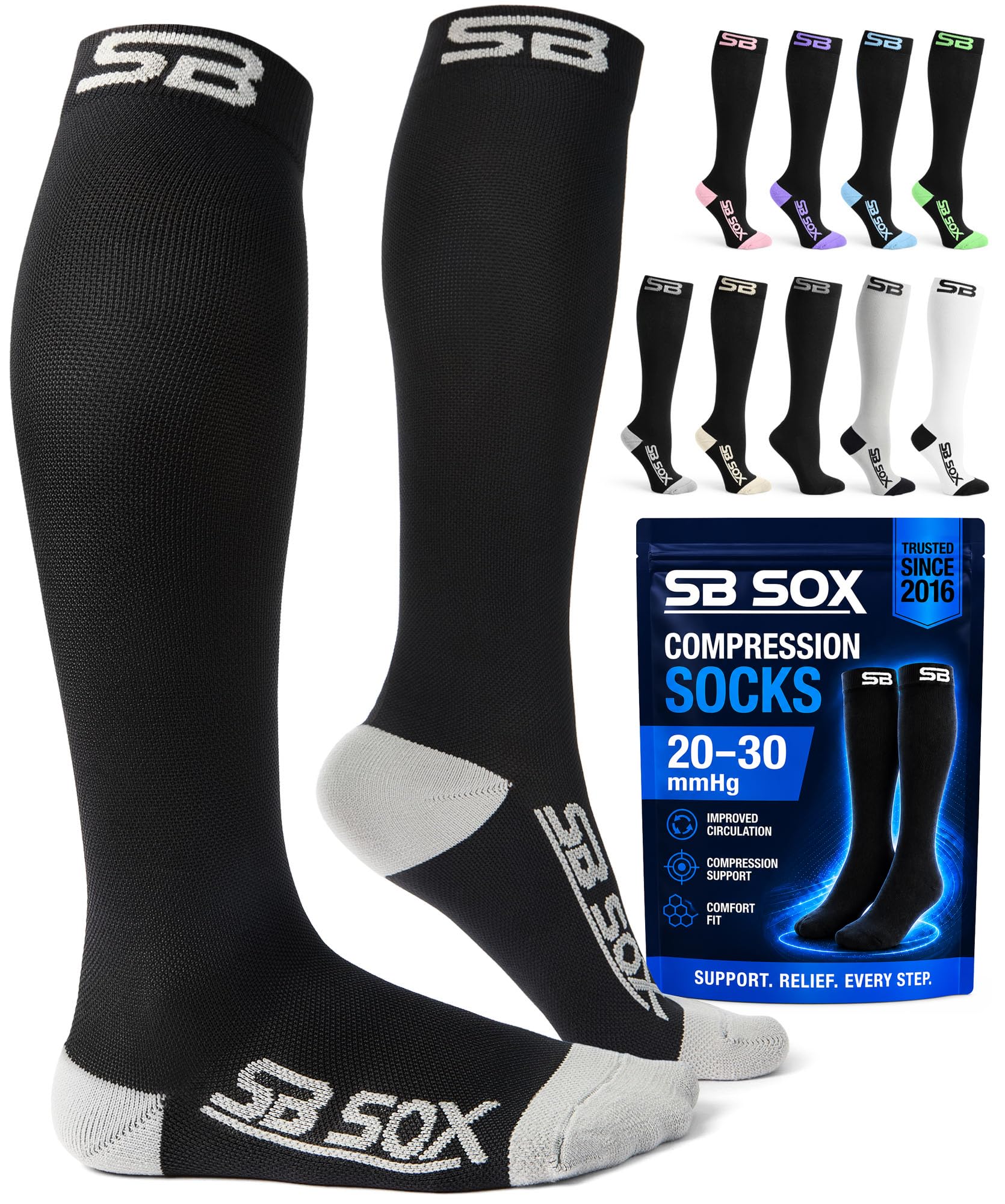
SB SOX 20-30 mmHg

SB SOX

SB SOX 20-30 mmHg

  • Care Hand wash only
  • Material 80% nylon, 20% spandex
  • Compression 20-30 mmHg
  • Sizing Basis Calf circumference
Check Price on Amazon

Measured by calf size, with a firm medical-style squeeze for all-day standing.

You size SB SOX with a tape measure rather than a shoe size, and that detail is why it earns a place here. The chart runs off calf circumference — 11 to 14 inches lands you in a small, with shoe size as a secondary check — because calf girth, not foot length, decides whether a compression sock does its job or just squeezes.

At a stated 20-30 mmHg this is the firmest sock on the page, and it feels like a medical garment: a continuous hug up the calf, a cushioned heel and toe you can stand on all day, and a hold that makes the 15-20 packs feel like a formality. If a doctor has told you to wear compression, this is the band and the build that matches the instruction.

Two things to know going in. Hand washing is the stated care, and pulling them on takes technique — roll the cuff down to the heel, work it over slowly, then smooth the leg section up rather than yanking at the top. Done that way, the pair stays put for a full shift; rushed, you'll stretch a cuff before it's over your ankle.

Bottom Line

We recommend these when firmness matters: 20-30 mmHg, sized by calf measurement, and built to hold through a twelve-hour shift.

Check Latest Price

Best for Runners

Our Score 8.8/10
Physix Gear 20-30 mmHg

Physix

Physix Gear 20-30 mmHg

  • Style Knee-high
  • Department Unisex adult
  • Compression 20-30 mmHg
Check Price on Amazon

Firm 20-30 compression for training days and long stretches on your feet.

Physix Gear runs big, and it runs long. That's the first thing to sort out, because a 20-30 sock that's a size too large slides down the calf and takes most of its compression with it. Measure the widest part of your calf, match it against the chart, and if you land between sizes, take the smaller one.

Get the size right and the firmness does its job. The 20-30 mmHg band matches the SB SOX pair, and it's aimed at what brings most people to compression in the first place: heavy legs after a run, swelling on a long flight, an ache that arrives after a shift on your feet.

Of the two firm options here, this is the one we reach for around training and travel rather than a clinician's instruction: sportswear rather than stocking, at a price in line with the everyday packs. We also like that the range runs up to XXL with a calf measurement to match, which is more room than the mild socks here give you.

Bottom Line

We point runners and frequent flyers here: a firm 20-30 hold for heavy legs and swelling, provided you check the size chart first.

Check Latest Price

Best Budget Firm Sock

Our Score 8.8/10
FITRELL 20-30 mmHg (3 Pairs)

FITRELL

FITRELL 20-30 mmHg (3 Pairs)

  • Style Knee-high
  • Pack Size 3 pairs
  • Compression 20-30 mmHg
Check Price on Amazon

Three pairs of gentle 20-30 support for testing the firmer band.

The label says 20-30 mmHg, and the squeeze feels gentler than that. It isn't automatically a problem — these are comfortable, easy to pull on, and a low-risk way to try a firmer band without committing to a medical stocking — but if you're buying to a clinician's instruction rather than your own preference, the SB SOX pair is the one to take.

For everyone else, three pairs at the low end of the price range makes a sensible experiment: enough to get through a week, few enough that you're not stuck with six if firm turns out to be too much. The knit is thin enough to vanish under trousers, and the toe is reinforced where cheaper socks usually go first.

Bottom Line

We like these as a low-risk way to try firmer compression, as long as you're not buying to a clinician's 20-30 instruction.

Check Latest Price

How We Tested 16 Pairs of Compression Socks

We started by gathering every pair we could find that listed a compression rating and, more importantly, sized by ankle and calf circumference instead of shoe size. Anything that came only in small, medium, and large got cut, because a sock that's two centimeters off at the calf doesn't do its job no matter what the box claims. That left us with 16 pairs, which we wore over five months.

Each pair went into rotation for the same kinds of days: a coast-to-coast flight, a long train ride, back-to-back twelve-hour shifts on hard floors, desk days, runs, and the hours after a workout when your legs feel like sandbags. We measured our calves before ordering, noted where each sock landed on its own size chart, and paid attention to whether the size that supposedly fit actually did. We also timed getting them on at 6 a.m. and peeling them off at night, since a pair that takes two hands and a minute of tugging stops getting worn.

Staying power got its own check: we noted where the cuff sat at 7 a.m. and looked again at dinner. Toe seams were judged inside a shoe, because a lump under the big toe is what sends most pairs to the back of the drawer, and we clocked which ones ran hot under trousers. Swelling was measured by how the ankles looked and how a shoe felt by evening, not by feel alone. Durability was the long game — every pair was washed after every wear, and we checked the heel, toe, and cuff for thinning and loss of snap at wash 10 and again past wash 20.

How to Choose

Pick the Pressure Band First

15-20 mmHg is the everyday band: travel days, long shifts, first-time wearers, mild end-of-day heaviness. 20-30 mmHg is firmer, and it's what a clinician usually means when they tell you to wear compression. Neither is better in the abstract, but buying the wrong one is a waste either way.

The trap is a listing that never states a number at all. Without a figure you can't match the sock to a purpose, and no amount of copper or 'medical grade' wording in the title substitutes for it. If a number isn't on the page, don't buy that sock for a specific need. Our firm pick, SB SOX, puts its 20-30 rating where you can find it.

Measure Your Calf, Not Your Shoe

Calf circumference is the measurement that decides fit, because that's where the graduated pressure does its work. SB SOX sizes on it directly, with 11 to 14 inches landing in a small and shoe size used only as a cross-check. Measure the widest part of your calf while standing, then compare it against the maker's chart rather than your usual sock size.

Expect unisex sizing to behave differently from what you're used to: it tends to run roomy in the foot and snug at the calf, which is why wide calves and small feet are the two groups most often let down. If you land between two sizes, follow the chart for that specific sock rather than assuming you always size up.

Let the Laundry Decide the Pack Size

A big pack only helps if the socks are easy to wash. A machine-washable eight-pack like ACTINPUT's goes in with the regular load; a hand-wash-only pair like SB SOX's asks for a sink and five minutes. The trap is buying eight pairs of hand-wash socks and discovering in week two that you'd rather skip a day than rinse them.

Match the pack size to the care regime, and air-dry rather than tumble. Heat is what kills the elastic in a compression knit, and a sock that has lost its stretch is just a tight sock.

Check Length and Cuff Before You Commit

Knee-high means the cuff sits just below the back of the knee, not over it. Too long and it bunches behind the knee when you sit; too short and it stops compressing the calf where the swelling actually collects. A pair that has to be folded down at the top isn't delivering the pressure you paid for.

Look for a wide, flat band rather than a thin elastic ring, and treat a cuff that rolls as a dealbreaker — once it rolls, the gradient collapses and the sock becomes an expensive ankle sock.

Frequently Asked Questions

Final Verdict

Start with the CHARMKING eight-pack. Eight pairs of 15-20 mmHg compression at a low per-pair cost is the setup most people actually keep up with, and the easy pull-on plus a cuff that stays where you put it are why it beats the socks that squeeze harder and get worn less.

If a clinician has told you to wear 20-30 mmHg, go to SB SOX instead — calf-measured sizing and a firm medical-style hold are worth the hand washing. And if laundry is the thing that stops you wearing compression at all, ACTINPUT's machine-washable eight-pack solves that problem for less per pair.