Strength & Weights

Best Barbell Pads for Hip Thrusts of 2026

A barbell pad is caught between two bad options: too thin and the bar digs into your hip bones; too thick and the bar rolls and shifts at the top of a heavy hip thrust. I’ve had both—the bruised hip bones and the pad that spun sideways mid-set—and neither makes you want to add another plate. The right pad spreads the load without turning the bar into a wobbly pool noodle, stays put through lockout, and fits the bar you actually train on.

My team and I put 14 pads through three months of hip thrusts, glute bridges, and a few squat-pad detours in a commercial gym and a basement rack. Comfort matters under real weight, but so does whether the strap or Velcro stays tight, whether the pad shifts on your hip bones, and whether a “universal” fit actually fits a standard bar. Value shows up in the seams and foam, not the packaging. The picks below are the ones that earned a permanent spot in the gym bag.

Best Overall

Our Score 9.6/10
FITGIRL Squat and Hip Thrust Pad

FITGIRL

FITGIRL Squat and Hip Thrust Pad

  • Length 14 in
  • Weight 13.7 oz
  • Closure Velcro straps
  • Material Synthetic rubber
Check Price on Amazon

A grip-lined sleeve that stays centered on the bar through heavy hip thrust sets.

The lining inside this sleeve is the detail that decides it for us. It grips the bar instead of sliding around it, and rotation is exactly what turns a heavy hip thrust into a bruise hunt. The middle of the pad is left open too, so when the foam bends under the bar at the top of a rep the closure does not peel apart the way a fully covered sleeve can.

The foam is dense in the way that matters once there is real weight on the bar: it stays firm rather than squashing flat, so the load spreads across the hips instead of concentrating on two points. We used it for thrusts, back squats and lunges on both an Olympic bar and a Smith machine, and it held its position on both without us fussing with it between sets. The interior grip showed up most on the Smith machine, where a smooth sleeve gives a slip-on pad very little to hold.

Two things worth knowing before you order. At 14 inches it is the shortest sleeve in this group; for hip thrusts that is fine, since the pressure lands in a band across the crease rather than across the whole pelvis, but broader-hipped lifters get more coverage from the 19-inch DMoose. And at 13.7 ounces it is the heaviest of the single pads here, which is a gym-bag fact rather than a lifting one.

The straps hold the pad in place while you set up, but they are not doing the heavy work; the grip lining and the open middle are. Several leg days in, the foam at the bend is still intact and the closure still bites, which are the two places a pad usually quits first.

Bottom Line

This is the pad we recommend first for hip thrusts: the grip lining keeps it from spinning on the bar and the foam stays firm under heavy loads.

Check Latest Price

Best Value

Our Score 9.6/10
NEALFIT Barbell Squat Pad

NEALFIT Barbell

NEALFIT Barbell Squat Pad

  • Length 17 in
  • Weight 8 oz
  • Diameter 3.5 in
  • Material High-density foam
Check Price on Amazon

Thick, tear-resistant foam and snug straps for the least money here.

The least expensive pad here is also one we are happy to load. Nothing about it feels like a shortcut: 17 inches of thick foam, velcro straps that hold it snug, and a shell that slides onto a bar without a fight.

Where it earns its place behind our top pick is the hip crease, the spot where cheap pads split after a few months of heavy thrusting. The mixed open- and closed-cell foam takes that bend without cracking, and the surface keeps enough grip that it does not wander between reps. On squats the thickness is the whole point: the bar stops being something you think about on your shoulders.

Fit is where it builds trust. The 17-inch sleeve is snug on both standard and Olympic bars and the straps keep it centered, so a gym with a mix of bar sizes is not a problem. If your bag is already full, though, this is not the pad that disappears into it.

Bottom Line

Our pick if you want a serious pad for very little money: the foam survives the hip crease and the straps keep it centered.

Check Latest Price

Best for Heavy Lifting

Our Score 9.6/10
Gymreapers Barbell Squat Pad

Gymreapers Barbell

Gymreapers Barbell Squat Pad

  • Length 17.5 in
  • Weight 7.37 oz
  • Diameter 3.5 in
  • Material Neoprene
Check Price on Amazon

Dense neoprene-covered foam that holds its shape when the bar gets heavy.

Set this beside our top pick and the difference is the foam: denser, a little less forgiving under the hand, and happier with heavy loads. If you want the bar to feel like it is resting on a firm block rather than sinking into a cushion, this is the pad that does it.

The neoprene cover is what we noticed first in use. It grips a bar without a fight over strap tension, and the 17.5-inch length sits as comfortably across the shoulders for squats as it does across the hips for thrusts. At 7.4 ounces it disappears into a bag, and a one-year manufacturer warranty is unusual for a piece of foam.

What is missing is a built-in closure. The pad is designed to be held by optional straps, so if you want a sleeve that wraps and fastens on its own, the FITGIRL or the Dark Iron is the better shape. For heavy thrusting, though, this is the pad we hand to anyone chasing a number, and the density is the reason.

Bottom Line

Choose this one when the bar gets heavy: the densest foam here, and it grips without a wrestling match over strap tension.

Check Latest Price

Best Set for a Home Gym

Our Score 9.6/10
RitFit 7-Piece Barbell Pad Set

RitFit 7-Piece Barbell

RitFit 7-Piece Barbell Pad Set

  • Includes Pad, resistance band, two ankle straps, carry bag
  • Material Rubber
  • Pad Size 17.3 x 3.9 in
Check Price on Amazon

Pad, band, ankle straps and a bag in one order for a first setup.

Open the box and you get the pad, a resistance band, two ankle straps and a carry bag, enough to kit out a first home setup in one order. The pad is why it is on this list, but the extras are the case for buying the set instead of a pad on its own.

The pad is the part that earns its keep: 17.3 inches of high-density foam with a contoured groove that seats on the neck for squats and holds across the hips for thrusts, plus two safety straps that keep it from wandering. It is a genuinely good pad rather than a freebie tossed in with the accessories.

Where the set makes sense is a first home gym or a bag being built from scratch. The band and the cuffs are usable rather than decorative, everything packs back into the bag, and the pad itself is comfortable enough to make you forget about the bar. If you already own bands and ankle straps, one of the standalone pads above is the better spend.

Bottom Line

Worth it as a starter set, not as a pad upgrade: the foam is good, but the extras are the reason to buy.

Check Latest Price

Best For First pad

Our Score 9.6/10
POWER GUIDANCE Barbell Squat Pad

POWER GUIDANCE Barbell

POWER GUIDANCE Barbell Squat Pad

  • Length 17.32 in
  • Weight 7.05 oz
  • Diameter 3.74 in
  • Material Foam
Check Price on Amazon

At the bottom of this group on price, this is the pad we point to when someone wants to spend as little as possible and still get real cushioning. It is 17.32 inches long, 3.74 inches across and weighs next to nothing, and the foam under the cover is dense enough that we never felt the bar through it.

The groove down the middle is the design detail worth noticing. It takes the bar's pressure off the bony ridge at the base of the neck during squats, and it does the same work across the hips on thrusts. Lunges and good mornings get the same treatment, because the foam spreads the load instead of concentrating it.

It is the pad that lives in a car or a locker. Light, cheap enough to own a spare, and equally at home under a squat, a lunge or a thrust, it asks for no special handling and takes up almost no room in a bag.

If cushioning is the only thing you need and you will take a minute to set a strap properly, this is the least expensive way into a decent pad. Want the pad to grip the bar by itself? Pay for a lined sleeve instead.

Bottom Line

The cheapest way into a pad that actually cushions: expect to cinch the straps and handle the grip yourself.

Check Latest Price

Best for Maximum Coverage

Our Score 9.4/10
DMoose Barbell Pad

DMoose Barbell

DMoose Barbell Pad

  • Length 19 in
  • Weight 7.05 oz
  • Diameter 4 in
  • Weight Capacity 550 lb
Check Price on Amazon

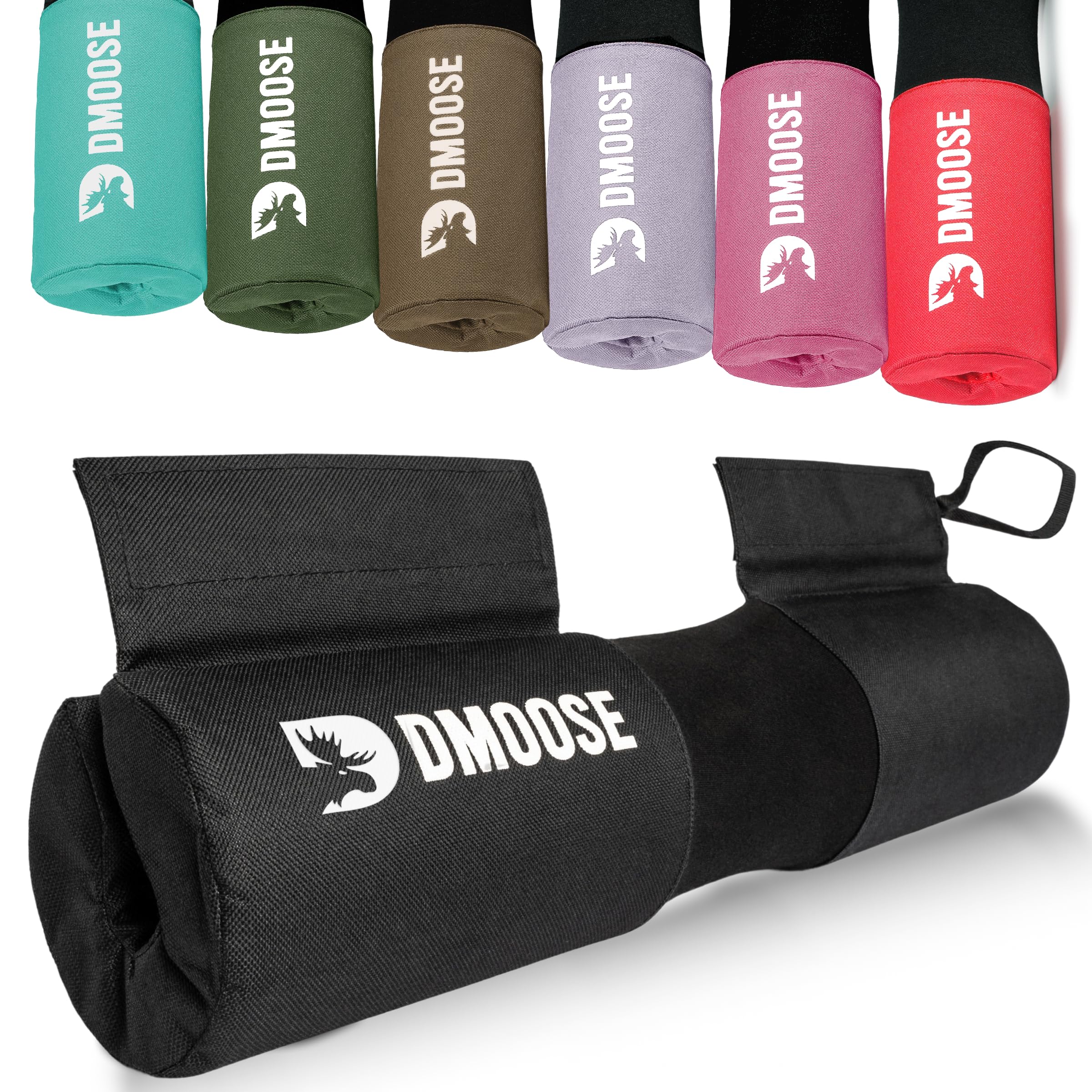
Nineteen inches of foam for lifters who need coverage across broad hips.

If you are broad through the hips, most pads here are a compromise: 17 inches of foam covers a band across the crease and leaves the edges of the load to find your hip bones. This one is listed at 19 inches long and 4 inches across, the biggest pad in this group, and that extra coverage is the entire reason to consider it.

The EVA foam is firm and the cover is a non-slip Oxford fabric, so it holds position on an Olympic bar and on a Smith machine without much strap tension. At 0.2 kg it is as light as anything here, which means it never becomes the reason your bag is heavy.

The straps are separate pieces you thread and fasten every time, and that is the part we liked least: two loose bands are easy to leave hanging on a rack. They do their job once they are on, and the pad is stable without them being guitar-string tight.

Hip bones are usually what ends a heavy thrust set early, and this is the pad that keeps them out of the conversation. If your stance is wide or your hips are broad, that coverage earns its place on leg day.

Bottom Line

The one we point to for broad hips and heavy thrusts, where 19 inches of foam keeps the bar off the hip bones.

Check Latest Price

Best Wrap-Style Pad

Our Score 9.4/10
Dark Iron Fitness Barbell Pad

Dark Iron Fitness

Dark Iron Fitness Barbell Pad

  • Length 15 in
  • Bar Fit Standard and Olympic
  • Closure Hook and loop
  • Weight Capacity 400 lb
Check Price on Amazon

A full-length hook-and-loop wrap that seats tight and wipes clean.

The first time we wrapped this around a bar, the difference was obvious. The hook-and-loop closure runs the full length of the pad, so you can crank it down until the foam is seated against the bar with no play at all, which is a different feel from a sleeve you slide on and hope stays put.

Under the sweat-resistant synthetic leather cover sits a thick high-density foam core, and it is the shoulder side of the pad that surprised us: 15 inches of it spreads a back squat across the traps instead of digging in, and the cover wipes clean in a way a knit sleeve does not. Stitching is the tidiest in this group, and the material still looks new after regular use.

There is a premium here, and it buys construction rather than coverage. For hip thrusts it is a good pad rather than the best one, because the 15-inch body covers less of the crease than the 17-inch sleeves, but anyone who squats more than they thrust will get more out of it than out of anything else on this list.

Bottom Line

A wrap that seats tighter than any sleeve here, and the pad we reach for on squat day rather than thrust day.

Check Latest Price

Best For One fixed bar

Our Score 9.2/10
Yes4All Ergonomic Foam Bar Pad

Yes4All

Yes4All Ergonomic Foam Bar Pad

  • Length 16 in
  • Weight 9.6 oz
  • Diameter 3.5 in
  • Foam Thickness 1.3 in
Check Price on Amazon

Fit is the thing to settle before you buy. This sleeve runs tight on some bars and loose enough to rotate on others, so if you train on more than one barbell, buy it somewhere you can send it back. If you have a single bar at home, the question mostly disappears.

When it does fit, the padding is right. There is 1.3 inches of foam with a contoured middle, a knit cover that feels softer against the skin than a nylon sleeve, and an inner PVC dot layer that adds a little grip. We used it for thrusts and hip bridges and the bar never came through to the hip bone.

For a fixed bar in a home rack, this is a sensible buy: soft enough for high-rep work, firm enough to keep its round shape, and light enough to leave hanging on the rack between sessions. It is the fit, not the foam, that decides whether it suits you.

Bottom Line

A good pad at a low price if your bar never changes; check the fit first if you move between bars.

Check Latest Price

How We Tested Barbell Pads for Hip Thrusts

We built the shortlist from pads sold for hip thrusts and bar squats, then filtered by dimensions, closure style, and price so we weren’t just testing lookalikes. That left 14 pads. I used them over three months at a commercial gym during weekday lunch sessions and on a basement rack at home; my team also worked them into bench, box, and floor hip thrust setups, plus a few squat sessions where the pad sat across the shoulders.

On the gym floor, I loaded a standard Olympic bar and did hip thrusts for reps, noting whether the foam compressed to the point where knurling pressed into my hip bones, whether the pad left deep pressure marks, and whether it felt dense or spongy at the top. I checked fit by sliding each pad onto a standard bar and a thicker bar, then watching how much of the bar stayed covered and whether the bulk got in the way of setting up on a bench. During sets, I looked for rotation, side-to-side sliding, and any gap that opened between the pad and the bar at lockout.

The strap and Velcro design got its own workout: I fastened and refastened each closure, adjusted it one-handed, and checked whether it loosened after a set or left a long tail hanging. Back home, I inspected stitching, cover wear, and foam rebound after repeated sessions, and compared what each pad cost against how it held up. The pads that scored well were the ones I stopped thinking about mid-set—no adjusting, no bruised hip bones, no rolling bar.

How to Choose

Start With Grip, Not Thickness

Rotation is what ruins a thrust set. The bar rolls, the pad rolls with it, and the edge of the foam ends up digging into your hip bone instead of the middle of the pad. Designs answer this in one of three ways: a lined interior that bites into the bar's knurling, a slick shell that depends entirely on straps, or a full-length wrap you cinch down before the first rep. We take a lined sleeve or a wrap every time, and we treat straps as backup rather than a solution.

This is where two pads with identical dimensions behave nothing alike on the same bar, so it is worth deciding before you compare anything else.

Match the Foam and the Length to What You Lift

Diameter changes how the bar feels. Around 3.5 inches is the norm in this group, and 4 inches puts noticeably more foam between the bar and the hip bone, which is welcome on thrusts and can feel vague on a heavy back squat where you want the bar locked against your traps. Length works the same way: 14 to 17 inches covers a hip crease comfortably, while 19 inches suits a lifter whose hips are wider than the pad they have been using.

Density matters more than either number. Denser foam costs more and survives the crease longer; softer foam feels plusher on the first set and takes a permanent groove sooner.

Check the Fit Against Your Bar

Most pads are slip-on sleeves built to take both a 1-inch standard bar and a 2-inch Olympic bar, but a sleeve that is generous for one is loose on the other, and a loose sleeve is the one that spins. That is the trap in a universal-fit claim: it tells you the pad will go on, not that it will stay put.

If you train on more than one bar, say a home rack plus a Smith machine at the gym, either buy where returns are easy or choose a full-length wrap with a hook-and-loop closure that adjusts to whatever it is wrapped around.

Pick a Closure You Can Live With

Three designs, three small annoyances. A velcro sleeve is fastest to fit but catches long hair and loses bite once lint works into the hook side. Two loose straps hold hardest and are the easiest thing to leave hanging on a rack. A full-length wrap seats tightest and costs you both hands and a few seconds every time.

If you clean your pad with a wipe rather than a wash, favor a smooth-faced cover over a knit one, which holds sweat and takes longer to dry.

Where Pads Actually Fail

The bend goes first: foam splits and stitching opens exactly where the pad folds under the bar. The closure is second, collecting hair and lint until it stops gripping. Both give warning, so glance at the crease every few weeks, and store the pad flat rather than crushed under plates at the bottom of a bag.

Frequently Asked Questions

Final Verdict

Start with the FITGIRL if you want one pad that handles hip thrusts and squats without rotating on the bar. The lined interior and the open middle are what separate it from the cheaper sleeves here, and the foam stays firm once the bar gets heavy.

If budget is the deciding factor, the NEALFIT gives you most of that comfort for less. And if your hips are broad or your thrusts are the heaviest part of leg day, order the DMoose instead: those extra inches of coverage are the difference between finishing a set and stopping because of the bar.