Strength & Weights

Best Adjustable Dumbbells of 2026

A rack of fixed dumbbells is a lovely thing right up until you have to find a wall for it. Adjustable pairs promise the same range of weights in something you can tuck beside a couch, and the good ones actually deliver — twist a dial or pull a pin and you've gone from curls to rows in seconds. What they fix is equal parts space, money, and clutter: two sets doing the job of eight, without turning your living room into a gym.

The catch is that adjustable dumbbells are a category where weaknesses surface in week three, not minute three. A set that feels solid on the stand can rattle overhead, a handle that seems fine in the store can chew your palms once you're sweating, and a locking mechanism is only as trustworthy as its last rep. My team has spent the past six months lifting with 11 sets, and the gaps in build quality, adjustability, and everyday ease of use showed up quickly. What follows are the ones we'd happily keep in our own training corners.

Best for Light Toning and Rehab

Our Score 9.6/10
FEIERDUN DB3 10 lb Pair

FEIERDUN

FEIERDUN DB3 10 lb Pair

  • Shape Square, anti-roll
  • Handle 4.5 in, TPU rubber
  • Settings 2, 4, 6, 8, 10 lb
  • Weight Range 2 to 10 lb per hand
Check Price on Amazon

Square ends that won't roll, with 2- to 10-pound settings for lighter work.

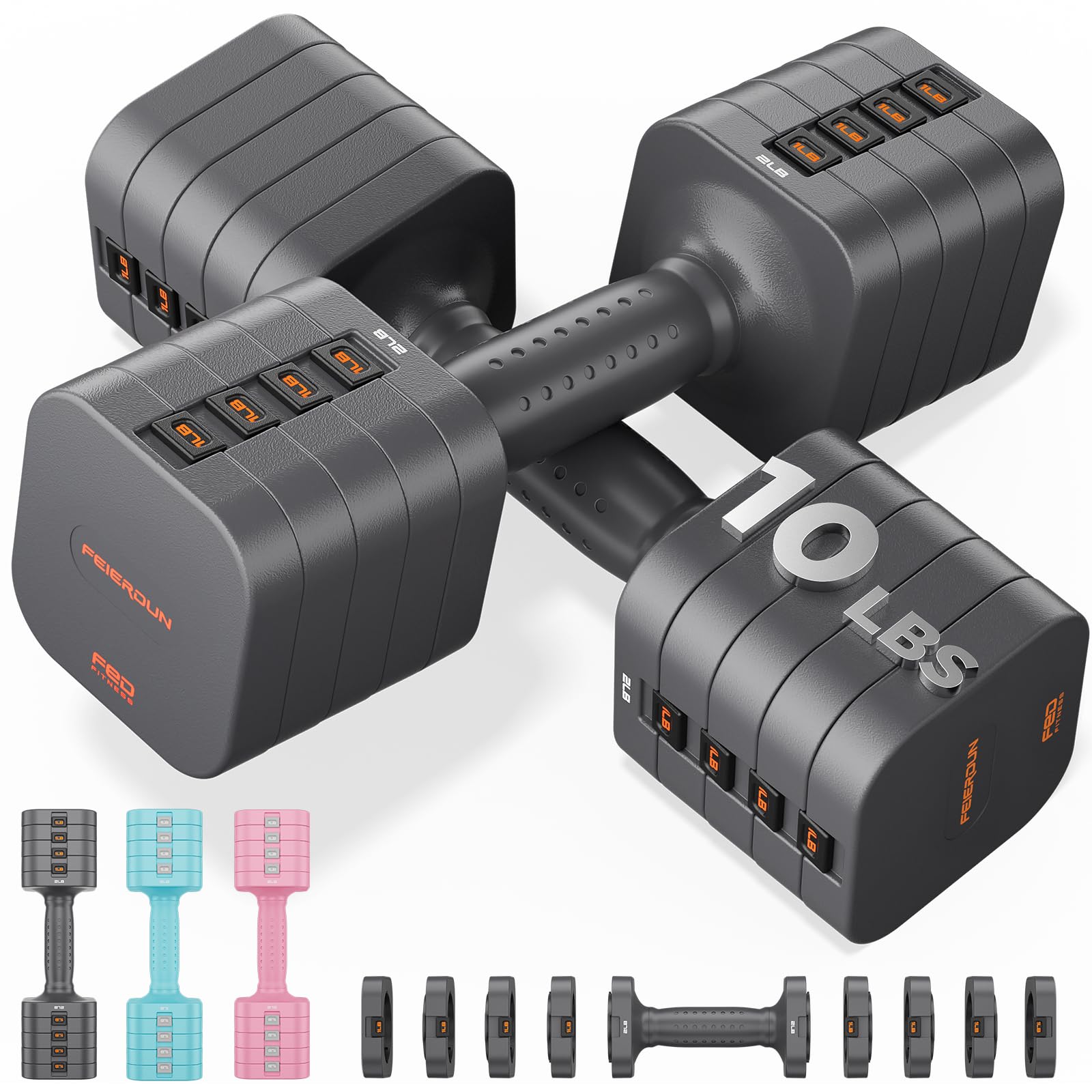
Square ends are the whole idea, and we think they're the right call for a light set: park them on a mat and they stay put, so a round of curls or a floor press doesn't turn into a chase. At 2 to 10 pounds per hand with a one-second twist between settings, this is the pair for toning, Pilates, and the slow return from an injury.

The five settings run 2, 4, 6, 8, and 10 pounds per hand, and the twist mechanism is quick enough to change mid-set rather than between exercises. The handle is 4.5 inches of TPU with a raised dot pattern — at these weights you don't need chalk or gloves, and the texture is grip enough when your hands are damp.

There's a bonus in the square shape: it's stable enough to double as a push-up stand. They also look less like gym equipment than anything else here, which is why one pair in our office lives beside a chair instead of in a closet.

What you give up is a slide: a round dumbbell rolls under a sofa out of the way, and this one sits exactly where you left it, in the middle of the floor, until you pick it up. In a room that has to look like a room, we count that as a fair trade.

Bottom Line

For toning, Pilates, and rehab work between 2 and 10 pounds a hand, this is the pair we reach for: square ends, one-second changes, a grip that doesn't need chalk.

Check Latest Price

Best For Light toning work

Our Score 9.4/10
equipro 4-in-1 Set

equipro

equipro 4-in-1 Set

  • Length 8.66 in
  • Settings 2, 3, 4, 5 lb
  • Weight Range 2 to 5 lb per hand
  • Handle Material TPU rubber
Check Price on Amazon

Most sets here can't go light enough. A 5-pound minimum per hand is no use for a shoulder exercise that calls for 2, and that gap is where this pair lives: 2, 3, 4, and 5 pounds a hand, changed by twisting the end.

It's a small thing — 8.66 inches long, a little over 3 wide — and the TPU handle is soft enough to hold bare-handed through a long set. The rotating mechanism clicks between weights without a tray, so nothing else has to come out of the closet with them.

They're also the pair that gets used when you weren't planning to train: lateral raises between calls, a few curls while the kettle boils. That's not a joke about resolutions; it's how light dumbbells actually earn their money.

Buy them as a first pair, a rehab pair, or the light end of a heavier setup. A 50-pound set can't do a 2-pound external rotation, and this one can, which is the whole argument for owning both.

Bottom Line

If your work sits between 2 and 5 pounds — rehab, barre, a break between meetings — this is the pair to buy, and nothing heavier here can do that job.

Check Latest Price

Best Overall

Our Score 9.2/10
PowerBlock Elite EXP 90

PowerBlock

PowerBlock Elite EXP 90

  • Settings 16
  • Expansion Kits to 70 or 90 lb
  • Footprint 12"L x 6.25"W
  • Weight Range 5 to 50 lb per hand
Check Price on Amazon

Widest range per hand here, and it grows to 90 pounds with add-on kits.

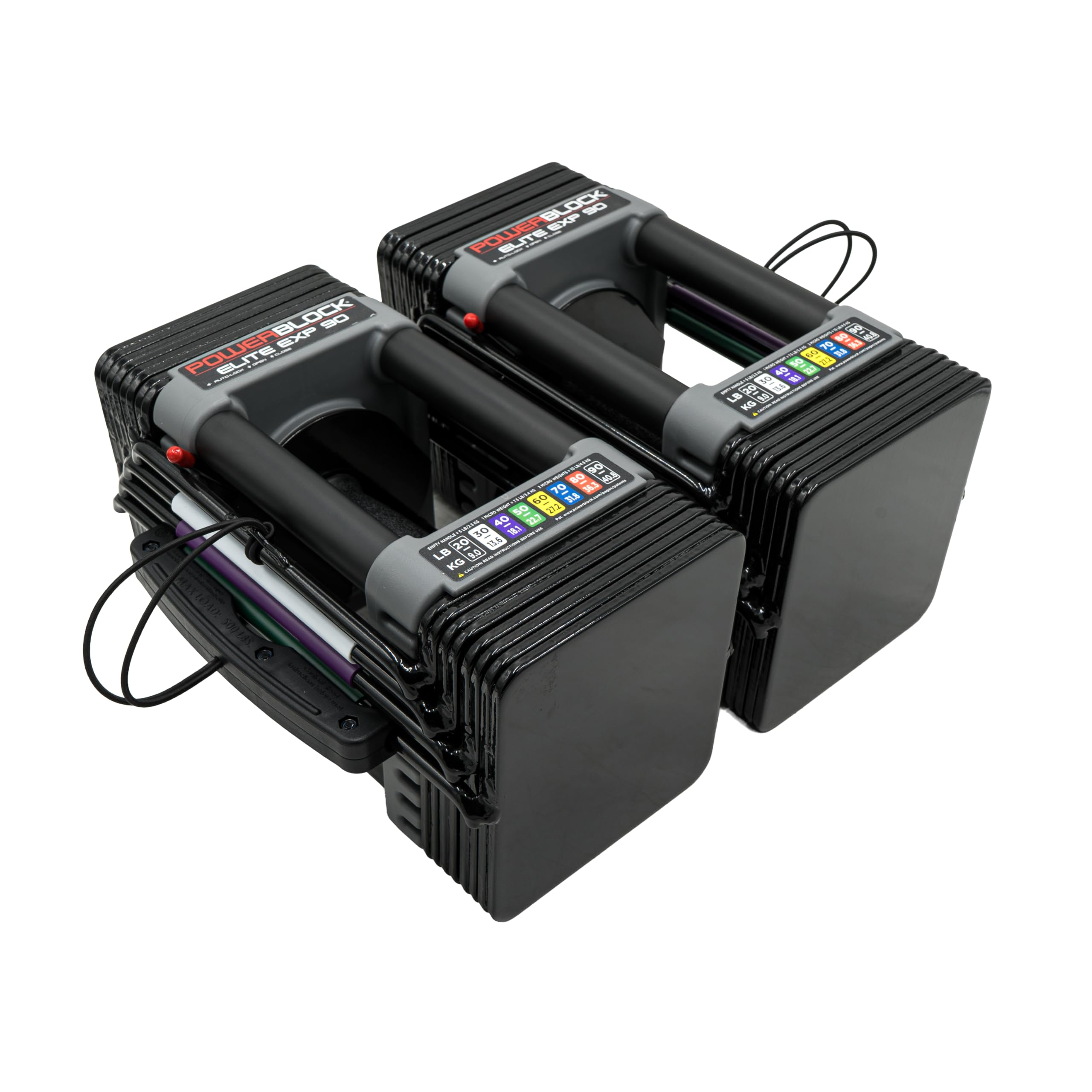
Sixteen settings between 5 and 50 pounds per hand, in a dumbbell 12 inches long and a little over 6 wide. Put that beside the sixteen pairs it stands in for and the arithmetic is the whole argument: a corner of a room instead of a rack. The magnetic pin slides from slot to slot, and the 2.5-pound micro weights let you take a press from 20 to 22.5 without hunting down a second dumbbell.

That range is why this is our top pick, not the mechanism. Most sets here stop at 25 or 40 pounds a hand, which is fine until a strict press outgrows them; the Elite EXP goes to 50 and takes add-on kits up to 70 and 90, so the money goes out once. We were also pleased by how little ceremony a change takes — the pin works with the dumbbell in your hand, no cradle, no walking it back between movements of a superset.

Feeling like a dumbbell is the thing it doesn't do. Your hand sits in the middle of a square cage, closer to the plates than on a fixed pair, and that shows up on curls and on anything where you'd normally rest the head on your thigh before pressing. Balance shifts as you add the micro weights, too. We accept both for the range, but if you press heavy and care how the dumbbell sits on your legs, the NordicTrack is the shape you want.

Powder-coated steel, a five-year limited warranty, and no spinning gears to strip are the quiet part of the deal. One measurement to take before ordering: at 50 pounds the cage is at its longest and boxiest, so check the shelf or floor space at full load rather than at 5 pounds.

Bottom Line

If your home gym has to cover everything from lateral raises to heavy presses, this is the pair we point you to: 50 pounds per hand, expandable to 90, in a footprint smaller than a milk crate.

Check Latest Price

Best for Small Spaces

Our Score 9.2/10
Lifepro Quick-Adjust 25 lb

Lifepro

Lifepro Quick-Adjust 25 lb

  • Length 13.6 in
  • Increments 2.5 lb
  • Weight Range 5 to 25 lb per hand
  • Handle Diameter 1 in
Check Price on Amazon

A 25-pound dial pair with 2.5-pound steps that tucks beside a desk.

Five to 25 pounds per hand in 2.5-pound steps is a narrow slice of what's on this page, and the right slice for a lot of rooms. A desk-side pair, a spare bedroom, a lifter whose heaviest press is a 20-pound dumbbell: at that scale a 50-pound set is money and floor space spent on weights you never touch.

The dial does the work. Set the dumbbell in its tray, turn, and the plates you don't need stay behind. At 13.6 inches long it parks under a console table, the handle is a full inch, and the whole thing feels denser than its size suggests.

What we appreciate most is the step size at this weight. Plenty of compact sets jump 5 pounds at a time, which is a big ask when you're pressing 12.5; here you can move from 12.5 to 15 and hold your rep range instead of your breath. It's the pair we keep in a living room rather than a garage, and that's a compliment.

One habit to build: seat the dumbbell fully before you twist. Turn it early and the slider can catch, and you'll spend a set wrestling with the tray rather than lifting. Done in order, a change takes about a second.

Bottom Line

For a small room and a light-to-mid lifting ceiling, this is the pair we like: 2.5-pound steps, a 13.6-inch body, and a dial that works in its tray.

Check Latest Price

Best Budget

Our Score 9.2/10
Amazon Basics 38 lb Set

Amazon Basics

Amazon Basics 38 lb Set

  • Storage Carry case
  • Per Hand 19 lb
  • Total Weight 38 lb
  • Handle Diameter 1 in
Check Price on Amazon

Plates, collars, and a carry case: the cheapest way into adjustable weight here.

Two 3-pound handles, four 5-pound plates, four 2.5s, four half-pound collars, and a case with a handle. Loading one means sliding plates on and spinning a threaded collar down, which takes longer than a dial — a minute or two per change, and you feel every one of them during a long superset.

We still think it earns a place, and it's the set we suggest for someone finding out whether home training sticks. Thirty-eight pounds totals 19 a hand: enough for lateral raises, curls, rows, and a floor press, and the case means it can live in a closet instead of on the floor of a spare room. The knurling is aggressive — sharp enough that we reach for gloves — but it grips.

One habit matters more than any other: spin each collar down hard before a set, then check it again after the first rep. A threaded collar that has backed off is how a plate ends up on a toe, and it costs five seconds to prevent.

Bottom Line

A sensible first adjustable set: 38 pounds of plates, a case, and 19 pounds a hand for the exercises most people actually start with.

Check Latest Price

Best Dumbbell-Style Feel

Our Score 9.0/10
NordicTrack Select-A-Weight 55 lb

NordicTrack

NordicTrack Select-A-Weight 55 lb

  • Settings 15 per dumbbell
  • Warranty 2 years
  • Increments 2.5, 5, and 10 lb
  • Weight Range Up to 55 lb per hand
Check Price on Amazon

Flat ends and knurled steel that press on your thighs like gym dumbbells.

Flat steel ends and a knurled metal handle make this the pair that feels least adjustable of anything here. That's the point. At the top of a press you get a flat head resting on your thigh and a grip that doesn't squirm, and the 10-pound handlebar works on its own for warm-up sets. If your training is bench, row, and shoulder press rather than high-rep isolation, this is where we start.

Each dumbbell carries 15 settings up to 55 pounds, and the increments are the useful kind: 2.5 pounds, then 5, then 10, so you can take a small step where it matters and a big one where it doesn't. Steel and hardened plastic, backed by a two-year warranty, and the pair replaces the better part of a rack.

The selector is the part to learn. Twist the handle before the dumbbell is fully seated in its tray and the pin can catch, so the change takes two tries instead of one; seat it, then turn. Give it that much care and it rewards you — and the trays are marked at each slot, so you can see at a glance whether you left it at 35 or 40.

Bottom Line

Buy these if you want a pair that presses, rows, and racks like the dumbbells at a gym: flat ends, knurled steel, and 55 pounds a hand.

Check Latest Price

Best For Budget heavy lifting

Our Score 8.8/10
Yaheetech Spinlock Set

Yaheetech

Yaheetech Spinlock Set

  • Plates 16 in 4 weights
  • Collars Spinlock
  • Bar Diameter 1 in
  • Total Weight 66 lb
Check Price on Amazon

The smell hits first: plastic-coated concrete plates, packed straight from the factory, with an odor that hangs around for a week or two. Then the bulk — a 5-pound plate here is fatter than a 5-pound iron plate, and the stack on each bar grows wide fast.

What you get for that is weight, and plenty of it: two threaded bars, sixteen plates in four sizes, four spinlock collars, and up to 66 pounds across the pair, roughly 33 a hand fully loaded. Assembly takes seconds — slide on what you want, spin the collars down, lift.

Heavy rows, shrugs, and floor press on a tight budget is where this set makes sense: it's the most weight for the money here, and the collars hold when they're snug. The ritual is the cost. Spin each one down, do the set, check them again, and treat a backed-off collar as a stop sign rather than a nuisance.

Bottom Line

For heavy rows and shrugs on the tightest budget, this is the set: 66 pounds of plates and two bars, once you get past the smell and the bulk.

Check Latest Price

How We Tested the Adjustable Dumbbells

We built the shortlist from around 30 sets, then filtered hard: maximum weight per hand, adjustment increments, footprint on the floor, and the price you pay per pound of usable range. That whittled it to 11 sets, which we lifted with for six months in home gyms, garages, and the corner of a spare bedroom, at 6 a.m. before work and again during evening supersets.

Adjustability and ease of use got timed with a stopwatch. We changed weight mid-workout between a set of presses and a set of rows, noting whether it took one hand or two, whether the handle had to be racked first, and whether we could find the right setting without crouching to squint at a number. We also ran each set through drop sets and quick transitions, because that's when a fiddly mechanism stops being charming.

For build quality and durability, we set them down firmly after every set rather than babying them, then checked for wobble in the plates, play in the handle, and any change in how tightly things locked after weeks of use. Grip was judged with sweaty bare hands — no chalk — and we measured bulk at the thigh during bench presses and noted whether the weight sat balanced or pulled forward. We sniffed each set straight out of the box and again two days later for odor, weighed every dumbbell on a kitchen scale against its stated number, and lugged each carrying case or stand up a flight of stairs to see how it actually handled.

How to Choose

Read the Range per Hand, Not the Pair Total

Two listings can both say adjustable dumbbells and mean very different things: a 38-pound set gives you 19 pounds a hand, while a 55-pound pair gives you 55. Find the per-hand ceiling first and hold it against your heaviest press, row, or lunge, then add roughly 10 pounds of headroom so there's somewhere to progress. Above 40 pounds a hand you're choosing between the PowerBlock and the NordicTrack on this list; below 25, a compact dial set does the job for less money and a fraction of the floor space.

Match the Step Size to Your Lifting

For isolation and rehab work, small steps matter more than a big ceiling. A set that jumps 5 or 9 pounds at a time can leave a lateral raise stuck between too light and too heavy, while 2.5-pound increments let you nudge. Coarse steps are fine for rows, presses, and anything where 5 pounds is a rounding error. Check the bottom of the range too: a 10-pound minimum is no use for a shoulder exercise that starts at 2, and several sets here can't go that low.

Pick the Mechanism for the Room You Train In

Three designs dominate. A dial or selector in a tray is fastest, but the tray needs floor beside you and stays there, so plan for two of them rather than just two dumbbells. A magnetic pin changes with the dumbbell in your hand, which keeps a superset moving. Threaded collars are the cheapest and slowest, at a minute or more per change, and they need a mid-session check. In a shared living room the trays become furniture; in a corner where you superset, the pin wins.

Handle, Shape, and Grip Decide the Feel

Grips run from about an inch to an inch and a half, and a thick handle is a real constraint for smaller hands. Knurled steel grips without chalk but can feel sharp on soft palms; rubber and TPU are kinder, though less secure when your hands are wet. Shape matters most at the top of a press: flat ends rest on your thighs, a square cage perches, and round plates roll off. If you press alone on a bench, flat or square ends are worth more than they look.

Check How the Weight Is Held Before You Buy

Adjustable dumbbells fail at the joints rather than the plates. Threaded collars back off, plastic selector frames crack, chrome flakes at the thread ends, and a plate that isn't fully engaged drops. Look at the retention design — a pin through the stack, a locking collar, a captured plate — and treat that part as what you're paying for. A set that holds its weight securely is worth more than one with three extra increments.

Frequently Asked Questions

Final Verdict

The PowerBlock Elite EXP 90 is the pair we recommend to most people building a home gym, because 50 pounds a hand with a route to 90 means you stop shopping for dumbbells. Two exceptions are worth naming. If you want a pair that presses and rows like the ones at a gym, with flat ends and knurled steel, the NordicTrack 55s cost about the same and feel far more familiar. And if 20 pounds a hand is your ceiling, the Lifepro 25s do the job in a fraction of the footprint — put the difference toward a bench.