Strength & Weights

Best Workout Sandbags of 2026

Sandbags are the least glamorous piece of gear in a gym and maybe the most honest. A loaded bag shifts and sags on your shoulder, which is exactly why it builds the kind of strength that shows up when you're hauling a couch up a stairwell. The fear is real, though: a seam lets go mid-clean and forty pounds of sand redecorates the garage floor. A good bag shouldn't do that. It should hold its shape, hold its weight, and take you from a light 20 pounds to a heavy 60 without a second purchase.

I've filled more of these than I'd like to admit, and the difference between a bag you keep for years and one that ends up at the curb usually comes down to the liner, not the shell. Over the past eight months, my team and I filled, carried, dragged, and dropped 11 workout sandbags to see which ones actually held. The picks below are the ones we'd buy again.

Best Pre-Filled

Our Score 9.6/10
Hyperwear SandBell

Hyperwear

Hyperwear SandBell

  • Fill Pre-filled USA sand
  • Shell Sealed neoprene
  • Weight 10 lb
  • Warranty 2-year limited
Check Price on Amazon

A sealed, pre-filled 10-pound bag for slams and carries with no sand to add.

The Hyperwear SandBell is the odd one here because it arrives full. The 10-pound bag is sealed with USA-sourced sand inside a neoprene shell, with no zipper, no hook-and-loop flap, and no fill port to tape shut. That makes it the one pick you can use the day it lands, and the soft shell is designed for slams on hardwood, tile, concrete, or grass without a mat.

The shell has more give than the nylon bags here, so it feels less like a duffel full of sand and more like a weighted medicine ball. We found that difference useful for slams and awkward carries, where the bag's softness takes some of the sting out of a miss. It is also the easiest bag to hand to someone who has never trained with a sandbag: there is nothing to fill, seal, or adjust.

What we appreciate most is the low friction. There is no sand to buy, no inner bag to seat, and no closure to check before a workout; you pick it up and go. That makes it the best choice here for a small apartment, a shared living room, or a beginner who wants a first sandbag without a project. The sealed shell also means there is no sand to sweep up after a session, which is a small thing until the bag lives in your living room.

Bottom Line

We keep this one for slams, carries, and quick sessions: it arrives filled, the neoprene shell is floor-safe, and the fixed 10-pound weight is the catch.

Check Latest Price

Best for Strongman

Our Score 9.4/10
IronMind Tough-As-Nails

IronMind

IronMind Tough-As-Nails

  • Capacity 300 lb
  • Included Two liners
  • Dimensions 24 x 36 in
  • Outer Material Cordura
Check Price on Amazon

A 300-pound strongman bag for heavy carries and loading, with two liners included.

The IronMind Tough-As-Nails is the bag for the lifter who thinks 50 pounds is a warm-up. It is 24 by 36 inches, rated to hold 300 pounds of sand when fully loaded, and sold with two liners and a training course. The empty bag weighs 1.8 pounds, so what arrives is a shell and a plan; the weight comes later, by the bagful.

We recommend it for heavy carries, shouldering, and loading because the Cordura outer shell is built for abuse and the capacity gives you years of room to add sand. The bag has a classic strongman shape rather than a circuit-training handle layout, so it rewards bear hugs, laps, and picks more than quick handle swaps. That is a feature if you want to train the awkward, heavy end of sandbag work; it is a waste if you want a bag for lunges and presses with a comfortable grip.

The practical cost is the fill. Three hundred pounds of sand is a lot to load, store, and clean up after, and the bag is at its best when you load it heavy enough to feel stable. For a garage gym with space and a lifter who enjoys loaded carries, it is the most serious bag here; for everyone else, the Elite Sports or REP Fitness bag is the easier daily tool.

Bottom Line

We choose this for strongman-style loading: the Cordura bag holds up to 300 pounds, ships with two liners, and rewards experienced lifters who want a heavy, simple tool.

Check Latest Price

Best For Affordable heavy work

Our Score 9.4/10
Ludus Imperium Sandbag

Ludus

Ludus Imperium Sandbag

  • Fill Sand not included
  • Filler Built-in filler bag
  • Closure Zipper and hook-and-loop
  • Outer Material Nylon Cordura
Check Price on Amazon

The Ludus Imperium bag is the plainest heavy bag here, and that is part of the appeal. The shell is nylon Cordura, the filler bag is built into the outer bag with an extra zipper and hook-and-loop closure, and the whole thing is designed to be emptied and refilled when you want a different weight. The strong150 model is the one to look at if you want a heavy working bag without the 300-pound commitment of the IronMind.

The built-in filler bag is the detail we like most. There is no separate sack to chase around the floor or stuff back into a narrow opening; the filler sits inside the shell and closes with its own zipper and flap. The Cordura outer takes drops and drags without the slick feel of a vinyl bag, and the compact shape is easier to shoulder than a long duffel. We also found the fill process less messy than expected, which is saying something for a bag with a built-in filler.

The trade-off is refinement. This is a simple bag, and it makes the most sense for a lifter who wants a heavy bag at a lower price and does not need the last word in polish. It is not the first bag we hand a beginner, but it is an easy one to recommend to someone who already knows how to use a sandbag and wants a heavy load without a strongman footprint.

Bottom Line

We recommend this for a lower-cost heavy bag: the built-in filler bag keeps the sand contained, the Cordura shell takes drops, and the simple design suits carries and throws.

Check Latest Price

Best Overall

Our Score 9.2/10
Elite Sports Sandbag

Elite

Elite Sports Sandbag

  • Closure Zipper and double-sealed shell
  • Handles Strategic web handles
  • Weight Range 25 to 50 lbs
  • Outer Material Ballistic nylon
Check Price on Amazon

A 25- to 50-pound adjustable bag with secure sealing and useful handles for home lifting.

A home gym usually has room for one bag, not a rack of them. The Elite Sports sandbag is built for that buyer: unfilled, rated for 25 to 50 pounds, with a ballistic nylon shell, a zipper closure, and a double-sealed inner setup. The empty shell measures 10 by 9 by 5.5 inches, so it stores on a shelf rather than taking a corner.

We recommend it first because that range is the practical middle for most lifters. Fifty pounds is enough to make presses, cleans, lunges, and carries feel serious without turning every session into a max test, and the bag scales down for warm-ups. The handles sit where we want them for shouldering and front carries, and the double-sealed inner setup gives us more confidence than a single hook-and-loop flap. That closure is the detail that sold us: a zipper plus a sealed shell is more protection against a sand spill than one flap alone.

It is the one we point to when someone wants a single sandbag for a small gym and a clear path from beginner weights to a solid working load. The 25-to-50-pound range is wide enough to keep a new lifter busy for months, and the bag still feels substantial at the top end. The empty shell stores on a shelf, and the sand is the only thing you need to add.

Bottom Line

We recommend this one first for a home gym: the 25-to-50-pound range, secure filler bags, and useful handles cover more training than any single fixed bag here.

Check Latest Price

Best for Heavy Loads

Our Score 9.2/10
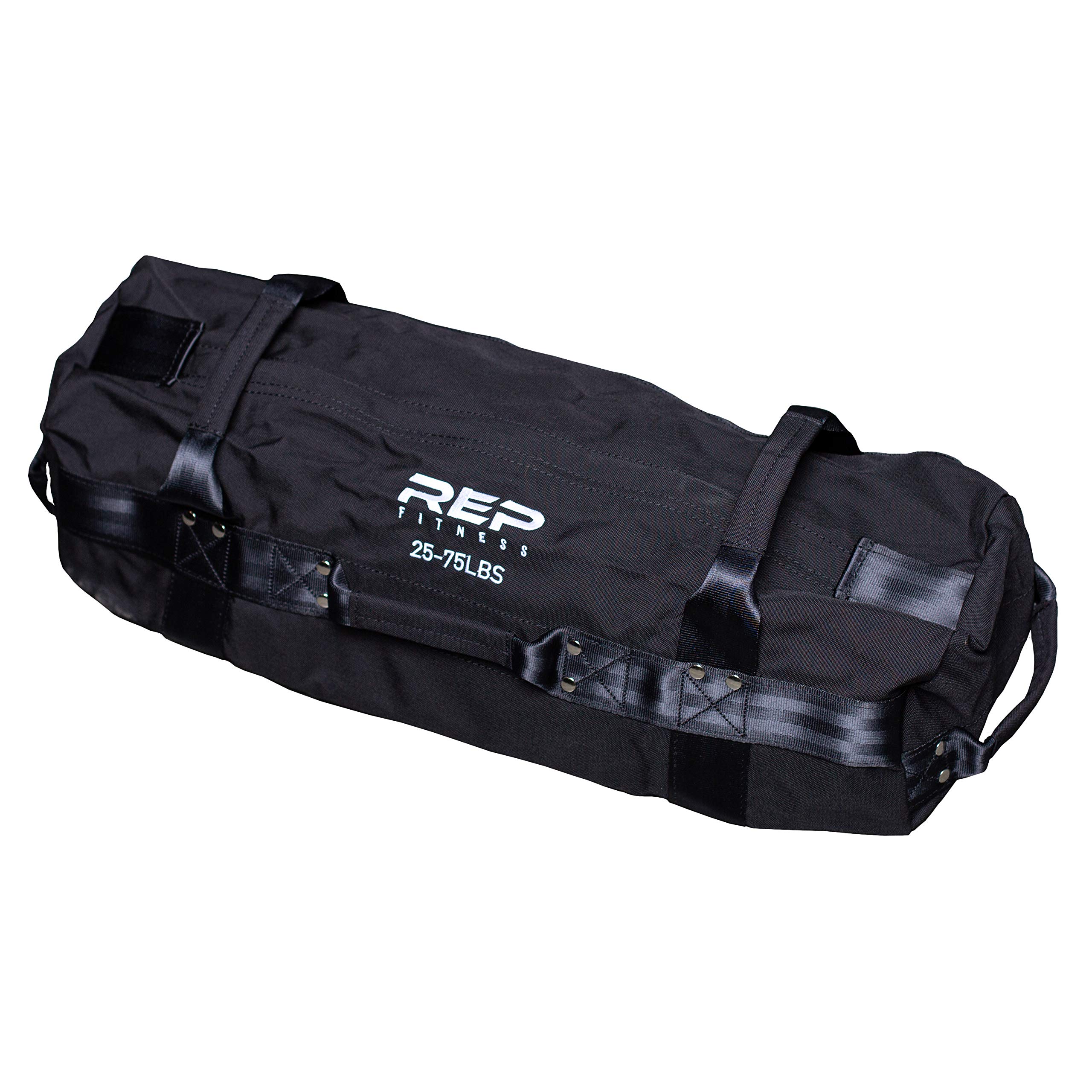
REP Fitness Sandbag

REP Fitness

REP Fitness Sandbag

  • Fabric 1000D Cordura nylon
  • Handles 7 reinforced handles
  • Weight Range 25 to 75 lbs
  • Reinforcement Triple-stitched seams
Check Price on Amazon

Seven reinforced handles and a 25- to 75-pound range, with larger sizes to 200 pounds.

The jump from 75 to 200 pounds is the reason to look at REP Fitness. The line runs from a 5-to-25-pound small up to a 125-to-200-pound XL, and the medium we recommend here covers 25 to 75 pounds. That means you can start with a bag that feels manageable and keep the same handle layout as you add fill, instead of buying a second sandbag when 50 pounds stops being enough.

The construction is the part that stands out. The shell is 1000D Cordura nylon with triple-stitched seams, cross-stitched reinforcement, and metal grommets; the seven handles are machine-stitched and secured with heavy-duty rivets. We like that combination because handles take the worst of sandbag training—the tug during a clean, the load on a front carry—and rivets give the attachment points more to hold onto than stitching alone. The shell is also water-resistant and quick-drying, which matters if the bag lives outside or gets used on wet grass.

The medium's 25-to-75-pound range is narrower than the line's headline suggests, so if you already know you want 100 pounds, price the large instead of trying to cram the medium. For a lifter who wants room to grow, it is the strongest heavy-range value here.

Bottom Line

We point heavier lifters to this one: the medium covers 25 to 75 pounds, the seven handles are reinforced with rivets, and the line climbs to 200 pounds.

Check Latest Price

Best For Heavy carries

Our Score 9.2/10
Wolf Tactical Sandbag

Wolf Tactical

Wolf Tactical Sandbag

  • Fill Sand not included
  • Fabric 1000D Cordura nylon
  • Capacity 100 lb
  • Grip Size Large
Check Price on Amazon

The Wolf Tactical bag is the 100-pound option we reach for when the goal is heavy carries and throws without a 24-by-36 strongman shell. The 1000D coated Cordura is the same heavy fabric family used in tactical gear, and the bag is sized to load with sand or a denser fill. We recommend it for the lifter who wants a heavy working bag and does not need the 300-pound ceiling of the IronMind.

The build is the draw. The 1000D coated Cordura is a heavy, stiff fabric, and the bag feels substantial when you pick it up by the handles. We also appreciate that the bag is easy to fill: the sand settles without a lot of shaking, and the bag is easy to pick up once loaded. It is not a bag for quick weight changes; this is a load-it-and-train tool, not a daily adjustable.

The caveat is capacity. The 100-pound rating depends on a dense fill, and ordinary play sand can leave the bag feeling lighter than the label suggests. That is not a dealbreaker for a bag that stays set up, but it is worth knowing before you plan a workout around the number on the shell. For a garage gym with a dedicated heavy-bag slot, it is a solid choice.

Bottom Line

We recommend this for a heavy bag without the strongman footprint: the 100-pound capacity and 1000D Cordura shell handle carries and throws, though the fill can be fussy.

Check Latest Price

Best for Shared Gyms

Our Score 9.0/10
Polyfit Classic Sandbag

Polyfit

Polyfit Classic Sandbag

  • Handles 8 gripping handles
  • Warranty No warranty
  • Weight Range 50 to 125 lbs
  • Outer Material Nylon
Check Price on Amazon

A 50- to 125-pound bag with eight handles for shared gyms and heavier home work.

Eight handles is the first thing you notice on the Polyfit Classic, and it is the reason this bag works well in a shared gym. The large size is rated for 50 to 125 pounds, with a nylon outer shell and filler bags that use hook-and-loop closures and double stitching. The outer bag is 28 inches wide and 12.8 inches high, so it is a two-arm hug when full, not a one-hand swing.

The handle layout gives you a grip for front carries, shoulder carries, and rows without hunting for a seam. We also like that the filler bags are separate, so you can build the weight in stages instead of dumping in a full load at once. The double hook-and-loop seal is the right idea for a bag that gets passed around; it gives you a second chance if the first flap picks up grit.

The large size is a lot of bag when it is only half full, and the 125-pound ceiling means it is not the last bag for a very strong lifter. For a group class, a couple, or one person who wants a 100-pound working bag, those are manageable trade-offs.

We come back to the handle count because it is what makes the Polyfit feel like a group tool. The bag is easy to pass, easy to load from either side, and easy to find a grip on when the floor is crowded. It is not the heaviest bag here, but it is the one we put in a small class or a garage gym where several people train at different weights.

Bottom Line

We like this one for a shared gym or a 100-pound working bag: the large size runs 50 to 125 pounds, the eight handles are easy to find, and the shell is built for group use.

Check Latest Price

How We Filled, Loaded, and Tested 11 Workout Sandbags

We started with more than 30 sandbags from strength and conditioning brands, then narrowed by capacity range, whether a filler liner came included, how much weight you get per dollar, and whether the bag was actually in stock. That left us with 11 models spanning compact 25-pound bags up to shells rated for 100 pounds or more. Every one was filled to its stated maximum on the driveway and weighed on a bathroom scale, which is how we caught a couple that bulged awkwardly or ran light once loaded. Then we emptied and refilled each one several times to see whether the fill opening frayed, whether hook-and-loop closures still gripped, and how long a weight change actually took. Bags with double-bagged liners and wide, resealable filler openings separated themselves quickly.

The real work happened in the garage and on the driveway: shoulder carries up and down the block, front-loaded squats, cleans, drags across concrete, and drops from shoulder height onto pavement. After each session we swept the floor and looked for grit, since a bag that quietly leaks sand is a bag you stop using. We also checked handle stitching and seam stress after heavy carries, stuffed the bags into car trunks for weekend trips, and left them in a humid garage for weeks to see whether the shells stiffened or started to smell.

Eight months in, we re-weighed every bag to catch slow leaks, re-checked seams and strap attachments, and compared cost per usable pound. The ones that survived without shedding sand, twisting their liners, or shredding a handle are the ones that made the list.

How to Choose Workout Sandbags

Start With a Weight Range You Can Grow Into

Most adjustable bags are sold by a range, and the range matters more than the headline maximum. A 25- to 50-pound bag covers a lot of home strength work: presses, cleans, lunges, and carries. If you already train heavy, a 50- to 125-pound bag gives you room without making every warm-up feel like a max attempt. The maximum is also a filling target, not a promise; dense sand gets you closer to it than a loose fill. We like the Elite Sports bag here because its 25-to-50-pound range starts light enough for a beginner and still gives an experienced lifter a useful working weight.

Look at the Closure Before the Fabric

The outer shell gets the attention, but the inner filler bag is what keeps sand off your floor. A good setup has a sealed filler bag plus a second closure on the outer bag—hook-and-loop and a zipper, or a double-sealed shell. Zippers can fail, and stitching at the fill opening takes a lot of stress, so check both. We pay more attention to the closure than to the fabric weight: a 1000D shell is little help if the filler bag spills. The Elite Sports bag uses a zipper and a double-sealed shell; the REP Fitness bag adds a water-resistant shell and triple-stitched seams. Fill to the recommended level rather than cramming in the last pound.

Handles Change the Exercise Menu

Handles are the difference between a bag you can carry and a bag you can train with. Seven or eight handles let you find a grip for front carries, shouldering, rows, and presses; a plain strongman bag is better for bear-hug carries and loading. More handles are not automatically better if the stitching is thin, so look for reinforced stitching or rivets at the attachment points. We reach for a multi-handle bag for most home workouts, but we keep a plain bag for heavy, awkward carries. The REP Fitness bag's seven riveted handles and the Polyfit bag's eight-handle layout are the two clearest examples here.

Plan for Sand, Space, and the Floor

Most workout sandbags ship empty, so the purchase is not finished until you buy sand. A 50-pound bag needs roughly 50 pounds of dry sand, and a 100-pound bag needs twice that; play sand or pea gravel works, but dense material gets you to the rated weight with less bulk. The bag also takes up more room full than empty, and a 50-pound bag dropped on a wood floor is a real load. The Hyperwear SandBell is the exception here: it arrives filled, so there is no sand run and no fill port to seal.

Frequently Asked Questions

Final Verdict

For most home gyms, the Elite Sports sandbag is the one to buy. Its 25-to-50-pound range covers presses, carries, and lunges; the double-sealed shell and handle layout make it feel like a training tool rather than a sack of sand. If you know you will outgrow 50 pounds, the REP Fitness medium gives you 25 to 75 pounds and a line that reaches 200.

If you want to skip sand altogether, the Hyperwear SandBell arrives filled and ready for slams. The choice is really about your ceiling: stay with the Elite for the easiest daily bag, move to REP for a heavier adjustable, or choose Hyperwear for zero setup.