Accessories

Best Workout Journals of 2026

For years my training log lived in my phone, which meant it mostly stayed in my pocket, unopened, between sets. What changed things was paper: something I could flip open on a bench, see last week's numbers on the same page, and actually trust. A good workout journal fixes one clear problem — it puts what you did last time in front of you, so you're not guessing at the weight on the bar.

Journals are personal in a way most gym gear isn't. Some lifters want blank pages and total freedom; others want prompts for sets, reps, and how hard the last set actually felt. My team and I spent four months writing in 16 of them, and one pattern was hard to miss: the journals people quit on are rarely the cheap ones — they're the ones that are a nuisance to write in, with a binding that fights you and boxes too small for real handwriting. The picks below are the ones we kept reaching for.

Best Overall

Our Score 9.6/10
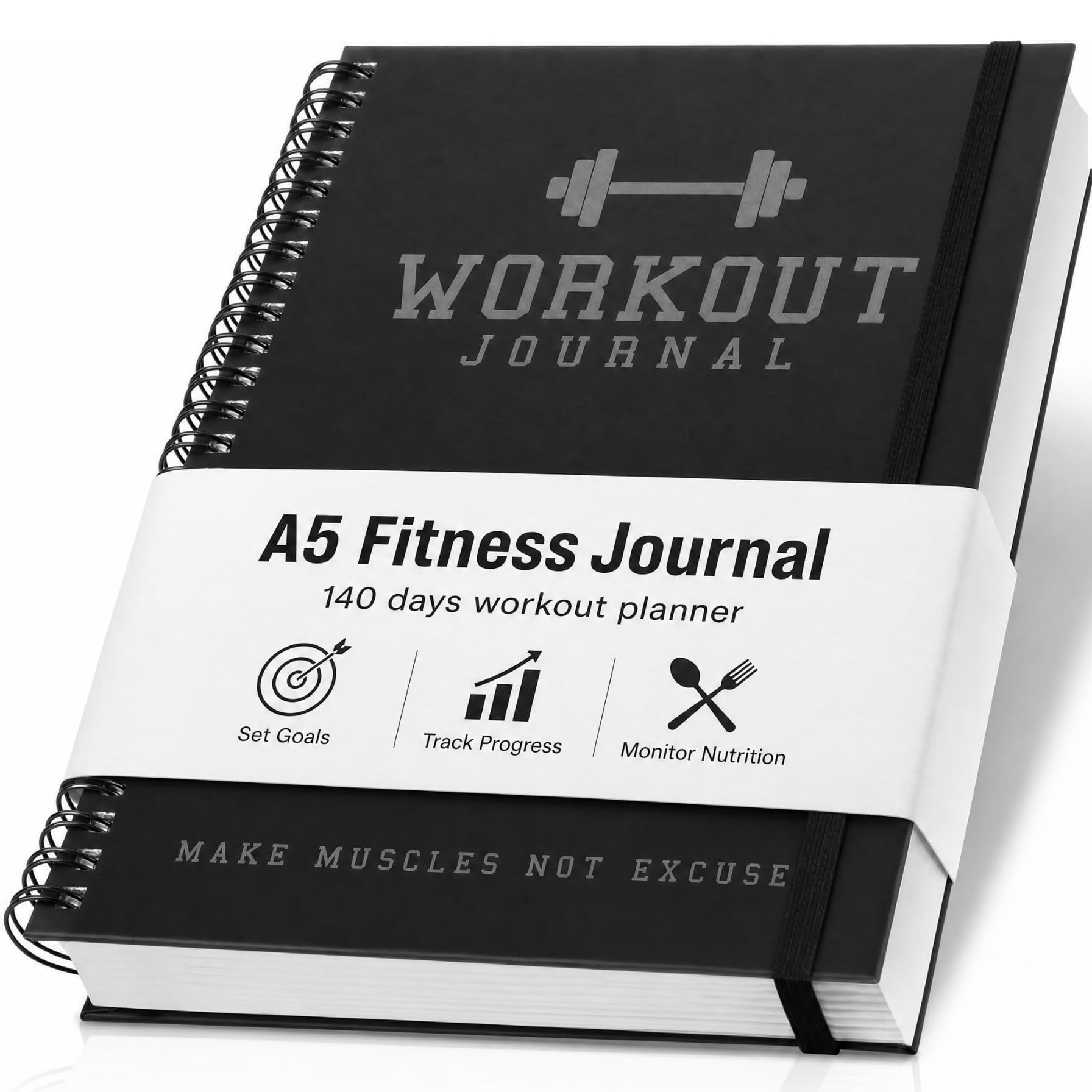
Nextnoid Hardcover Fitness Journal

Nextnoid Hardcover Fitness

Nextnoid Hardcover Fitness Journal

  • Pages 140
  • Binding Hardcover spiral
  • Coverage Up to 8 months
  • Page Size A5 (5.7 x 8.3 in)
Check Price on Amazon

Goal pages up front, roomy one-session spreads, and about eight months of paper.

Eight months of pages is the number that settles this one. The Nextnoid packs 140 A5 sheets into a hardcover spiral and spaces them for daily or weekly logging, so most people get through a training block or two before they need to think about a replacement.

What puts it at the top of this list is the front section. Goals, monthly targets and a calendar come before the workout spreads, so you start each block with something to chase instead of flipping back through old pages to work out what you lifted last Tuesday. That scaffolding does more for consistency than a motivational quote, and we were glad there wasn't one.

The working pages are plain in the best way: a row for the exercise, columns for sets, reps and weight, and a strip for notes, with roughly one session to a spread. It's uncluttered enough to fill in between sets, and the hardcover and spiral mean it lies flat on a bench and comes out of a bag with its corners intact.

At 5.7 by 8.3 inches it's small enough to carry and big enough that you aren't writing in code, and the elastic band keeps it shut and holds your place. Where it gives ground is specialisation: there's no nutrition logging and no program inside, so a lifter who wants the book to plan the session should look at the Habit Nest instead.

Bottom Line

We think most people should start here: goal pages give the training a direction, the spreads have room for a full session, and 140 pages cover about eight months.

Check Latest Price

Best No-Frills

Our Score 9.6/10
FL Fitness Logbook

FL Fitness

FL Fitness Logbook

  • Cover Polypropylene
  • Paper 100 GSM
  • Page Size A5 (6 x 8 in)
  • Companion App Free scanning app
Check Price on Amazon

Thick paper and blank rows for lifters who already know their program.

No goal pages, no calendar, no motivational quote at the top of the week — the FL logbook is rows and paper, and that is exactly why it earns a place here. We hand it to people who already have a program and want somewhere to write it down without working around somebody else's prompts.

The paper is the selling point: 100 GSM stock that takes pen and a fair amount of erasing without going fuzzy, and a black polypropylene cover that handles a damp gym bag without staining. Every page is laid out the same way — exercise, weight, reps, cardio and notes — which makes it quick to fill in and easy to scan back through.

The company also offers a free app that scans a filled page into digital form. It comes with conditions attached, so treat it as a bonus for backing up a block rather than the reason to choose this book.

There's no spiral to snag on a strap or unwind in a bag, and the pages hold together through months of use rather than tearing out at the edge, which is the usual way a gym log dies.

Bottom Line

We reach for this one mid-program: thick paper, no scaffolding, and a cover that tolerates a sweaty gym bag, for lifters who bring their own routine.

Check Latest Price

Best Budget Hardcover

Our Score 9.4/10
ZICOTO Ultimate Workout Journal

ZICOTO

ZICOTO Ultimate Workout Journal

  • Pages 140
  • Extras Elastic band and bookmark
  • Binding Hardcover spiral
  • Page Size A5 (5.83 x 8.27 in)
Check Price on Amazon

A rigid cover, elastic band, and two workout days per page.

Two workout days to a page is the whole idea here, and it changes how the book lives in your bag. Instead of a full spread per session, each day gets a compact block with its own rows and notes, which stretches 140 pages across far more sessions than the same count laid out one day at a time.

There's more hardware than the plain cover suggests: a rigid hard cover, an elastic band to keep it shut, a ribbon to hold your place, and pages that resist tearing. It doesn't look expensive, and it doesn't need to.

We think it's the easiest of the compact journals to keep using. The cover means the pages don't curl, the elastic means you never lose your place, and the layout is simple enough to fill in during a rest period without hunting for the right column.

Brisk sessions are the point — four or five lifts, a couple of notes, done. If you write long cues under every exercise, this is the wrong shape of book, and the Taja or the SaltWrap will serve you better.

Bottom Line

We recommend it for short, frequent sessions: the hardcover and elastic make it easy to live with, and two days per page make the paper go further.

Check Latest Price

Best Workout and Nutrition Log

Our Score 9.2/10
NewMe Fitness Food & Workout Journal

NewMe Fitness

NewMe Fitness Food & Workout Journal

  • Size 5.5 x 8.5 in
  • Pages 140
  • Binding Spiral-bound
  • Coverage 4 to 6 months
Check Price on Amazon

One book for training and meals, with roomy rows and a cardio line.

Lifting and eating are the same project for most of us, and the NewMe is the journal here that treats them that way: training pages through the book, nutrition and daily health tracking alongside, all in a spiral notebook half an inch thick.

The training page is why it made the list. Rows for exercise, sets, reps and weight, a cardio line, and enough notes space to record how a set actually felt — and it's quick to fill in during a rest rather than saving it all for the car. We found it the least fiddly of the bigger books to write in one pass.

It's built for four to six months of tracking, which is a realistic lifespan for a daily log, and the laminated, bend-resistant cover keeps the pages flat in a bag. The nutrition side is a reminder system rather than a macro tracker — a line or two a day rather than a database — which suits anyone who wants awareness of what they ate without weighing every gram.

If you want a full food diary with room for every meal, the SaltWrap goes deeper. For the lifter who wants to see whether the protein and the reps lined up, this is the one that still fits in a gym bag.

Bottom Line

We think it's the best fit for people who want training and meals in one book: generous workout rows, simple food lines, and about six months of daily pages.

Check Latest Price

Best Guided Program

Our Score 9.2/10
Habit Nest Gym Buddy Journal

Habit

Habit Nest Gym Buddy Journal

  • Pages 160
  • Program 12 weeks
  • Workouts 65 guided sessions
  • Equipment Full gym required
Check Price on Amazon

Twelve weeks of planned sessions with video guidance for anyone without a routine.

Racks, cables, benches, machines: the Gym Buddy assumes you have all of it. Train in a garage with a pair of dumbbells and most of this book will be telling you to use equipment you don't own.

What you get for that assumption is a written program instead of an empty template: twelve weeks, 65 workouts, two muscle groups per session with four exercises each, sets and reps already specified, and a box beside every line for what you actually lifted. Video guidance covers the movements, which helps when an exercise is new to you.

It suits the person who stalls at the rack wondering what to do next. The decision about what to train is already made, so the only input left is the weight on the bar, and the book keeps you moving through a session instead of negotiating with yourself about the next machine.

We think it's worth it as the only journal here that supplies the training as well as the paper — a coach in book form for anyone without a program of their own. Finish the twelve weeks and you'll want a blank log to carry on, so treat this as a block rather than a permanent system.

Bottom Line

For anyone with a full gym and no program, this is the closest thing to a coach in book form: 65 sessions written out, with space to record what you lifted.

Check Latest Price

Best for Tracking Measurements

Our Score 9.2/10
Taja Fitness Workout Journal

Taja Fitness

Taja Fitness Workout Journal

  • Pages 160
  • Binding Spiral-bound
  • Page Size A5 (5.5 x 8.2 in)
  • Goal Tracking Up to 10 goals
Check Price on Amazon

Measurement and photo pages alongside 160 pages of plain training rows.

Paper is the Taja's argument: 160 pages, the most in this group, with a chunk of them spent on the parts most logs skip — body measurements before and after a block, progress photos, and space for up to ten goals with a note on how you plan to hit them.

The workout pages are plain and generous: rows for a range of exercises, a cardio line, room for notes, on a 5.5 by 8.2 inch page that slides into a gym bag. The spiral lays flat on a bench and the elastic closure keeps it from flapping open.

What we appreciate most is that the measurement pages aren't an afterthought. Run a twelve-week block and you can answer the question of whether your arms actually changed, and the training rows are roomy enough that logging still feels quick.

The layout is deliberately plain — no coaching prompts, no suggested splits, nothing telling you what to do — which makes it easy to run your own program and less helpful if you're still deciding what yours looks like.

Bottom Line

We like it best for anyone tracking more than weight and reps: the measurement and photo pages give a training block a scoreboard.

Check Latest Price

Best For Style and portability

Our Score 9.2/10
Clever Fox Fitness Journal

Clever Fox Fitness

Clever Fox Fitness Journal

  • Cover Vegan leather
  • Coverage About 4 months daily
  • Page Size A5
  • Workout Pages 126
Check Price on Amazon

The cover is vegan leather, and this is the one journal here that looks like something you'd leave on a coffee table rather than hide in a gym bag. We think that's worth something — a log you don't mind carrying is a log you're more likely to fill in — and the undated pages mean a missed week doesn't leave a gap staring back at you.

Inside there's a goal page with deadlines, a workout calendar, and 126 workout spreads with rows for exercises, sets, reps, weight and notes — at four sessions a week, roughly seven months of training.

The writing area is compact: A5 pages with boxes sized for short entries, so large handwriting will feel cramped. If that's you, the SaltWrap's 7 by 10 pages give you room to write in sentences.

What it doesn't do is coach. You bring the program and the book records it, which is the right trade for someone who already knows their way around a squat rack and wants a nicer object to log in.

Bottom Line

We recommend it to lifters who want a log they're happy to be seen with: the vegan leather cover and clean, undated spreads make daily writing feel less like admin.

Check Latest Price

Best For Fixed lifting templates

Our Score 9.2/10
Workout Log Gym Planner

Workout

Workout Log Gym Planner

  • Pages 100
  • Paper 100 GSM
  • Workouts Per Book 100
  • Exercises Per Page 9 plus cardio line
Check Price on Amazon

The template is the product: nine exercises, one cardio line, a notes strip, repeated a hundred times. If your training week looks on paper the way it did three months ago, that's all you need.

The cover is heavy at 500 GSM — card stock territory — and the paper is a solid 100 GSM, so it feels more substantial in the hand than the page count suggests. Ten goal lines with target dates open the book, and there are sections for body weight, measurements and personal bests at the back.

One hundred workouts works out to about eight months at three sessions a week, long enough that the front matter is worth filling in properly. The A5 page at 6 by 8 inches is the right compromise for carrying to the gym.

We think it earns its place on the strength of that structure: goals at the front, personal bests at the back, and a weekly and monthly review that gives you a reason to flip back through what you wrote. It's a training record, not a diary, and it's happiest in the hands of someone with a routine.

Bottom Line

If your training week looks the same on paper for months at a time, this is the template we hand people: nine rows, a cardio line, and review pages that make the numbers add up.

Check Latest Price

Best For Home gym logging

Our Score 9.2/10
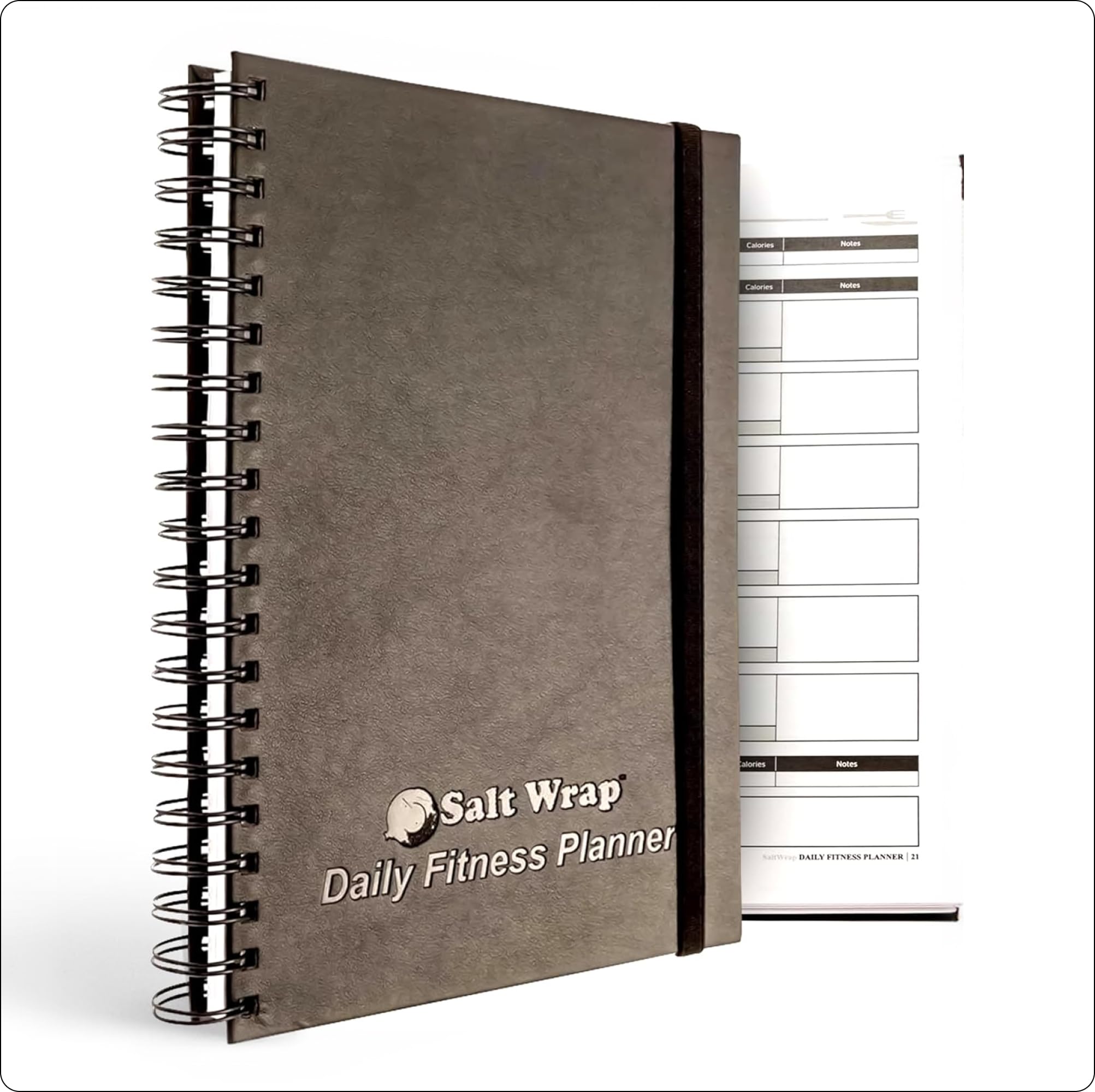
SaltWrap Daily Fitness Journal

SaltWrap Daily Fitness

SaltWrap Daily Fitness Journal

  • Size 7 x 10 in
  • Cover Faux leather
  • Pages 100
  • Tracking Training and nutrition
Check Price on Amazon

At 7 by 10 inches, the SaltWrap is the one book here that isn't trying to fit in a gym bag. It's a desk journal: a daily spread with training on one side and food on the other, sized so you can write in sentences rather than abbreviations.

The training side takes the session plan and every rep, with prompts that walk you through setting up a program if you don't already have one. The weekly check-in is the part we didn't expect to like: it asks you to rate energy levels and joint health alongside your lifts, which is the sort of thing a compact log never has room for.

Nutrition gets equal billing — meals, water and notes sit on the same spread as the workout, so both halves of the day are in front of you at once. The faux leather cover and the general heft make it feel like a proper journal rather than gym kit.

The catch is the format itself: it's too big to carry around the gym floor, so it works best left in a locker or on a desk and filled in at the end of a session. Train at home and that isn't a drawback at all.

We point people to it when they want the whole picture in one place: training, food, and how the body felt that week, with enough room to say so properly.

Bottom Line

We point people to it for the full picture — training, food, and a weekly check-in on how the body felt — as long as they're logging at a desk, not between sets.

Check Latest Price

How We Tested (and Kept Using) 16 Workout Journals

We built the shortlist from scratch, reading through what's actually on the market, comparing page counts, ruling styles, binding types, and formats, then narrowing to 16 journals that covered the three main camps: blank, prompted, and hybrid layouts. The field ran from thin spiral-bound notebooks to hardcover books with ribbon markers, so the differences between them were never just cosmetic.

Over four months, each journal went wherever training actually happens: leg days at a commercial gym, lunchtime sessions when the only free floor space was a corner near the dumbbell rack, and a living room rug for at-home workouts. Every book lived in a gym bag next to a water bottle and a sweaty towel, and we wrote in them the way anyone would — quickly, between sets, sometimes with damp hands.

We paid attention to how each one behaved in use: whether ink feathered or smeared under a wet palm, whether the book lay flat on a bench or snapped shut mid-set, and how long it took to jot down a set of squats. We noted whether one page held a full session or forced us to flip back and forth, whether the prompts matched how we actually train, and whether a week or an entire training block fit on a single spread.

Size got its own test — each journal had to slip into a gym bag pocket or a jacket without becoming a hassle, while still leaving enough room to write legibly. At the end of four months we flipped back through every book to see which ones had held up, which ones we'd kept using, and which ones we'd quietly stopped opening. That last part told us more about value than any cover price could.

How to Choose

Count your session before you count pages

Write out your last three workouts and count the exercises. Five to seven lifts at three or four sets each is a standard session, and a nine-row page covers it with room to spare; a split with supersets and accessory work wants more. Half-page formats, like the two-days-per-page ZICOTO, are excellent for brisk sessions and cramped for annotated ones.

This one check prevents most regret. The book that fits your session gets filled in; the one that doesn't becomes a notebook with good intentions.

Work out how long the book will actually last

Page counts are the most misleading number on the shelf, because a page isn't a workout. A 100-workout book at three sessions a week is roughly eight months; 126 workout pages at four sessions a week is closer to seven. Formats that fit two days on a page stretch the same paper across twice the training.

Do the division before you buy. Undated pages also don't waste space when you take a week off, which is a quiet argument for them over anything pre-printed with dates.

Decide how much scaffolding you want

Some journals open with goals, a calendar and a monthly review; others, like the FL logbook, give you rows and nothing else. Neither is better — the question is whether prompts get filled in or skipped.

If you already follow a program, blank rows keep you fast. If you've never planned a training block, structure earns its pages: the Habit Nest goes as far as writing the twelve weeks out for you, which is a different product from a log book and the right one when deciding what to do is the hard part.

Match the format to where you train

A5 books, which is most of the picks here, fit a gym bag and lie flat on a bench. A 7 by 10 daily spread like the SaltWrap doesn't; it's a desk journal you fill in afterwards, and it's the better choice if you train at home or want meals logged in the same place.

If you write large, lean toward the roomier A5 layouts or the big format. Cramped boxes are the fastest way to stop logging.

Check the paper and the wear points

Two specifications tell you most of it: paper weight, where 100 GSM and up handles pen and erasing without feathering, and binding. Spiral and wire bindings lie flat, which matters mid-session, but the wire and page edges are what tear first after months in a bag. Plastic covers shrug off moisture; hardcovers protect corners.

For a book that lives in a gym bag, look at how the cover meets the pages before you commit, and don't pay more for a heavier cover alone.

Frequently Asked Questions

Final Verdict

The Nextnoid is our default recommendation. Goal pages give a training block a direction, the spreads hold a full session without crowding, and 140 pages run about eight months — long enough that the book becomes a record rather than a receipt.

If you want to be told what to lift, the Habit Nest writes out twelve weeks for you, provided you train in a full gym. If you want nothing but rows and thick paper, the FL logbook is the cleaner choice.