Training Shoes

Best Weightlifting Shoes of 2026

Running shoes are built to absorb impact, which is the opposite of what you want when you're standing under a loaded barbell. A proper weightlifting shoe gives you a firm, incompressible sole, a slight heel lift for squats, and a body that holds your foot steady. I've had sessions where the only thing between a solid lift and a wobbly one was the shoe—and I've also had pairs that pinched my toes or slipped at the heel.

Over the past six months, my team and I have tested 12 pairs through squats, deadlifts, cleans, and plenty of accessory work, plus the walk from the car to the gym. We paid attention to sizing and fit, since some run narrow, and we noted how each pair held up after repeated sessions. One thing first-timers miss: a weightlifting shoe should feel snug but not painful, and a higher heel isn't automatically better—it depends on your ankle mobility and the lift. The picks below are the ones that delivered stability, comfort, and value without asking you to compromise.

Best Overall

Our Score 9.2/10
Reebok Lifter PR II

Reebok

Reebok Lifter PR II

  • Heel Raised wedge
  • Forefoot Room for wider feet
  • Platform Firm, non-compressible
  • Shoe Type Lifting shoe
Check Price on Amazon

A firm, grounded platform for squats and pulls, comfortable through the rest of the session.

The heel on the Lifter PR II sits lower than a competition shoe's, and that's the first thing worth knowing about it. What's there is firm. Set your feet for a squat and the platform feels planted rather than springy, with none of the give a cushioned trainer has. We noticed it most on front squats, where a soft sole usually shows up as a slow drift forward.

For a commercial-gym lifter, the lower heel is the right trade. It asks a little more of your ankles than a tall wedge, but it keeps the shoe usable for lunges, presses, carries, and everything after the main lift — we kept ours on from the first warm-up set to the last farmer carry instead of swapping back into trainers. The lacing pulls the midfoot down snugly, which is what stops your foot sliding forward under a heavy bar, and the forefoot has room for wider feet, something not every lifting shoe manages.

The boring parts are where these quietly win. The heel is a firm wedge rather than a soft stack, the upper hasn't stretched out, and the glue line around the toe — the first place a cheap lifter lets go — shows no sign of lifting on ours. Nothing about the pair feels disposable. If you want maximum heel drop for depth, the Nordic Lifting MEGIN gives you more; for one pair that covers squats, pulls, and the rest of the session, this is the one we reach for.

Bottom Line

The pair we tell most lifters to buy: a firm, planted platform for squats and pulls that stays comfortable enough to leave on for the rest of the session.

Check Latest Price

Best for Squat Depth

Our Score 9.0/10
Nordic Lifting MEGIN

Nordic Lifting

Nordic Lifting MEGIN

  • Grip Non-slip outsole
  • Heel Elevated heel
  • Sole Sturdy, not hard plastic
  • Shoe Type Squat and deadlift shoe
Check Price on Amazon

More heel lift than anything else here, for lifters who lose depth at the bottom.

More heel than anything else on this list, and it changes the bottom of a squat. The extra drop takes some of the ankle demand out of the position, so a lifter who runs out of depth with heels rising has somewhere to go. The sole under it is sturdy without being a plastic brick — it gives a little, which is why these don't feel like standing on a block.

Where the MEGIN gets awkward is fit. The toe box is narrow and the sizing runs small, so go up if you're between sizes, and if your feet are broad, the Reebok above will treat you better. What we liked is how much shoe you get for the money: a solid, grippy base that stays put on a platform, and enough flex that leg press and lunges don't send you hunting for trainers.

The thing to go in knowing is the sole bond. These are glued, and the toe is where a hard-worked pair can start to separate — the one reason they sit below the Reebok rather than at the top of this list. If squat depth is your limiter and you'll keep an eye on that seam, the extra heel is worth it.

Bottom Line

Buy these if depth is what you're missing: the most heel lift in this group, on a sole that's sturdy without feeling like a plastic block.

Check Latest Price

Best Budget Squat Shoe

Our Score 8.8/10
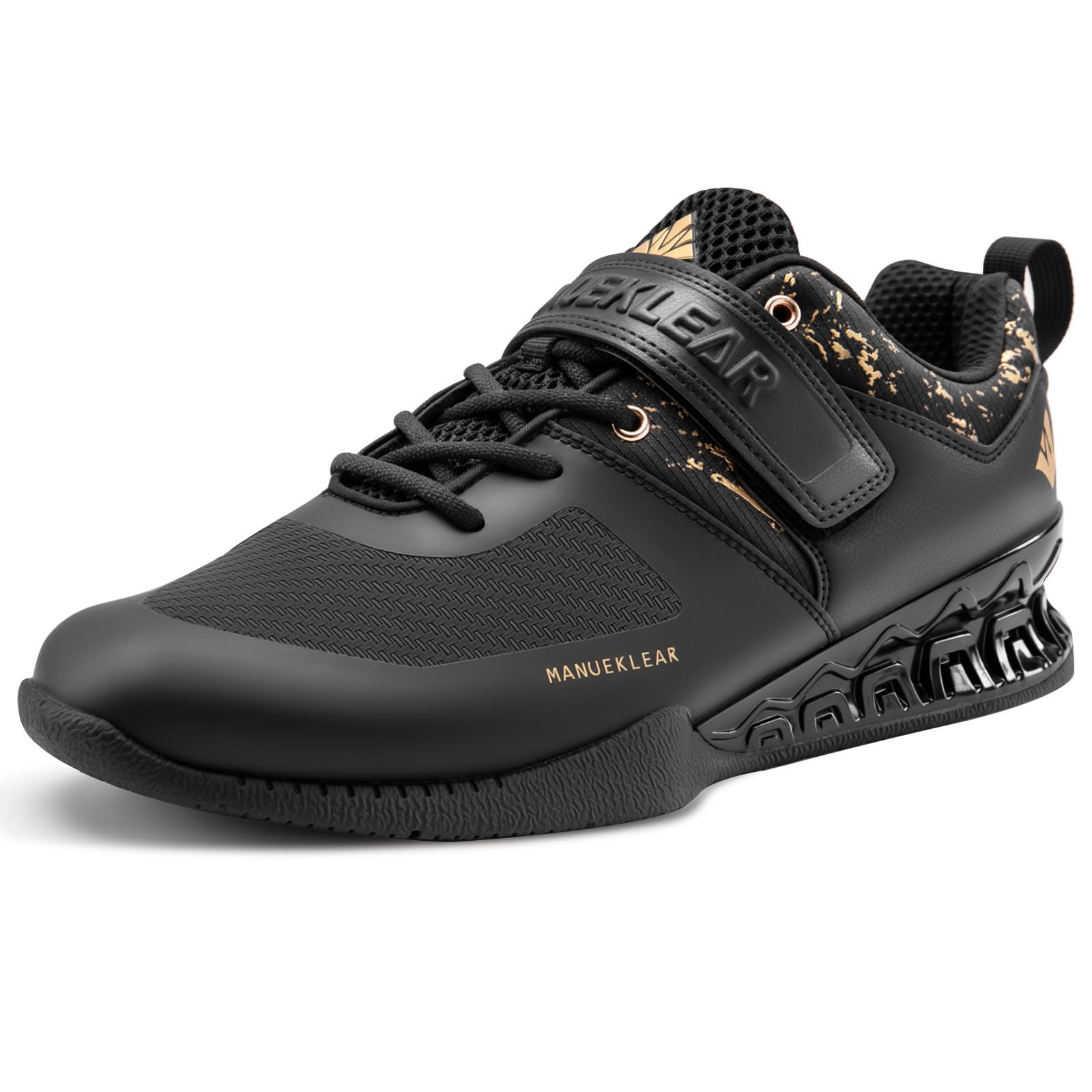
MANUEKLEAR Professional Squat Shoe

MANUEKLEAR

MANUEKLEAR Professional Squat Shoe

  • Base Wide, flat, non-slip
  • Heel Raised heel
  • Toe Box Standard width
  • Shoe Type Squat shoe
Check Price on Amazon

A real heeled squat shoe for the least money here, with a wide, stable base.

A raised heel, a wide flat base, and the lowest price of any heeled shoe here — as a first pair, that combination is hard to argue with. The platform is a hard, non-slip slab that doesn't squirm underfoot, and the heel does what a heel is supposed to do: it buys depth at the bottom of a squat without asking your ankles for it.

The savings show up in the details. The toe box is standard width rather than wide, so a lifter with broad feet will feel their toes crowding before the session is over, and the sole is glued rather than stitched — that toe seam is where a hard-worked pair can start to give. This is a shoe for once or twice a week; four sessions a week deserves the Reebok.

What surprised us is how quickly they go on and come off — a couple of seconds to slide in and tighten, which matters when you're changing shoes between lifts. Comfort is better than the price suggests, too: the arch isn't aggressive, so flat feet don't fight them, and there's more padding around the collar than a budget shoe usually gets.

Bottom Line

The cheapest way into a real heeled squat shoe, and a sound first pair — provided your feet are standard width and you're not training in them four days a week.

Check Latest Price

Best For Deadlift and bench

Our Score 8.8/10
MANUEKLEAR Deadlift Shoe

MANUEKLEAR

MANUEKLEAR Deadlift Shoe

  • Sole Thin, flexible, high-grip
  • Upper Soft
  • Toe Box Wide
  • Shoe Type Deadlift shoe
Check Price on Amazon

These are the flat ones. They're sold as deadlift shoes and that's the right frame: a thin, flexible sole with a rubber bottom, closer to a sock than to a shoe. Traction is the best of the four — the sole holds on rubber flooring and on wood — and the wide toe box lets your toes spread into a three-point base.

What you give up is everything a heeled shoe gives you. There's no lift under the heel, so squatting in these asks the same of your ankles as squatting barefoot, and the upper is soft enough that it won't rescue a wobbly position. We keep them for deadlift and bench days, where being close to the floor is the whole point, and we don't reach for them when the session is built around squats.

One small annoyance has an easy fix: the insole slides around inside the shoe. Pull it out and the problem goes away, and the shoe is arguably better without it — you sit a little closer to the floor, which is the reason to own a pair like this in the first place.

Bottom Line

For pulling days, this is the closest thing to lifting in socks: a flat, grippy slipper that costs the least here and does one job very well.

Check Latest Price

How We Put These Weightlifting Shoes to the Test

We started by scanning reviews and spec sheets for shoes with a non-compressible sole, a secure midfoot strap or lacing system, and a heel height between 0.5 and 1 inch—then filtered out anything that looked like a rebranded running shoe. That left 12 pairs, which we ordered in our usual gym sizes, plus a half size up in a few cases to see how the fit ran.

For six months, we rotated through them for squat, deadlift, and clean sessions, plus accessory work like lunges and overhead presses. We wore them on wooden platforms, rubber gym floors, and the concrete walk from the parking lot. In the rack, we noted whether our feet stayed planted during heavy sets or slid under load; on the platform, we checked whether the sole flexed or felt like a brick. We also paid attention to break-in—some pairs felt comfortable on day one, others needed a week before the toe box stopped pinching.

Fit and sizing got their own check: we compared each shoe's length and width to our regular training shoes, noted whether the heel slipped or the toes had room to spread, and tracked any hot spots during long sessions. Durability came down to inspection after each month—stitching at the toe cap, wear on the outsole, fraying on straps, and whether the interior lining stayed intact. Value was simple: did a lower-priced pair feel as stable as a pricier one, and were the expensive ones actually better made? The shoes that made the list are the ones that stayed comfortable, stable, and intact through all of it.

How to Choose

Decide Between a Raised Heel and a Flat Sole

This is the choice that matters most. A raised heel tilts you slightly forward and shortens how far your ankles have to travel to reach depth, which is why lifters whose heels come up at the bottom of a squat get so much out of a pair. A flat sole keeps you closer to the ground and suits pulling, where a wedge under your heel changes your start position.

So split your training honestly. If squats are the main event and depth is the struggle, buy the heel — the Nordic Lifting MEGIN gives the most of it here. If you pull heavy and squat casually, a flat shoe does more for you. Lifters who do both seriously often end up owning one of each.

Judge the Platform, Not the Upper

A lifting shoe is a platform with a sock attached. Press your thumb hard into the heel of anything you're considering: if it gives, it's a trainer with lifting marketing, and that foam will absorb force you're trying to put into the floor. Twist the shoe side to side as well — one that folds easily won't hold you steady when a squat gets grindy.

The upper matters less, but it shouldn't be so soft that your foot shifts inside it. A snug midfoot and a firm heel are what keep you planted, not thick padding.

Get the Fit Right

Lifting shoes should be snug through the midfoot — you don't want your foot sliding forward as you drive out of the hole — with enough room at the toe for your toes to spread. Most of these are built on a narrow last, so wide-footed lifters should size for width first and length second; the Reebok Lifter PR II is the most accommodating of the four.

Try them on late in the day when your feet are at their largest. A lifting shoe doesn't stretch much, so a cramped toe stays cramped on every set, and going up half a size beats hoping it breaks in.

Know What Fails, and What to Spend

The first thing to go on a lifting shoe is the bond between sole and upper, usually at the toe. Look at that seam before you buy. If you train three or more days a week, put your money there — one mid-priced pair that holds together beats two cheap pairs that don't.

A budget shoe still earns a place as a second pair for pulling days, or as a first pair while you work out whether a raised heel suits you at all.

Frequently Asked Questions

Final Verdict

Buy the Reebok Lifter PR II. It's the pair here with the fewest conditions attached: firm underfoot, secure through the midfoot, roomy in the toe, and built in a way that hasn't made us handle it carefully. For most lifters in a commercial gym, that settles it.

Two situations change the answer. If squat depth is what's holding you back, the Nordic Lifting MEGIN's taller heel buys you more of it. If money is the constraint, the MANUEKLEAR Professional Squat Shoe is the cheapest way into a raised heel, and the flat MANUEKLEAR is the better pick for anyone who mostly pulls.