Cardio Machines

Best Under Desk Bikes of 2026

An under-desk bike makes a simple promise: pedal through your inbox, never leave your chair, get a little movement into a day that would otherwise be eight hours of sitting. Then you try one and meet the real problems. The thing creeps across the rug mid-meeting, whirs loud enough that a coworker asks what that sound is, or pushes your knees into the underside of the desk after ten minutes. The right one solves all of that — it stays where you put it, fades into the background of a call, and lets you pedal as hard or as gently as the afternoon allows.

I've kept one under my own desk for two years, and the difference between the good ones and the frustrating ones shows up in week two, not minute two. My team and I have spent the past eight months living with 11 of them through ordinary workdays, and one piece of wisdom worth knowing up front: tension control is where cheap models give themselves away, since the resistance jumps in hard steps instead of easing from a flat spin to a genuine climb. The ones that survived our rotation all had two things in common — they were quiet, and they were easy to shove out of the way when the workday ended. The picks below are the ones I'd leave under my own desk.

Best Overall

Our Score 9.2/10
DeskCycle Under Desk Bike

DeskCycle

DeskCycle Under Desk Bike

  • Item Weight 23 lb
  • Pedal Height 10 inches (standard)
  • Max User Weight 500 lb
  • Resistance Levels 8, up to 39 pounds
Check Price on Amazon

A real pedal stroke, real resistance, and quiet enough for calls.

Ten inches of pedal height is what makes the DeskCycle work under a desk you already own. That's where the standard version puts the pedals, low enough that most people won't need to raise anything, and an adjustable-height version exists if your chair sits high or your desk sits low. The resistance is the other half of the argument: eight settings, up to 39 pounds, the only figure of its kind stated among these machines. We found that spread covers a lazy spin during a long call and something you can genuinely push against for ten minutes.

What you feel through the pedals is a flywheel turning 14 times per stroke, on sealed bearings, with magnetic resistance. That's the difference between this and a cheap mini bike: the stroke stays smooth at low effort instead of turning jerky, and it stays quiet enough to pedal straight through a meeting. The frame is steel and rated to 500 pounds, and at 23 pounds the unit doesn't wander across the room.

The display detaches on a cord so it can sit on your desktop where you can read it, which we came to appreciate more than the spec suggests. The pedals have straps, worth using once you crank the resistance. The friction you'll actually meet isn't the bike sliding, it's a wheeled office chair rolling away from it, so lock the casters or put a mat under both.

Twenty-three pounds also means this is a fixture rather than something you carry between rooms, and the pedal stroke is a circle rather than an elliptical glide. Neither is a fault, exactly; both decide who this is for.

Bottom Line

We recommend it for most desks: it pedals like a real bike, states the widest resistance range here, and stays quiet through meetings.

Check Latest Price

Best Elliptical Stride

Our Score 9.2/10
Cubii JR1

Cubii

Cubii JR1

  • Dimensions 23.2"D x 17.56"W x 10"H
  • Item Weight 25.4 lb
  • Max User Weight 150 lb
  • Resistance Levels 8
Check Price on Amazon

A gliding, knee-friendly motion with the most planted feel here.

If a tight pedal circle is what stops you, the JR1 changes the shape of the movement. The path is elliptical rather than circular, there are eight resistance levels, and there's no power cord to plan a room around. It's the machine we point to when someone wants to keep pedaling through knee stiffness rather than push through it.

Setup is two foot pads and nothing else. From there it's a quiet, planted glide, and the knob moves through eight settings that run from barely-there to a real push. We pedaled through a video call without anyone asking what the noise was, which is the whole promise of a machine like this.

The weight that keeps it steady is the same weight you have to lift. Moving it takes two hands and some intent, and it doesn't skate across carpet the way the five-pound folding bikes do. On a hard floor, put something underneath it before you settle in.

Where this earns its price is the feel: a longer, more forgiving stride than a pedal circle, and a frame that sits like furniture rather than a gadget. If you want to push hard, the DeskCycle gives you more resistance for less; if you want twenty quiet minutes without your knees objecting, this is the one we hand people.

Bottom Line

We pick the JR1 when comfort outranks portability: the gliding stride is gentle on knees, and nothing here feels more planted while you pedal.

Check Latest Price

Best Motorized Value

Our Score 8.8/10
MERACH MR-E32

MERACH

MERACH MR-E32

  • Power Corded electric, 60W motor
  • Height 7.4 inches
  • Item Weight 11.1 lb
  • Speed Settings 12 manual, 12 auto modes
Check Price on Amazon

Motorized movement, twelve speeds, and a remote for mid-range money.

A 60-watt motor, twelve manual speeds, and twelve auto programs put the MR-E32 in the middle of the price range and the middle of the effort range. It will move your legs for you, or hold a pace while you work, and it does that for less than the two premium machines here. That's the value: motorized movement without giving up quiet operation.

It arrives assembled. Controls are a touch panel plus a remote, and the display reads time, distance, speed, count, and calories. At 7.4 inches tall it vanishes under almost any desk, and at 11.1 pounds it slides out of the way when you want your footroom back.

The catch with anything motorized is that you can't push back against it. The pedals turn at the speed you choose, so you get circulation and looser legs rather than strength, and the stride is compact next to a gym elliptical. It also needs an outlet, which quietly decides where it lives.

For a desk job, a long recovery, or anyone who wants movement without a routine to learn, that's the right trade. If you want to finish a session breathing hard, stay with the manual bikes.

Bottom Line

We think this is the value pick of the motorized machines: twelve speeds, a remote, and quiet operation at a mid-range price.

Check Latest Price

Best Budget Motorized

Our Score 8.6/10
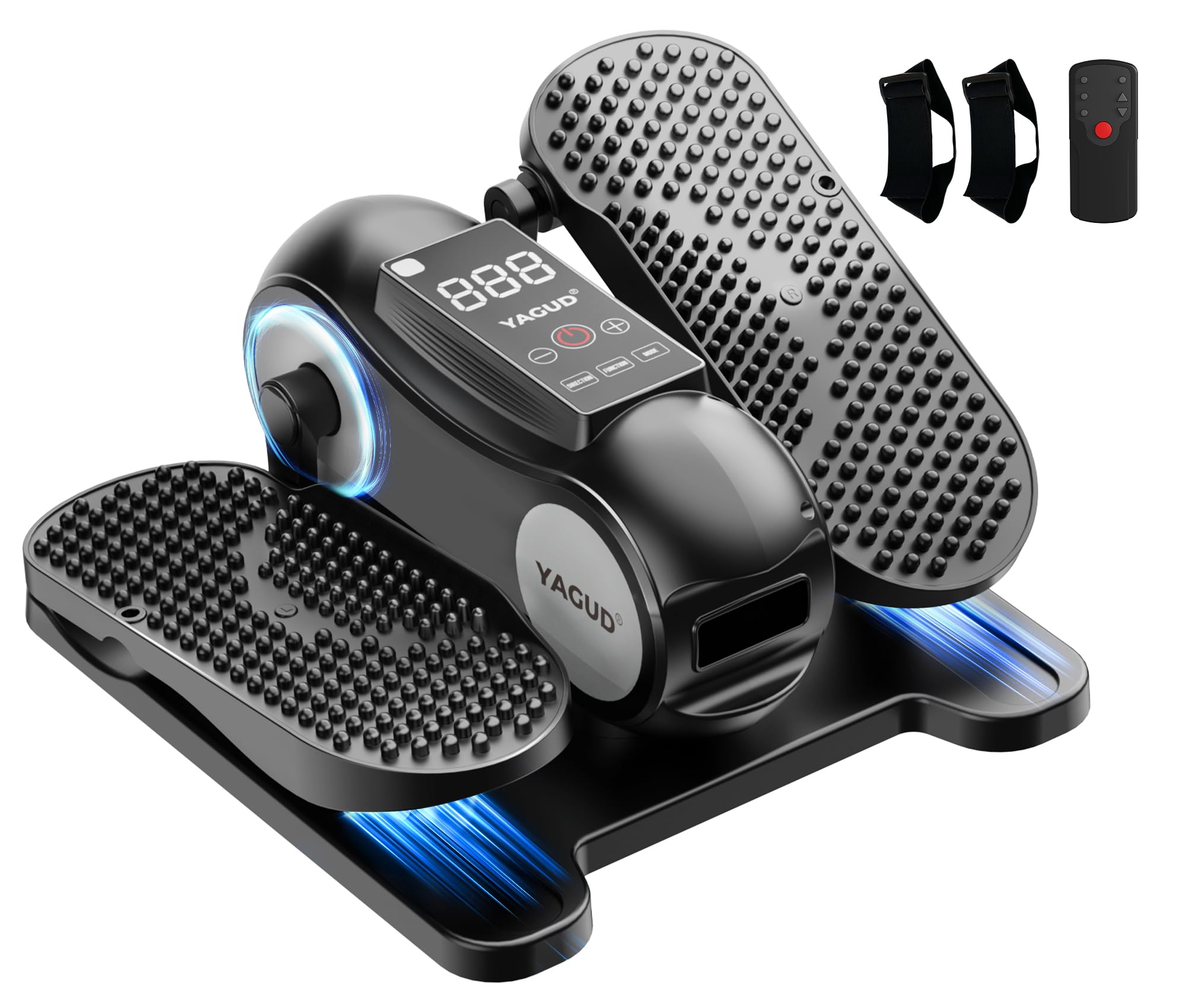
Yagud Under Desk Elliptical

Yagud

Yagud Under Desk Elliptical

  • Modes 12 auto modes, 12 speeds
  • Control Remote and panel
  • Movement Forward and reverse
  • Max User Weight 220.5 lb
Check Price on Amazon

The motor pedals for you, and the remote saves you bending down.

There's no pedaling to it in the usual sense. The motor drives the pedals and your legs go along for the ride, with twelve auto modes and twelve speed levels, forward and reverse, all reachable from a remote so you never bend down to change anything.

Nothing to assemble, a clear display, and quiet running. For someone with limited mobility that combination is the entire point: you sit down, press a button, and your legs start moving without a routine to memorize or a strap to fasten.

Twelve speeds sounds like more than it is. They're pace settings, not resistance, because the motor keeps turning whatever you do, so what you get is circulation and range of motion rather than strength. Anyone who wants to push needs a manual machine.

As the least expensive route into a motorized elliptical here, it's the one we name for a parent or grandparent who wants movement without a learning curve, and the remote is the detail we kept reaching for.

Bottom Line

We suggest this for anyone who wants the machine to do the work: twelve motorized modes, a remote, and nothing to assemble.

Check Latest Price

Best Folding Design

Our Score 8.4/10
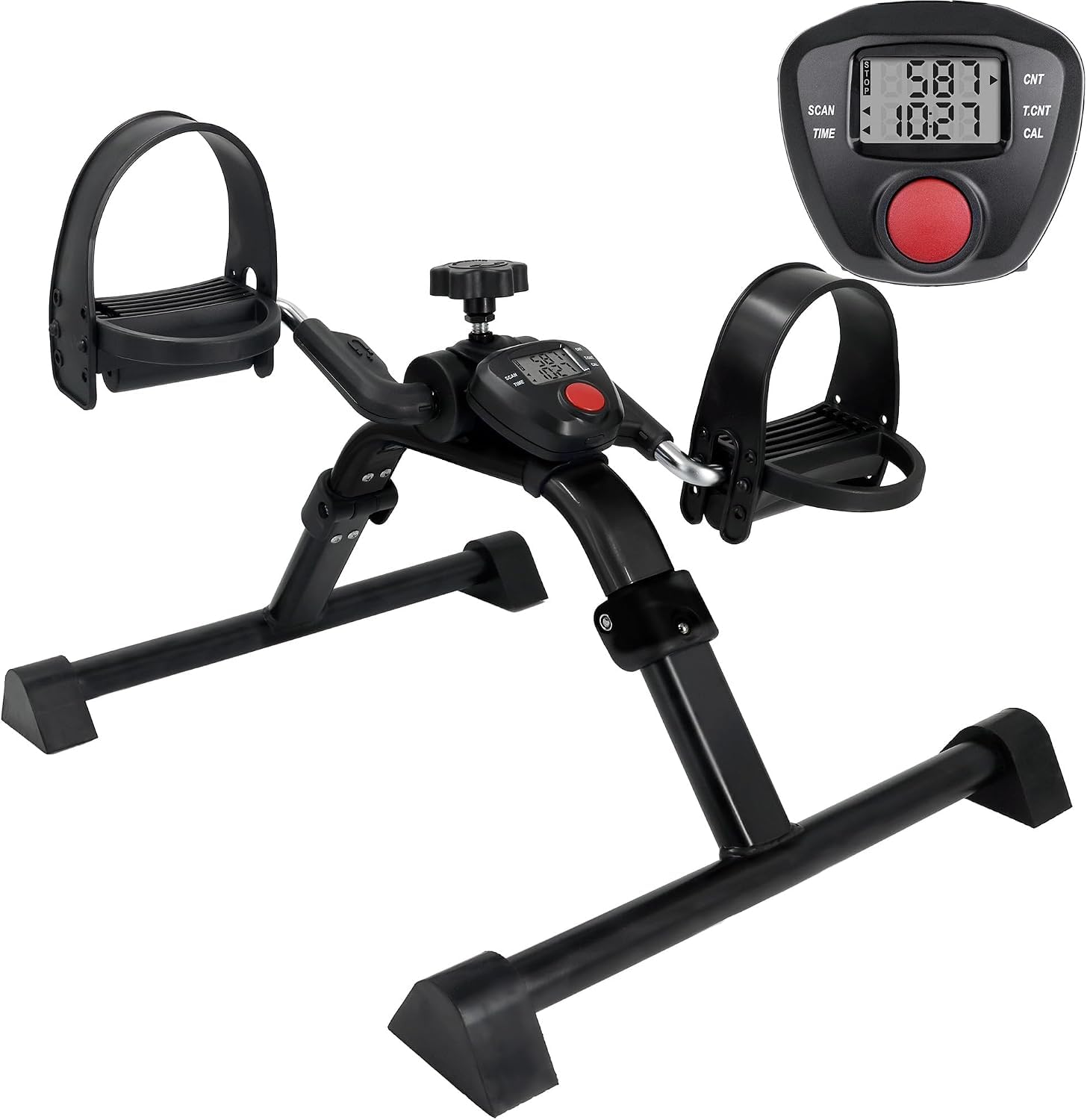
Vaunn Foldable Pedal Exerciser

Vaunn

Vaunn Foldable Pedal Exerciser

  • Frame Foldable
  • Dimensions 18.75"D x 15.5"W x 11.25"H
  • Item Weight 5.7 lb
  • Resistance Levels 5
Check Price on Amazon

Folds flat, weighs under six pounds, and stows in a closet.

Folded, the Vaunn takes up roughly the space of a briefcase, and at 5.7 pounds it's the lightest full-frame machine here. The fold isn't a gimmick. It's how this lives in an apartment where the living room has to become a living room again at seven o'clock.

What we like most is that folding didn't cost anything in use. Magnetic resistance runs through five settings, quiet enough to stay in the room while someone else watches television, and the same pedals work your arms when you lift the unit onto a table. Setup is the fold plus one fitting, so there's nothing to dread.

Light has a price. The frame shifts under hard pedaling, and the stroke turns choppy once you crank the resistance up, so this is a machine for steady low-effort spinning rather than intervals. The straps also run small, and anyone with bigger feet should plan to pedal without them.

For storage-first buyers, students, and small apartments it's the sensible answer, and it's a low-stakes way to learn whether you'll actually use one of these before spending on a bigger machine.

Bottom Line

We recommend it when the bike has to disappear: it folds flat, weighs under six pounds, and costs less than the dedicated desk machines.

Check Latest Price

Best For Carrying between rooms

Our Score 8.4/10
RYGEO Mini Exercise Bike

RYGEO

RYGEO Mini Exercise Bike

  • Material Iron frame, ABS plastic
  • Item Weight 4.19 lb
  • Power Source Self-powered
  • Resistance Levels 5
Check Price on Amazon

At 1.9 kg, this is light enough to pick up and carry to another room without setting down your coffee, and that's the entire argument for it. Five resistance settings, an iron and ABS frame, and a low-intensity motion aimed at knee and shoulder recovery as much as desk cardio.

We treat it as the entry ticket. It does the basic job of keeping your legs moving and it costs less than anything else on this list. The trade shows up the moment you push: it walks across a smooth floor, the pedals feel small under a big foot, and the resistance runs out before it gets interesting.

So put it on carpet or a mat, keep the effort easy, and use it to find out whether you'll stick with pedaling at all before spending more. As a second unit to leave at the office, it's easy to justify.

Bottom Line

We see it as the cheap first step: light enough to carry with one hand, though it's one of the least steady machines here.

Check Latest Price

Best For Travel and small spaces

Our Score 8.4/10
MEMEDA Folding Pedal Bike

MEMEDA

MEMEDA Folding Pedal Bike

  • Frame Quick-fold mechanism
  • Dimensions 15.75"D x 11.81"W x 15.75"H
  • Item Weight 5.73 lb
  • Resistance Levels 5
Check Price on Amazon

The MEMEDA folds on a quick-release hinge into something you can stand in a closet corner, and at 2.6 kg it's light enough to move with one hand and slide into a car. The LCD reads time, count, RPM, and calories, and the pedal straps adjust for different feet.

One number to check first. The listing puts the frame at about 15.75 inches at its tallest, well above the flat ellipticals here, so sit in your chair and measure from the floor to the underside of your desk before you count on pedaling underneath it. A shallow kneehole may only leave room in front of the desk rather than under it.

We recommend it for a small apartment, a spare-room desk, or travel, where the fold and the weight matter more than refinement. This is portability, not a training tool, and it's honest about that.

Bottom Line

We recommend it for travel and tiny apartments, not for pedaling under a closed desk without measuring your clearance first.

Check Latest Price

Best for Arms and Legs

Our Score 8.2/10
Sunny Smart Mini Cycle

Sunny

Sunny Smart Mini Cycle

  • Height 11.7 inches
  • Resistance Stepless knob
  • Item Weight 11.7 lb
  • Max User Weight 300 lb
Check Price on Amazon

Lift it to the desktop for arm work, then pedal quietly on the floor.

Flip this one from the floor to the desktop and it becomes an arm bike, which is the trick that earns the Sunny its place on a list of desk bikes. At 11.7 pounds with a carry handle, moving it from under the desk to on top of it takes one hand and no thought.

Resistance is stepless: one knob turned continuously rather than a set of clicks. We prefer that for dialing in an easy setting you can hold for an hour, and we miss it when we want to come back to the same effort tomorrow. The mesh belt drive keeps things quiet, and the LCD tracks speed, time, distance, and calories.

What convinced us to include it is the weight limit: 300 pounds, the highest among the smaller pedal bikes here, on a frame that feels more substantial than its size suggests. The belt drive is quiet enough for shared space, and the handle makes it the one machine in this group you can relocate mid-workday without a plan.

Two AAA batteries run the display, so keep spares in a drawer. And check the kneehole of a shallow desk before you commit, because at 11.7 inches tall it wants a little more room than the flat ellipticals.

Bottom Line

We keep this one for its arm-and-leg flexibility: lift it onto the desk for a shoulder session, and it still pedals quietly on the floor.

Check Latest Price

How We Tested the Best Under-Desk Bikes

We started by pulling together every under-desk bike we could find from the brands shoppers actually buy, then narrowed the field by pedal height clearance, resistance type, stated weight, and price. Models that only fit under a standing-height desk or that needed tools most people don't own to adjust got cut early. That left 11 bikes, which we ran through eight months of normal working life rather than a week of novelty riding.

Each one arrived at a desk and stayed there. We timed assembly solo with only the included tools, then timed it again after breaking the bike down for storage, because a machine you dread setting up is a machine you stop using. We weighed every bike on a bathroom scale and moved each one between a closet and a desk at the start and end of the day, noting whether it rolled cleanly, needed a lift, or scraped the doorframe. Riding happened during actual calls and email blocks, on both carpet and hardwood, so we could watch for creeping, wobble, and how much knee room we had left under a standard-height desk.

We measured noise with a decibel app in a quiet room while pedaling at a steady, easy pace, then again at the highest resistance each bike allowed, and noted whether the sound carried through a headset microphone. Tension got turned through its full range mid-ride to check for steps or dead zones, and we paid attention to how smooth the stroke felt at slow speeds, since a choppy pedal makes your hips rock. Value came down to whether a bike held its settings and stayed quiet after months of daily use, and whether the parts that wear — pedals, knobs, straps — felt like they'd outlast the warranty.

How to Choose

Measure clearance before anything else

The tallest point of the machine has to sit below the underside of your desk, with room left over for your knees at the top of each pedal stroke. Set your chair at working height, measure from the floor to the underside of the desk, and hold that against the unit's height. The flat ellipticals here run about 7 to 8 inches; most pedal bikes run 10 to 12, with one folding model closer to 16.

If the numbers are tight, a lower-profile elliptical or an adjustable-height bike buys back the difference. What you shouldn't do is buy on faith and then discover you're pedaling with your knees against a drawer.

Manual or motorized

A manual bike asks you to do the work: you choose the resistance and you turn the pedals. A motorized elliptical does the pedaling and lets your legs follow, which suits circulation, stiff joints, and anyone who won't reliably push themselves after a long day.

The trade is effort. You can't push back against a motor, so a motorized unit won't build much strength no matter which of its twelve speeds you pick. Choose motorized when the goal is movement; choose manual when the goal is a workout.

Resistance range beats the number of levels

Eight clicks on a cheap knob can all feel like the same nothing, so the count tells you less than the range behind it. A stated figure, like the 39 pounds the DeskCycle offers, or a stepless knob like the one on the Sunny, is a better sign that you'll find a setting worth holding for twenty minutes.

If you only want light spinning while you answer email, none of this matters and five settings is plenty. If you want to finish a session slightly out of breath, buy the resistance, not the readout.

Staying put on your floor

The most common frustration with these machines isn't the pedaling, it's the travelling. Light units walk across hardwood, and a wheeled office chair rolls away from the pedals until your legs are stretched out straight. A rubber mat under the bike fixes most of it, and locking the chair's casters fixes the rest.

Weight is the other answer: the 23- to 25-pound machines here stay where you put them. Before you blame the bike, check whether your chair is the thing that moved.

Noise, storage, and the weight you'll actually lift

Belt drives and sealed bearings are quiet, and a heavier flywheel is quieter still, which is why the big machines can be used mid-call without anyone noticing. That same weight is what you lift every time the bike changes rooms.

Under six pounds and folding is the right answer for a closet, a suitcase, or a living room that has to look like one again by evening. Twenty-plus pounds is the right answer for a permanent spot under a single desk.

Frequently Asked Questions

Final Verdict

For most people the DeskCycle is the answer. It fits under a standard desk, gives you resistance you can actually push against, and fades into the background of a workday.

Choose the Cubii JR1 if a pedal circle bothers your knees and you prefer a glide, or the MERACH if you want the machine to do the work for less than the premium bikes cost. If you're still deciding whether you'll use one at all, the RYGEO is the cheapest way to find out.