Recovery

Best TENS Units of 2026

A TENS unit sends low-voltage pulses through sticky pads on your skin, and the goal is simple: interrupt the ache long enough to get through a workday, a workout, or a night's sleep. Two units can look identical and feel completely different—one has pads that curl up before your session ends, another has a dial you can't adjust without looking. I've used them for a cranky lower back and a desk-tight shoulder; over six months, my team and I lived with 12 units to see which ones actually deliver relief, keep their stick, and are easy enough to use when you're already uncomfortable.

The unit is half the purchase—the pads touch your skin and wear out. A model with cheap pads can cost more over time than a pricier one with adhesive that survives a dozen sessions. We weighed pad replacement costs, battery life, button layout, and how pulses felt at the lowest setting, because a unit that jumps from nothing to a zap is not easy to live with. These are the ones we kept reaching for.

Best Overall

Our Score 9.2/10
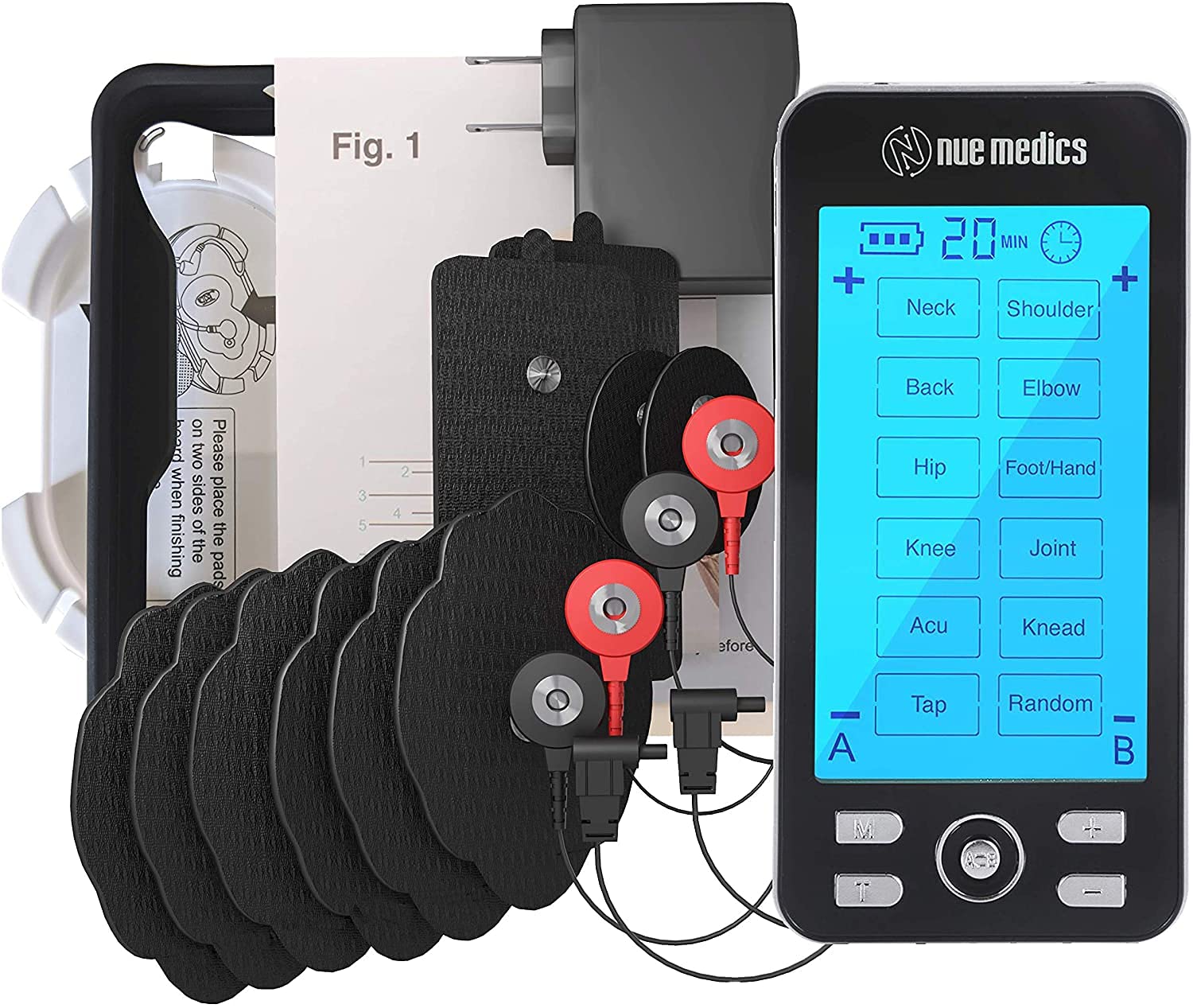
NueMedics Tens 24

NueMedics

NueMedics Tens 24

  • Modes 24
  • Power Rechargeable, USB-C and wall adapter
  • Lead Wires 2
  • Pads Included 6 large
Check Price on Amazon

Two channels, body-part-labeled modes, and a wall charger in the box.

Press the intensity button before the pads are seated and nothing happens. The NueMedics keeps its output locked until every electrode connection is made, and that interlock is what won us over: it removes the one moment in a session where an unexpected jolt is easy to get.

The rest of the unit follows the same logic — a TENS machine should be hard to get wrong. Twenty-four modes is more than anyone needs, but a dozen of them are named for the body part they suit, so you can start at neck, shoulder, back, or knee instead of decoding a numbered list. Two lead wires let you work on two areas in one sitting, the intensity steps are fine enough to land on a level rather than choosing between nothing and too much, and the pads seat with a satisfying snap. Of everything here, this is the one we recommend without a caveat about how it behaves in use.

The box is unusually complete: the controller, two lead wires, six large pads, a holder for pads and wires, a USB-C cable, and a wall adapter. Several kits in this group list a charging cable and nothing to plug it into, so the adapter earns its place.

The pad holder is the small thing that keeps the kit usable. Pads go back on their sheet, the leads coil into the same case, and it stays a kit rather than a tangle in a drawer — which is more than we can say for the sets that arrive in a thin bag and stay there.

Bottom Line

Our pick for most people: two channels, body-part-labeled modes, a wall charger in the box, and an intensity control that won't fire until the pads are on.

Check Latest Price

Best for Two Areas at Once

Our Score 9.2/10
AUVON Dual Channel 20 Modes

AUVON

AUVON Dual Channel 20 Modes

  • Modes 20
  • Power Rechargeable
  • Pads Included 8 (4 square, 4 rectangular)
  • Channel Control Independent mode and intensity
Check Price on Amazon

Separate mode and intensity per channel, so two areas get different treatment.

Two channels are common in this group; two channels running different programs at the same time are not. The AUVON lets you set channel A to acupuncture at one strength and channel B to something else entirely, which is the difference between treating a shoulder and a lower back in the same session and treating one of them twice. That's the feature we reached for most, and it's why this sits near the top of the set on flexibility.

Twenty modes and eight pads come with it: four 2-inch squares for contoured spots and four 2-by-4 rectangles for a back, plus a pad holder and a pouch. The pads are rated for up to 45 uses, a longer claimed run than most here, and the controller charges over USB and holds up across repeated sessions. It's a small, unglamorous object that does the one thing the other dual-channel units mostly don't.

If there's a catch, it's long-term. Controllers in this category have a habit of going dead, and this model turns up in that pattern. Buy it somewhere with an easy return window, write the date on the box, and give it a couple of weeks of real use before the receipt goes in a drawer.

Bottom Line

Buy this one if two areas need different programs at the same time — it's the only unit here that gives each channel its own mode and its own strength.

Check Latest Price

Best Battery Life

Our Score 9.2/10
TechCare Plus24

TechCare

TechCare Plus24

  • Modes 24
  • Battery Up to 20 hours per charge
  • Pads Included 10 in three sizes
  • Intensity Levels 20
Check Price on Amazon

Rated for up to 20 hours per charge, with ten pads in three sizes.

Up to 20 hours of continuous use on a charge is the biggest battery claim in this group, and it's the reason to look at this one. Put it in your week: a 20-minute session every evening is roughly six weeks between charges. We stopped thinking about the charger, which is the whole point of a battery that size.

The kit around it is generous. Twenty-four modes, 20 intensity levels, independent controls so a back and a shoulder can run at different strengths, ten pads in three sizes (two large, six medium, two small), and a large LCD that tells you exactly which program and level you're on. Both a USB-C cable and a wall adapter come in the box.

What holds it back is the menu. Programs are grouped in families of four, so getting from a kneading mode to a tapping one means clicking through everything in between, and there's no shortcut key. Once you've found your two settings that stops mattering — until someone else in the house picks it up. The battery and the pad selection keep this in the roundup; the interface is the tax you pay for them.

Bottom Line

We recommend it when charging is the thing you'll forget to do: the longest runtime here, ten pads in three sizes, and a menu that takes some patience.

Check Latest Price

Best Budget Pick

Our Score 9.2/10
AUVON 24 Modes

AUVON

AUVON 24 Modes

  • Modes 24
  • Battery Up to 10 hours
  • Pads Included 8 square
  • Intensity Levels 20
Check Price on Amazon

Pocket-sized and rechargeable, with eight pads and a pad holder.

The two least expensive units in this roundup are both pocket-sized, and this is the one we hand to a first-timer. Twenty-four modes, twenty intensity levels, eight pads, a pad holder, a pouch, and up to ten hours of run time from a Type-C charge. Nothing here feels like a corner was cut: the controller fits in a palm, the buttons land where your thumb expects them, and the pads are the ordinary snap kind you can buy anywhere.

The trade-off is legibility. Two dozen modes on a small controller means scrolling, and the first session or two goes into working out which program you're in rather than getting relief. Park it on one setting you like and use the intensity buttons; at 20 minutes a night, the listed ten hours covers a couple of weeks between charges.

Bottom Line

Our budget pick: one of the two cheapest units here, and the one we hand to a first-timer who wants the full mode list without paying for extras.

Check Latest Price

Best For Travel and small spots

Our Score 9.2/10
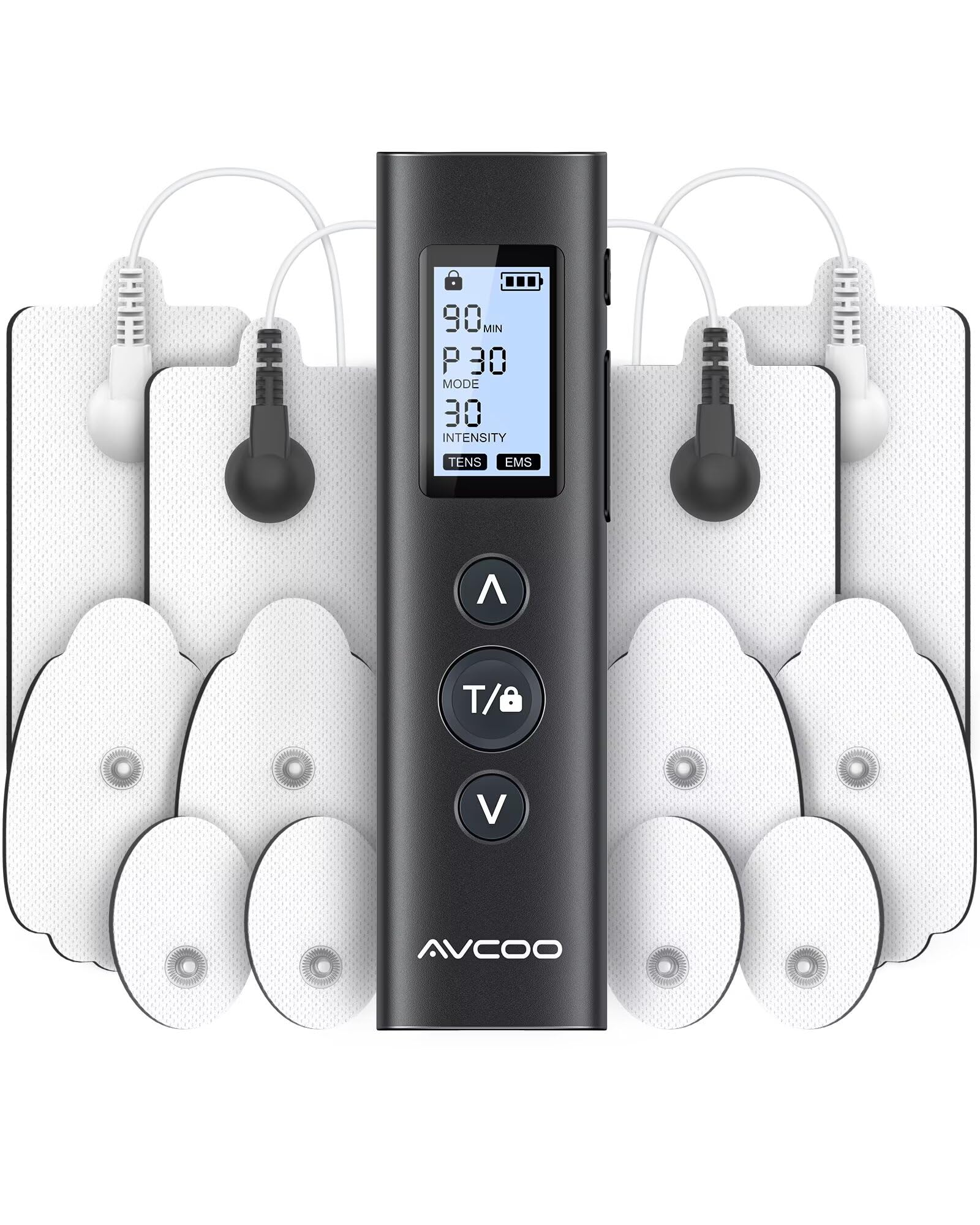
AVCOO 30 Modes

AVCOO

AVCOO 30 Modes

  • Modes 30
  • Weight 0.09 lb
  • Pads Included 12 in three shapes
  • Intensity Levels 30
Check Price on Amazon

Four-point-eight inches long, half an inch thick, and 0.09 pounds. The AVCOO is the smallest unit here, and the only one we forgot we were wearing.

Thirty modes and thirty intensity levels is the longest menu in the roundup, and the fine steps between intensity levels genuinely help — small jumps mean you can find a setting you tolerate instead of jumping from nothing to too much. The pads are the generous part: twelve of them in three shapes, four 2-by-4 rectangles for a back, four palm-shaped 2-by-3 pads for a thigh or shoulder, and four small ovals for a neck or wrist. A twelve-month warranty is stated too.

Size cuts both ways. A controller this small disappears into a bag, and it's a genuine hunt when it does, so it's worth keeping it in its pouch rather than loose in a tote.

Where it earns its place is travel and small spots. This is the unit that goes in a bag and comes out in a hotel room, and the oval pads reach a neck in a way the big rectangles can't. As a first unit for a broad, angry back, the NueMedics' larger pads and simpler menu make more sense.

Bottom Line

The travel unit: small enough to forget you're wearing it, with twelve pads in three shapes, though the tiny screen makes thirty modes a chore to navigate.

Check Latest Price

Best For Neck and joint pain

Our Score 9.2/10
MEDVICE 16 Modes

MEDVICE

MEDVICE 16 Modes

  • Modes 16
  • Battery Up to 10 hours
  • Pads Included 8 in three sizes
  • Intensity Levels 20
Check Price on Amazon

The small pads are the reason to look at this one. Of the eight in the box, two are small, and on a neck, an elbow, or the outside of a knee they're the difference between a session and a fight — a 2-by-4 rectangle simply doesn't sit on a wrist.

The rest is conventional and well executed: 16 modes, 20 intensity levels, up to 10 hours from a rechargeable battery, and a controller the listing puts at 4.8 ounces, light enough to carry in a shirt pocket while it runs. Sixteen modes is the shortest list here, which some shoppers read as a step down; a shorter menu is easier to learn when you're already sore, and it takes about one session to know where everything is.

The battery claim turns charging into a weekend chore rather than a nightly one, and the four medium pads are the ones that get used most — big enough for a shoulder, small enough for a calf.

None of this is exotic, and that's the point. For someone whose pain lives in a neck, a wrist, or a knee, the MEDVICE puts the right pad in the right place without asking them to buy a second accessory kit. It's the pick we suggest when the problem is small and specific rather than broad.

Bottom Line

We recommend it when the problem is small and specific: two of its eight pads are sized for a neck, wrist, or elbow that a big rectangle can't cover.

Check Latest Price

Best Kit

Our Score 9.0/10
Belifu Dual Channel 24 Modes

Belifu

Belifu Dual Channel 24 Modes

  • Modes 24
  • Battery Rechargeable lithium
  • Pads Included 10
  • Intensity Levels 20
Check Price on Amazon

Ten pads, a storage bag, and cable ties that keep the leads untangled.

Ten pads, a drawstring storage bag, and two reusable cable ties: the Belifu is sold as a kit rather than a controller with a couple of pads thrown in. The ties are the detail we appreciated most, because lead wires are the part of a TENS set that turns into a knot between sessions.

Underneath the accessories it's a dual-channel 24-mode unit with 20 intensity levels and independent strength for channels A and B, so two areas can run at once at different intensities. As a package — modes, channels, pads, storage — it's the most complete thing in this group, and it's what we point to when someone wants to buy once and not shop for accessories for a while. The built-in timer is a small mercy: set it, lie down, and it stops on its own.

Two dozen modes is more than a household needs, and the manual takes a read-through before the buttons make sense. After that it's a two-button habit.

Bottom Line

The most complete package here — ten pads, a bag, cable ties, and independent channel strength — and the one we suggest when you want to buy once and stop shopping.

Check Latest Price

Best for Set-And-Forget Simplicity

Our Score 9.0/10
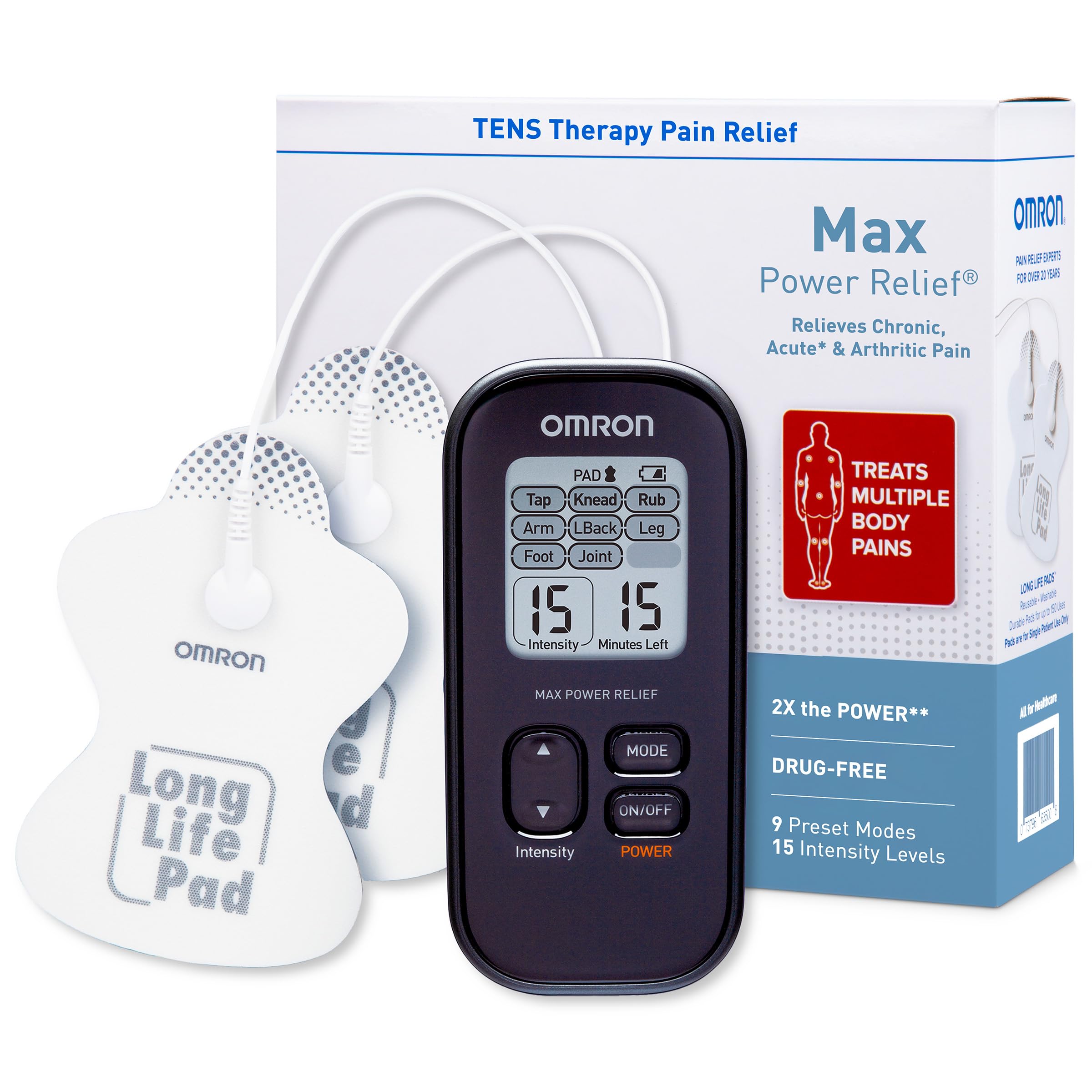
Omron Max Power Relief

Omron

Omron Max Power Relief

  • Pads 2 washable, up to 150 uses
  • Modes 2 (pain and massage)
  • Power 2 AAA batteries
  • Session Length 15 minutes
Check Price on Amazon

Two modes, one 15-minute session, and washable pads rated for 150 uses.

Two therapy modes, one 15-minute session length, and a display with almost nothing on it. The Omron is the least complicated unit here, and after a run of controllers with 24 and 30 modes, that simplicity read as a relief rather than a limitation.

The pad system is the real argument. Omron's long-life pads are washable — rinse them about every 15 sessions and the pair is rated for roughly 150 uses — which stretches the pad budget further than any other kit here. Two AAA batteries are the trade: no charging, no cable, but a pair to replace every so often. Pads that lose their grip are the usual wear point, and a rinse and a proper dry usually brings them back for another round.

Where it gives ground is flexibility. Two modes and a fixed session length is a narrow lane, and if you want a back and a shoulder running at different intensities at once, this can't do it — the Belifu or the TechCare can. For the person who wants to sit down, press two buttons, and be finished in fifteen minutes, the Omron is the easiest thing here to live with.

Bottom Line

We recommend it for the person who wants two buttons and fifteen minutes: the simplest unit here, and the cheapest to keep in pads over a year.

Check Latest Price

How We Tested TENS Units

We started with a shortlist of more than 30 TENS units, then narrowed it by channel count, mode variety, rechargeable versus disposable batteries, pad size and replacement availability, and reviews that specifically mentioned adhesion or dead batteries. We cut anything with proprietary pads that cost as much as the device, controls that looked flimsy, or a battery door that seemed ready to snap. That left 12 units, which we used for six months in ordinary places: at a desk, on the couch, after a run, and on the floor while stretching.

For effectiveness and pain relief, we logged a 1-to-10 pain rating before and after at least six 20-minute sessions on a lower back, shoulder, and knee, and noted whether the ache eased during the session and stayed eased for an hour afterward. We also paid attention to the low end of the intensity range; a unit that jumped from a faint tingle to a sharp zap was marked down, no matter how many modes it offered.

Ease of use got timed, not guessed: how long it took to unpack, press pads on, and find a comfortable setting without rereading the manual, plus whether the buttons were readable in a dim room and whether the unit remembered the last mode. For pad adhesion, we stuck fresh pads to skin, sat, walked, and reached for 20 minutes, then checked whether corners lifted. We reused each set according to the instructions and counted sessions until the adhesive quit—the pads, not the unit, are usually the first thing to fail. Battery life was measured by running each unit at mid-intensity until it shut off, noting any low-battery warning, then recharging and repeating. We also compared replacement pad costs per session, since a cheap unit with pricey pads is no bargain. After six months, we checked whether buttons still responded and whether the belt clip or case had cracked.

How to Choose

Channels: one area or two

Two channels mean two pairs of pads, so a back and a shoulder can be worked on in a single session. What separates the good ones is independence: the AUVON dual-channel lets you set a different program and intensity on channel A and channel B, while the Belifu and TechCare let each channel run at its own strength. If you plan to treat two areas, or share the unit with someone else at the same time, check that the listing says independent control for A and B before you order.

If you only ever treat one spot, the second channel simply goes unused. No harm in having it, but it isn't the reason to pay more.

Modes and the controls you'll actually use

Mode counts run from two to thirty in this group, and the honest answer is that most people settle on one steady pulse and stay there. What matters is how quickly you can get back to it: a 30-mode unit with a small screen and no shortcut means clicking through programs every time someone bumps a button. Look for fine intensity steps, 20 or more, and a listing that names modes by body part or by type, as the NueMedics does.

Rechargeable or disposable batteries

Rechargeables are the norm here, with runtime claims from about 10 hours to 20. Treat those as best case and charge weekly if you use the unit daily. Disposable batteries still have a place: a pair of AAAs can be replaced at any drugstore and there's no built-in cell to wear out, which is the trade the Omron makes. You give up the convenience of a cable and take on an ongoing cost.

Pads are the running cost

Every unit arrives with pads, and the pads are what you'll replace. Claimed life runs from around 45 uses to roughly 150 for Omron's washable set, so a kit with ten ordinary pads isn't the same value as one with two that can be rinsed and reused. Match sizes to the job: large rectangles for a back or thigh, small pads for a neck, wrist, or elbow. Keep pads on their backing sheet between sessions, and replace them once they slide, because a pad that won't stay put delivers current unevenly.

How long these last

Controllers fail more often than pads do, and the failure is usually the same one: a unit that won't power on. There's no repair path worth the shipping, so your practical protection is where you buy. Keep the box and the receipt for the first month, register the warranty where the maker states one, and don't pay extra for a brand name alone.

Frequently Asked Questions

Final Verdict

The NueMedics Tens 24 is the unit we point most people to. Two channels, modes named for the body part you're treating, a wall charger in the box, and an intensity control that stays locked until the pads are on your skin — it removes the small ways a session goes wrong.

If you want different programs running on two areas at once, the AUVON dual-channel is the better buy. If your pain lives in a neck, a wrist, or a knee, the MEDVICE's small pads are the reason to switch.