Accessories

Best Swim Fins of 2026

Ill-fitting swim fins announce themselves fast: a hot spot on the instep, a heel strap that rubs, a blade that fights your kick instead of extending it. A good pair should feel like a natural extension of your foot—secure enough for a strong flutter kick, comfortable enough for a long snorkel, and simple enough to pull on at the pool deck without a wrestling match. I swim laps year-round, and over the past six months my team and I have put 12 pairs through pool sessions, open-water swims, and the bottom of a packed beach bag.

Size and fit trip up most shoppers: swim fins are not shoe sizes, and a pair that feels snug dry can turn punishing after 20 minutes in the water. We also inspected construction at the foot pocket, heel strap, and blade edges, because durability matters more than a fancy fin profile. Some models pack flat and travel easily; others demand their own bag. A few of the best-value pairs were also the simplest, which is worth remembering as you scan the picks below.

Best Overall

Our Score 9.2/10
CAPAS Swim Training Fins

CAPAS

CAPAS Swim Training Fins

  • Material Silicone
  • Blade Type Short blade
  • Dimensions 13.2 x 7 in.
  • Foot Pocket Closed heel
Check Price on Amazon

A quick, secure short-blade fin for everyday lap swimming and kick sets.

The short blade is the reason we keep the CAPAS near the top of the bag for lap days. It gives enough surface to feel the water without turning every length into a leg-press set, so the kick stays quick and the turnarounds stay manageable. The closed heel adds to that impression: the pocket holds the foot steady instead of letting it swim around inside the fin.

The foot pocket is soft enough that we stopped thinking about it during longer kick sets, and the pull-on shape is simple to live with. There is no left or right fin to sort at the wall, which sounds minor until you are balancing on a wet deck and trying to get moving again. In the water, the fin floats, so a kick that comes off in deep water is not automatically a lost fin.

We prefer this short-blade shape for freestyle and backstroke sets because it encourages a faster rhythm rather than a slow, powerful push. It is not the fin for someone who wants maximum glide from each kick, and it does not try to be. What it does is make regular pool work feel more purposeful without leaving the calves wrecked for the rest of the day.

Bottom Line

The CAPAS is our default lap-swimming fin: the short blade keeps the kick quick, the closed heel stays put, and the pair floats if it comes off.

Check Latest Price

Best for Competitive Training

Our Score 9.2/10
Arena Powerfin Pro II

Arena

Arena Powerfin Pro II

  • Weight 1.76 lb
  • Material Silicone
  • Blade Type Short blade
  • Foot Pocket Open heel
Check Price on Amazon

Left- and right-specific silicone blades stay stable through fast training kicks.

Arena's Powerfin Pro II is built like a piece of competitive equipment, not a holiday flipper. The left and right fins are shaped separately, the heel is open, and the silicone blade has slits and side grooves meant to keep the kick controlled at speed. Even the notches underneath are there to influence how the fin releases through the water.

For a competitive swimmer working on underwater speed, that specificity is the point. The open heel lets the ankle move more naturally than a closed full-foot pocket, and the separate left and right shapes make the fin feel less like a symmetrical paddle.

Stability is where this fin earns its keep. It stays locked through fast kicking and flip turns, and the short blade keeps the tempo quick enough for sprint work. A casual snorkeler will find it overbuilt; a swimmer with a coached plan will understand what the extra shaping is for.

We put it at the top of this set for competitive training because it gives the most controlled feedback when the pace rises. It is a specialist's fin, and it makes that clear from the first length.

Bottom Line

We point competitive swimmers here: the left- and right-specific Powerfin gives a stable, controlled kick for fast training sets.

Check Latest Price

Best For Pool and ocean

Our Score 9.2/10
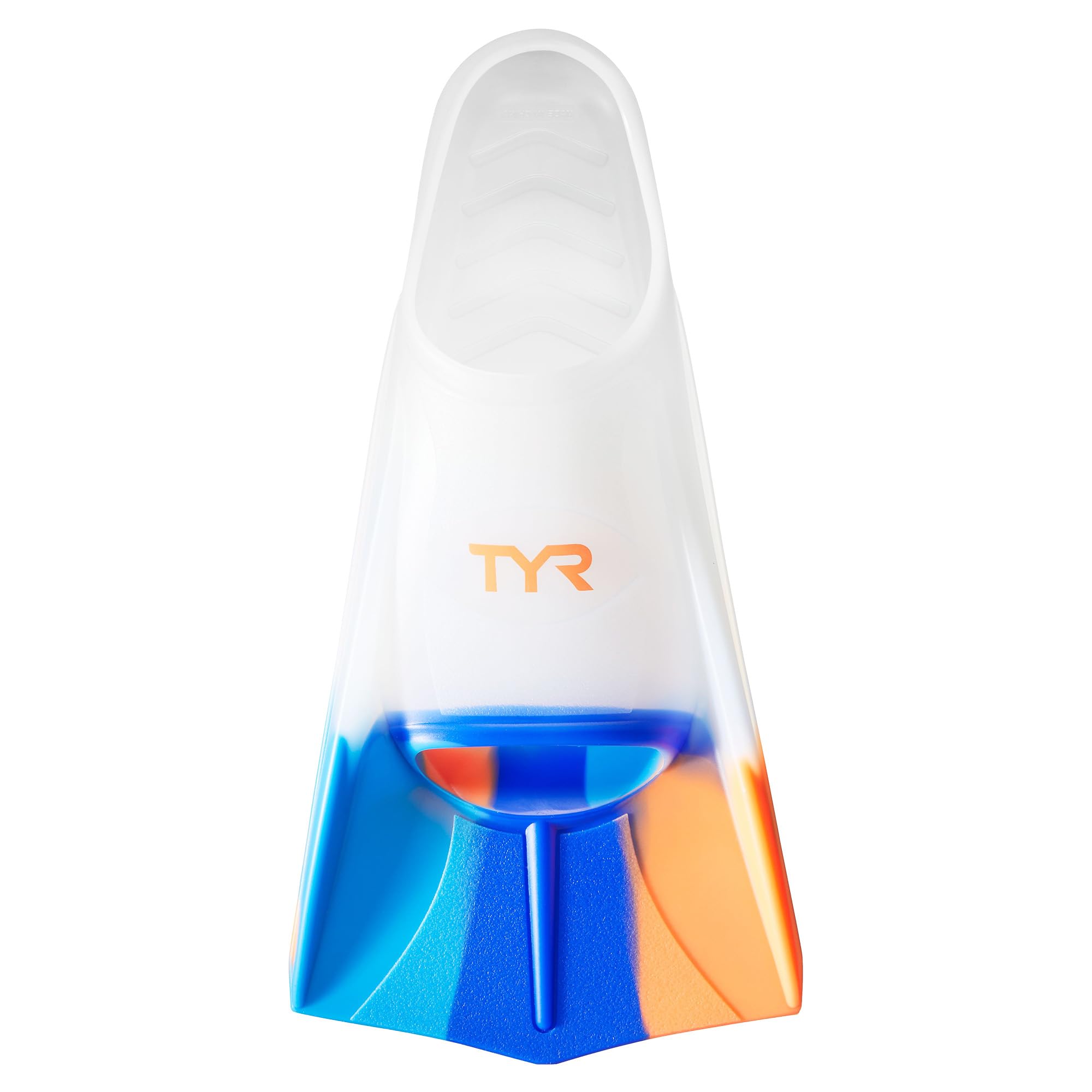
TYR Stryker Silicone Fins

TYR

TYR Stryker Silicone Fins

  • Weight 16 oz
  • Footpad Non-slip
  • Material Silicone
  • Blade Type Short blade
Check Price on Amazon

TYR's Stryker is a silicone short-blade fin with a non-slip footpad, and the material is the first thing we notice. Silicone has a softer, more rubbery feel than the stiff plastics used on some pool fins, and it tends to sit against the foot rather than bite into it.

We rate it as a strong choice for a swimmer who wants a short blade with a more substantial feel. The blade is shaped for a quick flutter kick, and the textured footpad gives a little more grip on wet tiles than a bare rubber sole. It has enough structure for lap work and enough flexibility for open-water swimming, so it covers both without feeling like a compromise.

What makes it worth considering is the combination of a secure foot pocket and a blade that does not fight a fast kick. We keep it in the rotation for pool sets and the occasional ocean swim, and it handles both without drama.

Bottom Line

We rate these well-made silicone short fins for pool and ocean swimming, with a secure pocket and a blade that rewards a quick kick.

Check Latest Price

Best for Body Alignment

Our Score 9.0/10
FINIS Long Floating Fins

FINIS

FINIS Long Floating Fins

  • Weight 1.5 lb
  • Material Rubber
  • Blade Type Long floating blade
  • Dimensions 20.98 x 10.98 in.
Check Price on Amazon

Buoyant long blades lift the legs and make body position easier to feel.

Buoyancy is the whole point of the FINIS Long Floating fin. The blade is designed to lift the legs toward the surface, and that changes the feel of a kick set: the hips come up, the legs trail less, and the swimmer gets a clearer sense of where the kick is going. As a training tool for body position, it is doing a different job from a short pool fin.

We reach for a fin like this when the goal is alignment rather than speed. The long blade gives a slower, more deliberate push and plenty of feedback through the leg, which is useful for a swimmer trying to stop the legs from dragging. It floats in fresh and salt water, a small convenience that matters more than it sounds when you are working near a wall or a boat.

The trade-off is that the long blade asks for more leg strength, so it is not the pair we choose for a relaxed snorkel where a short fin will do. It is at its best in a training session where the fin is the point, not an accessory to a longer trip.

Bottom Line

These are the fins we choose when body position is the problem: the buoyant long blade lifts the legs and makes the kick easier to feel.

Check Latest Price

Best for Pool Comfort

Our Score 9.0/10
Cressi Light Fins

Cressi

Cressi Light Fins

  • Weight 1.7 lb
  • Material Rubber elastomer
  • Blade Type Short blade
  • Foot Pocket Full foot pocket
Check Price on Amazon

Soft full-foot pocket makes long pool sessions kinder to the feet.

The Light's foot pocket is made from soft rubber elastomers, with a full-foot shape that wraps the foot rather than clamping across the instep. That softness is the first thing you notice on a long pool session, and it is why this fin stays in our bag when the feet are already tired from a previous workout.

The short blade is reactive without feeling like a paddle: it gives resistance for leg workouts, but the stroke stays quick enough for drills and flip turns. Cressi builds this one for pool training and recreational swimming, and that comes through in the way the fin behaves at slow and moderate speeds.

We rate it as the comfort pick of the group for pool swimmers, especially anyone who has had a stiff foot pocket rub the top of the foot raw. It is not the most propulsive short fin here, but it is the one we reach for when the session is long and the feet need a break.

Bottom Line

We think the Cressi Light is the comfort-first pool fin here, with a soft full-foot pocket that makes long kick sets easier on the feet.

Check Latest Price

Best For First fins

Our Score 9.0/10
Gintenco Swim Fins

Gintenco

Gintenco Swim Fins

  • Material Plastic
  • Warranty 1 year
  • Age Range Adults and kids
  • Blade Type Short blade
Check Price on Amazon

Gintenco's short fins are aimed at the swimmer who wants a simple training aid without spending a lot to find out whether fins agree with them. The blade is short and flexible, the pull-on pocket is straightforward, and the fin is available in a wide range of colors and sizes for adults and kids.

The easy-on shape is a real advantage for family use. Kids can get these on and off without an adult kneeling in the water to help, and the short blade gives just enough resistance for a beginner to feel the kick without exhausting the legs. The one-year warranty is a sensible touch at this end of the market.

We treat it as a starter fin rather than a long-term workhorse. It is the pair we suggest for a first swim-lesson season or a casual pool habit, when the priority is low cost and easy handling. A competitive swimmer will want more structure and a more precise fit.

Bottom Line

The Gintenco is the low-cost pair we suggest for a first fin or a child's swim bag, when easy handling matters more than long-term toughness.

Check Latest Price

Best For Snorkel travel

Our Score 9.0/10
Cressi Agua Short Fins

Cressi

Cressi Agua Short Fins

  • Weight 1.3 lb
  • Material Polypropylene (PP), Rubber
  • Blade Type Short blade
  • Foot Pocket Self-adjusting full foot
Check Price on Amazon

The Agua Short is the fin we pack when the suitcase is already full. Its short blade and soft full-foot pocket take up far less room than a long snorkeling fin, and the whole pair is light enough to carry down to the water without a second thought.

The self-adjusting foot pocket is the design detail that makes it work for travel. It has enough give to accommodate different foot shapes, and the pull-on style is quick at the water's edge. The shorter blade also makes the walk from car to beach less of a production.

In the water, it provides useful propulsion for snorkeling and casual laps, but it is not the pair for a competitive kick set. The short blade gives up some thrust to a long fin, and that is the trade you make for a fin that packs so easily.

We think it earns its place in a travel bag: the easy packing and soft pocket make more difference on a trip than a little extra speed. It is at its best when the trip includes as much walking and packing as swimming.

Bottom Line

Our pick for snorkel-trip luggage is the Agua Short: it packs small and pulls on easily, even if it gives up thrust to a long blade.

Check Latest Price

Best for Travel and Sharing

Our Score 8.8/10
Greatever Snorkel Fins

Greatever

Greatever Snorkel Fins

  • Closure Adjustable buckle
  • Blade Type Short blade
  • Dimensions 15.7 x 7.1 in.
  • Foot Pocket Open heel
Check Price on Amazon

Adjustable open heel fits several feet and packs flat for trips.

The Greatever fins are the pair we reach for when one set of fins has to work for more than one person. The open heel and adjustable strap let the pocket open wide, then close down around the foot, so the same fin can move between a teenager and an adult without a wrestling match on the beach.

That adjustability is the main event. The buckles are easy to work with one hand, and the fin slips on and off without the wet-foot tug-of-war that full-foot pockets can require. The short blade is also travel-friendly: it is compact enough for a carry-on, and the included mesh bag gives wet gear somewhere to go after a snorkel.

We see it as a recreational travel fin rather than a serious training tool. The short blade provides enough push for snorkeling and casual swimming, but it is not the fin for chasing a personal best in the pool. For a family trip where fins get shared and stuffed into a suitcase, that is a sensible trade.

Bottom Line

We like these for shared travel gear: the adjustable open heel fits several feet and the short fin packs away easily.

Check Latest Price

How We Chose and Tested Swim Fins

We built the shortlist by looking at recreational snorkeling fins, lap-swimming fins, and bodyboarding fins, then filtering for useful size ranges, replaceable straps, and blade materials that held up to chlorine and salt water. Over six months, we put 12 pairs through twice-weekly pool sessions, a few freshwater lake swims, and a week at the beach.

On wet pool decks, we timed how long each pair took to pull on and off, noting whether we needed two hands, whether straps twisted, and where pressure landed after 30 minutes of kicking. We tried them barefoot and, where the pocket allowed, with a thin neoprene sock, then checked each maker’s size chart against our usual shoe size to see how much room the fit really left. Comfort got judged the honest way: by whether we forgot about the fins mid-set or started planning our escape.

In the water, we swam flutter-kick sets and surface snorkels, comparing how quickly each fin responded off the wall and whether the blade loaded evenly or wobbled. Between sessions, we inspected foot-pocket seams, strap anchors, and blade edges for separation, cracking, or memory loss, and a few pairs lived in a hot car to see how they handled neglect. Portability was measured with a kitchen scale and a carry-on: we noted packed weight, whether the pair rolled into a mesh bag, and how much room it claimed. Finally, we compared what each pair included against what it cost, because a fin that needs replacement straps in a season is not a bargain.

How to Choose

Match the blade to the swim

A short blade is the better default for lap training. It keeps the kick quick, gives enough resistance for leg work, and is less likely to overwhelm a swimmer who is still learning to coordinate fins with a flutter kick. Long blades generate more propulsion and more lift, which is why they are useful for body-position work and snorkeling; they also ask for more leg strength and more space in the water. We start a fitness swimmer on a short fin and move to a long blade when the goal is alignment or easy cruising.

Fit the pocket, then the size

Full-foot fins feel streamlined and are simple to pull on, but they depend on a close match to your foot shape. Open-heel fins with an adjustable strap are more forgiving for sharing and for wide feet, though the strap and buckle become parts to inspect. The common mistake is ordering by shoe size alone: full-foot pockets can run small or large by model, and a pocket that feels merely snug on land can become painful after twenty minutes of kicking. We treat foot length as the starting point and use the maker's chart rather than guessing up.

Look at flex and failure points

The blade's stiffness changes the workout: a flexible fin is easier on the ankles and better for long sessions, while a stiffer fin gives more resistance and feedback. Material alone does not tell you which you are getting, so look at the blade thickness and the way the foot pocket joins the blade. On adjustable fins, the strap, buckle, and rivet are the parts to check before every swim. On full-foot fins, the heel cup and toe opening are where repeated flex shows up first. We inspect those joints before we trust a fin for regular training.

Pack for the water you are visiting

Travel fins should be judged by packed length, not by the word compact. A short blade that fits diagonally in a carry-on is more useful than a fin that needs its own gear bag. If one pair will be shared, an adjustable open heel can cover several feet, but the extra hardware needs a pre-swim check. For a snorkel trip, choose a fin you can walk in and pack without a struggle; for lap swimming, prioritise a pocket that stays secure through turns.

Frequently Asked Questions

Final Verdict

The CAPAS fin is the pair we point to first for lap swimming: the short blade keeps the kick quick, the closed heel stays put, and the fin floats if it comes loose. If your legs drag and you want the fin to teach body position, the FINIS Long Floating is the more useful tool, as long as you check the fit. For a shared travel pair, the Greatever's adjustable heel is convenient, but inspect the straps before every swim.