Strength & Weights

Best Step Platforms of 2026

A step platform looks like the least complicated thing in a home gym — a slab of plastic with a few risers underneath. Then you step onto a cheap one mid-circuit and feel it shift, or the top turns slick the moment your shoes and hands get sweaty. What a good platform actually fixes is unglamorous but essential: it stays exactly where you put it, adjusts without a wrestling match, and gives you a surface you trust when you're moving fast and not looking down.

I've used steps in carpeted living rooms and on rubber gym floors, and the pattern holds — sturdiness and grip matter far more than the number of height settings printed on the box. Over the past four months, my team and I have put 14 platforms through step aerobics, physical therapy routines, and the odd living-room circuit, and the differences showed up in a single session. Price didn't predict much either; the most expensive platform we tried wasn't the steadiest. The picks below are the ones we kept reaching for.

Best Overall

Our Score 9.4/10
Reebok Step

Reebok

Reebok Step

  • Weight 15.7 lb
  • Deck Surface Multi-textured with target zones
  • Height Levels 3
  • Height Settings 5.9, 7.9, 9.8 in
Check Price on Amazon

Wide deck, three locking heights, and no wobble at the top setting.

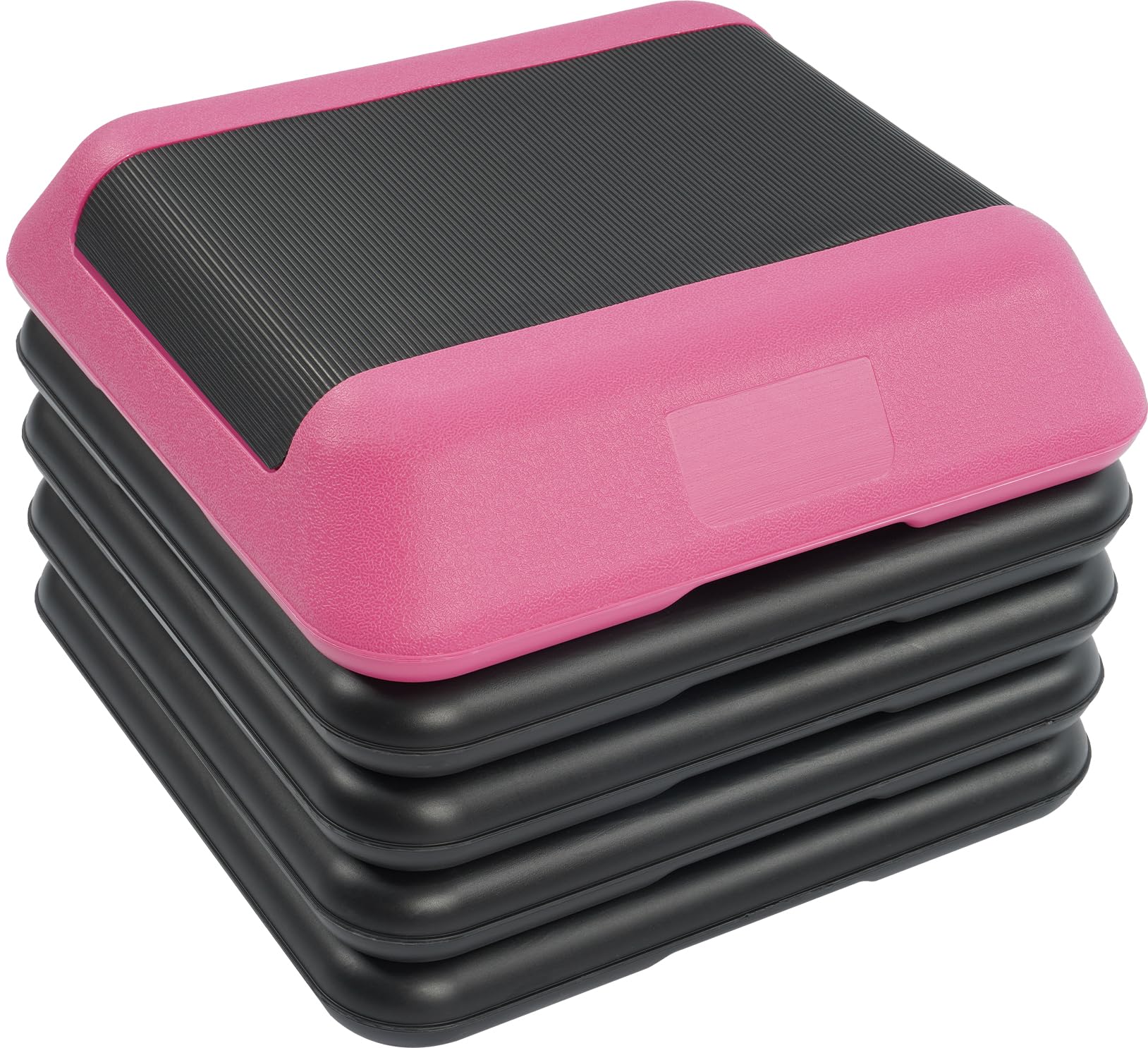
The risers on the Reebok Step click into the deck and lock there, and that single detail is why it is the platform we point most people toward. Several steps here hold their risers by gravity alone, so lifting one means chasing four loose blocks across the floor; this comes up as a single piece. The three settings land at 5.9, 7.9, and 9.8 inches, and the spring-loaded release makes changing them a two-second job.

The deck is long and wide enough that you can follow a routine without staring at your feet, and it lands with no flex or hollow knock underneath. We were also taken with the target zones molded into the surface — faint blocks that give your feet a reference point when you are learning a new combination — and the non-skid feet held on a wood floor through fast intervals.

The catch is where the range starts. At just under six inches, the Reebok's lowest setting is higher than the middle setting on some platforms here, so if you are new to stepping, rehabbing a knee, or simply short, this is not the step to learn on; the Amazon Basics goes lower and the mini Step goes lower still. For everyone else, 5.9 inches is a comfortable working height and 9.8 is enough to make an eight-count feel serious. The deck is long enough that storage takes some planning, since it goes under a bed or against a wall rather than on a closet shelf. Two years of warranty is the longest coverage on this page, which softens the premium a little.

Bottom Line

If you want one step for step class, HIIT, and strength days, this is the one we tell people to buy: locking risers, a wide deck, and no wobble at the top height.

Check Latest Price

Best For Strength step-ups

Our Score 9.4/10
Yes4All High Step Platform

Yes4All

Yes4All High Step Platform

  • Deck Size 16 x 16 in
  • Height Levels 5
  • Height Settings 4, 6, 8, 10, 12 in
  • Weight Capacity 275 lb
Check Price on Amazon

The Yes4All and our Fitvids pick are the same idea executed twice: a 16-inch square platform, four stackable risers, and heights from 4 to 12 inches in two-inch steps. The difference that matters is capacity — 275 pounds here against 400 there — which is worth knowing before you plan deficit deadlifts or heavy split squats on it.

Where it earns its place is on the floor. Each riser carries four non-skid feet, so the stack does not skate on wood and does not leave marks, and at 5.24 kg the whole thing moves from room to room easily. The height range covers the usual round of hip thrusts, step-ups, and elevated push-ups, and a year of warranty is more coverage than the 90 days some steps here offer.

The top is the reason this sits behind the Fitvids rather than beside it. It is a separate mat bonded to the platform, and it can lift at the corners — worth checking along all four edges when the box arrives and worth keeping dry. Set it up where it will live, treat the surface kindly, and it does the job it was bought for.

Bottom Line

A solid second high step, with 12 inches of height in a 16-inch footprint — just check the bonded top mat along its edges when it arrives.

Check Latest Price

Best Full-Size Deck

Our Score 9.2/10
ZENY 43-Inch Step Platform

ZENY

ZENY 43-Inch Step Platform

  • Weight 18.3 lb
  • Deck Size 43 x 16 in
  • Height Settings 4, 6, 8 in
  • Weight Capacity 550 lb
Check Price on Amazon

Gym-length 43-inch deck that costs far less than our top pick.

Forty-three inches of deck changes what you can do on a step. The ZENY gives you a 16-inch-wide platform, wide and deep enough that side steps, grapevines, and fast direction changes do not end at the edge, and it doubles as a bench for chest presses and dips. It is also rated to 550 pounds, the highest capacity in this group, which matters if two people share it or you plan to load it with dumbbells.

That combination is why we think it is the best value here for pure cardio work. The risers are the trade-off: they sit in recesses under the deck without snapping, so lifting the platform leaves them behind. If the step lives in one place you will never notice; if you put it away after every session, carry the deck and the risers separately and it stays civil. Four risers give it heights of 4, 6, and 8 inches, which covers most routines without going high enough for power work.

At 18.3 pounds it is the heaviest platform we recommend, and moving it is a two-hand job. What you get in return is gym-level rigidity: the deck does not flex under a fast landing, and the surface has enough texture to grip a shoe. It is the platform we leave set up.

Bottom Line

The longest deck here for far less than our top pick — the one to buy if your workouts are all cardio and you want gym-sized room underfoot.

Check Latest Price

Best High Step

Our Score 9.2/10
Fitvids Step Platform

Fitvids

Fitvids Step Platform

  • Deck Size 16 x 16 in
  • Height Levels 5
  • Height Settings 4, 6, 8, 10, 12 in
  • Weight Capacity 400 lb
Check Price on Amazon

Stacks to 12 inches for step-ups and hip thrusts without taking over the room.

Sixteen inches square is the entire footprint, so think of the Fitvids as a high step rather than a dance floor: step-ups, split squats, hip thrusts, box jumps, elevated push-ups, and anything else where you load one leg and want a taller box. The platform takes four risers and climbs from 4 inches to 12 in five two-inch steps, the same range as the other square platforms here.

It is rated to 400 pounds, more than the other high steps in this guide, and at 12 pounds it moves with one hand. The risers press firmly into the deck; a couple needed a solid push to seat the first time, which is a one-time nuisance rather than a lasting one. The top is textured plastic with a raised pattern, and each riser carries non-skid feet so the stack stays off your floor.

What sold us is how little it gives up at the top of its range. At 12 inches it stands as planted as it does at four, and that steadiness is what makes it useful for loaded work as well as cardio — the difference shows up the moment you add weight or land hard. When the workout ends, all four risers fit beneath the deck, so it tucks into the corner of a room with no space for a bench.

Bottom Line

The high step we recommend for step-ups, hip thrusts, and box jumps: 12 inches of height, a 400-pound rating, and risers that store underneath.

Check Latest Price

Best for Small Spaces

Our Score 9.2/10
The Step Mini Platform

The

The Step Mini Platform

  • Weight 3.51 lb
  • Deck Size 18 x 11 in
  • Height Settings 3, 5 in
  • Weight Capacity 330 lb
Check Price on Amazon

Carry it in one hand and stash it under the bed; 330-pound capacity.

Eighteen inches long and 11 wide is small for a step and generous for a footstool, which tells you what this Freestyle platform is for: single-step work, calf raises, balance drills, and the physical-therapy exercises people do beside a bed or a kitchen counter. The two heights are 3 inches and 5.

What we appreciate is how completely it disappears between sessions. It weighs 1.59 kg, the risers nest into the underside so it carries as one piece, and it slides under a bed or behind a couch without a second thought. It is rated to 330 pounds, which is more than the footprint suggests, and the top is a molded grip pattern rather than a bonded mat, so there is no edge to peel.

The catch is the way it holds together. The risers sit in the base without a lock, and lifting the platform by one edge can leave them on the floor mid-carry. Carry it flat with both hands, or set it up once and leave it, and the problem never comes up. On carpet it sits dead flat and does not creep, which is more than some larger platforms here manage.

Bottom Line

We recommend this one for travel, tight apartments, and therapy drills: an 18-inch platform with two heights, a 330-pound rating, and almost no floor presence.

Check Latest Price

Best Budget

Our Score 9.0/10
Amazon Basics Step Platform

Amazon Basics

Amazon Basics Step Platform

  • Deck Size 26.8 x 11 in
  • Riser Sizes 4 in and 6 in
  • Height Levels 2
  • Weight Capacity 400 lb
Check Price on Amazon

Two heights, a 400-pound rating, and risers that store under the deck.

This is the least expensive route onto a full-length step we tested, and nothing about it feels like a shortcut on the basics. The deck measures 26.8 by 11 inches, the two risers take it to 4 or 6 inches, and it is rated to 400 pounds — more capacity than several pricier platforms here. The risers clip into the base for transport, the feet are non-skid, and the top has a molded texture rather than a mat, so there is no edge to lift.

Where it stops is height. Six inches is the ceiling, which makes this a beginner's and intermediate platform rather than the one for advanced classes or for anyone who wants eight inches for power work. As a first step, a spare for a partner, or a physical-therapy tool for standing drills and balance work, we think it is the sensible buy; just do not expect it to grow with you past the intermediate stage.

Bottom Line

The best value here: a full-length deck, two heights, and a 400-pound rating for less than any other full-size pick.

Check Latest Price

Best For Compact circuit routines

Our Score 9.0/10
Freestyle Step Circuit Platform

Freestyle

Freestyle Step Circuit Platform

  • Deck Size 28.5 x 14.5 in
  • Height Levels 3
  • Risers Included 4
  • Weight Capacity 275 lb
Check Price on Amazon

Fourteen and a half inches of width is the number that matters here. That is three and a half inches more deck side-to-side than the budget steps in this guide, and it is the difference between a cautious side step and a full one. The length is 28.5 inches, which puts this squarely in circuit-step territory rather than gym-step.

Four risers give it three heights starting at 4 inches, the deck is rated to 275 pounds, and there is a notch at the edge for a resistance band — a small feature that makes lateral band walks possible without a door anchor. At 5.04 kg it shifts around the room between sets without complaint.

Grip is the part to plan for. The textured top is fine in shoes, but on smooth wood or tile the platform can skate, and the fix is a mat underneath rather than a different step. On carpet we had no complaints.

What you are buying is a compact circuit step. At 28.5 inches it is more than a foot shorter than the 43-inch ZENY, and any routine built on wide grapevines will feel abbreviated. If you have the floor space and want the full-length feel, spend the extra on the ZENY; if you want a wide deck that stores against a wall, this earns its place.

Bottom Line

Worth it if you want a wider deck than a budget step without paying gym-step money, as long as you are not expecting full-length choreography.

Check Latest Price

How We Tested These Step Platforms

We built the shortlist from platforms that turn up again and again in studio step classes and physical therapy clinics, then read specs and customer reviews to cut anything with a vague weight limit, a smooth untextured top, or risers that don't positively click into place. That left 14 platforms, which we used for four months across living rooms, basements, and garages — on carpet, hardwood, and rubber mats.

Height changes got timed with a stopwatch, because I wanted to know whether adjusting mid-workout was realistic or a two-minute detour; a few took under ten seconds per riser, while others needed both hands and a knee on the floor. Each one got the same treatment: step-ups in sneakers and in socks, side steps, a deliberate sideways push mid-step to see if the base slid, and a seated set to check whether it worked as a bench. We measured the usable surface length to see which platforms fit a full foot and which forced a half-step, and noted which footprints were small enough to slide under a couch.

Over the four months we kept checking the details that fail quietly — riser clips that loosen, corners that flex under a heavier user, tops that scuff or turn slick once sweat soaks in. We weighed what each platform cost against what it actually did, and the priciest ones weren't the steadiest; a couple of modest models handled everything we threw at them and are still in weekly use.

How to Choose

Deck length decides the workout, not the photo

The most useful number on any step listing is the length of the deck. A 43-inch platform is gym size: it supports a full grapevine and doubles as a bench for chest presses and dips. The 26- to 28-inch platforms here are circuit steps — fine for basic combinations and step-ups, cramped the moment you move sideways. A 16-inch square is a high step, built for loading one leg at a time.

Photos flatten that difference. A compact step shot head-on looks exactly like the one in your class. Read the length before you read anything else, and be honest about whether you follow choreography or just want a box to step onto.

Locking risers versus loose stacking

Risers either click into the deck or simply stack beneath it. Click-locks cost more and are worth it if the step has to be moved or put away after every session, because the whole platform comes up as one piece. Stacked risers separate the moment you lift the deck, which turns setup into a four-part assembly.

Look at the increments too. Some platforms offer only 4 and 6 inches; others climb from 4 to 12 in two-inch steps. If you plan to progress, the finer range gives you somewhere to go that isn't a jump of two inches at once.

Where the range starts matters more than where it ends

Beginners and anyone rehabbing a knee need a genuinely low first step — four inches, or three on a mini. Several good platforms here start at nearly six inches, which is already a working height for most people. Advanced steppers want eight inches or more, and a few platforms top out before that.

Check both ends of the range against the person who will use it most. Buying a platform you only ever use at one height means paying for risers that stay in the closet.

The top surface and the weight rating

Molded, textured plastic tops don't peel. Bonded mats eventually can, especially at the corners, so give a new step a look along its edges before the first workout. Grip is a separate question: on smooth wood or tile, the feet under the platform matter more than the pattern underfoot, and a yoga mat stops the creeping.

Then the rating. Most platforms here are rated between 275 and 550 pounds. If two people share the step, or you plan to load it with dumbbells or a bar, buy on that number rather than on how sturdy it looks in the photo.

Frequently Asked Questions

Final Verdict

Buy the Reebok if you want one platform for everything. The click-lock risers and the wide deck are what the extra money buys, and they are the difference between a step you drag out and one you use four times a week.

Two situations change the answer. If your sessions are all cardio and the step can live in one place, the ZENY gives you a much longer deck for far less money. If your training is step-ups, hip thrusts, and box jumps rather than choreography, skip both and take the Fitvids high step.