Cardio Machines

Best Spin Bikes of 2026

A spin bike earns its floor space only if it’s quiet enough for early rides, stable when you stand to climb, and comfortable enough that you’re not shifting on a too-wide, too-narrow, or too-hard seat by minute 40. The spec sheet won’t tell you any of that. Over the past six months, I lived with seven spin bikes, and my team put each through assembly, daily rides, and the cleaning and adjusting that comes with routine use.

What separates a good bike from a frustrating one is usually the stuff you notice after week one: whether the seat suits your body, whether the bolts stay tight, whether the frame stays planted when you sprint, and whether the adjustments hold where you set them. We compared all seven on build quality, assembly, quiet operation, and long-term reliability, weighing each against what it costs. The picks below are built around how you’ll actually ride at home.

Best Overall

Our Score 9.0/10
Schwinn IC4 Indoor Cycling Bike

Schwinn

Schwinn IC4 Indoor Cycling Bike

  • Footprint 54.6"D x 30.7"W
  • Resistance Magnetic, 100 micro-adjustable levels
  • Connectivity Bluetooth; Peloton and Zwift compatible
  • Weight Capacity 330 lb
Check Price on Amazon

Gym-grade stability, 100 magnetic steps, and Bluetooth that pairs with Peloton and Zwift.

Two things separate the IC4 from the cheaper bikes here, and both show up the moment you ride to a class instead of just pedaling: Bluetooth that pairs with Peloton and Zwift, and magnetic resistance split into 100 micro-adjustable steps. On a 30-second surge you can add two clicks and hold your cadence instead of jumping from easy to a wall.

The frame is the other half of the argument. At 112 pounds with a 330-pound rider rating it doesn't rock when you come out of the saddle, and the belt drive keeps it quiet enough for an early ride in a shared apartment. We rode standing climbs and sprint intervals on it and never once thought about the floor underneath.

The console is the weakest part of the package. It reads like hardware from a decade ago, and the numbers that matter in a class — output, cadence against a target — come from the app on your tablet, not from the screen. Assembly is a proper unassembled-carton job, pedals and all, so give it an evening rather than twenty minutes.

This is the bike we buy ourselves when intervals are the point: nothing else here combines a gym-grade frame, real app compatibility, and resistance fine enough to follow a coach's call. Schwinn backs the frame for 10 years, which softens the premium. And a small thing we appreciated — the pedals take clip-in cycling shoes or plain sneakers, so one pair of shoes doesn't lock the rest of the household out.

Bottom Line

If you want a home bike that behaves like the one in the studio and talks to the app you already pay for, this is the one we point you to.

Check Latest Price

Best Value

Our Score 9.0/10
CHAOKE 520A Exercise Bike

CHAOKE

CHAOKE 520A Exercise Bike

  • Footprint 32.3"D x 19.2"W
  • Resistance Magnetic, 100 levels
  • Item Weight 48 lb
  • Weight Capacity 300 lb
Check Price on Amazon

Quiet, smooth magnetic resistance and easy assembly for a fraction of the top pick's price.

The question with a bike at this price is what got left out, and on the 520A the answer is the electronics. The money went into the parts that decide how a ride feels: 100 levels of magnetic resistance, a 300-pound frame, and a belt drive that keeps the noise down to your own breathing.

Assembly is genuinely a half-hour job. Most of it arrives built, and what's left is the stabilizers, the seat post, the bars, and the console. We can't say that about every bike in this roundup, and it's the difference between riding the same night and riding next weekend.

At 48 pounds it weighs less than half of our top pick, which you notice when you wheel it into a corner rather than when you're on it. The H-frame stays level through seated intervals, the 32.3-by-19.2-inch footprint slides into spaces the big bikes can't use, and the seat and bars cover riders from about 4-foot-8 to 6-foot-1. Check the handlebar collar after the first week; a post that isn't fully seated will rock under hard pulls.

For most people building a first cardio corner, this is the bike we hand them. It does the two things that actually matter — resistance that ramps smoothly and a frame that doesn't announce every pedal stroke to the neighbors — and it runs on batteries, so it doesn't need to live near an outlet. That last point buys more placement freedom in a small room than it sounds like it should.

Bottom Line

The bike we hand most first-time buyers: smooth magnetic resistance and a quiet frame without paying for electronics you'll cover with a tablet.

Check Latest Price

Best for Guided Workouts

Our Score 9.0/10
MERACH S26 Exercise Bike

MERACH

MERACH S26 Exercise Bike

  • Resistance Magnetic, 8 levels
  • Item Weight 62 lb
  • Weight Capacity 300 lb
  • Rider Height Range 4'8" to 6'2"
Check Price on Amazon

Coached sessions in Merach's own app on a quiet, stable frame that fits tall riders.

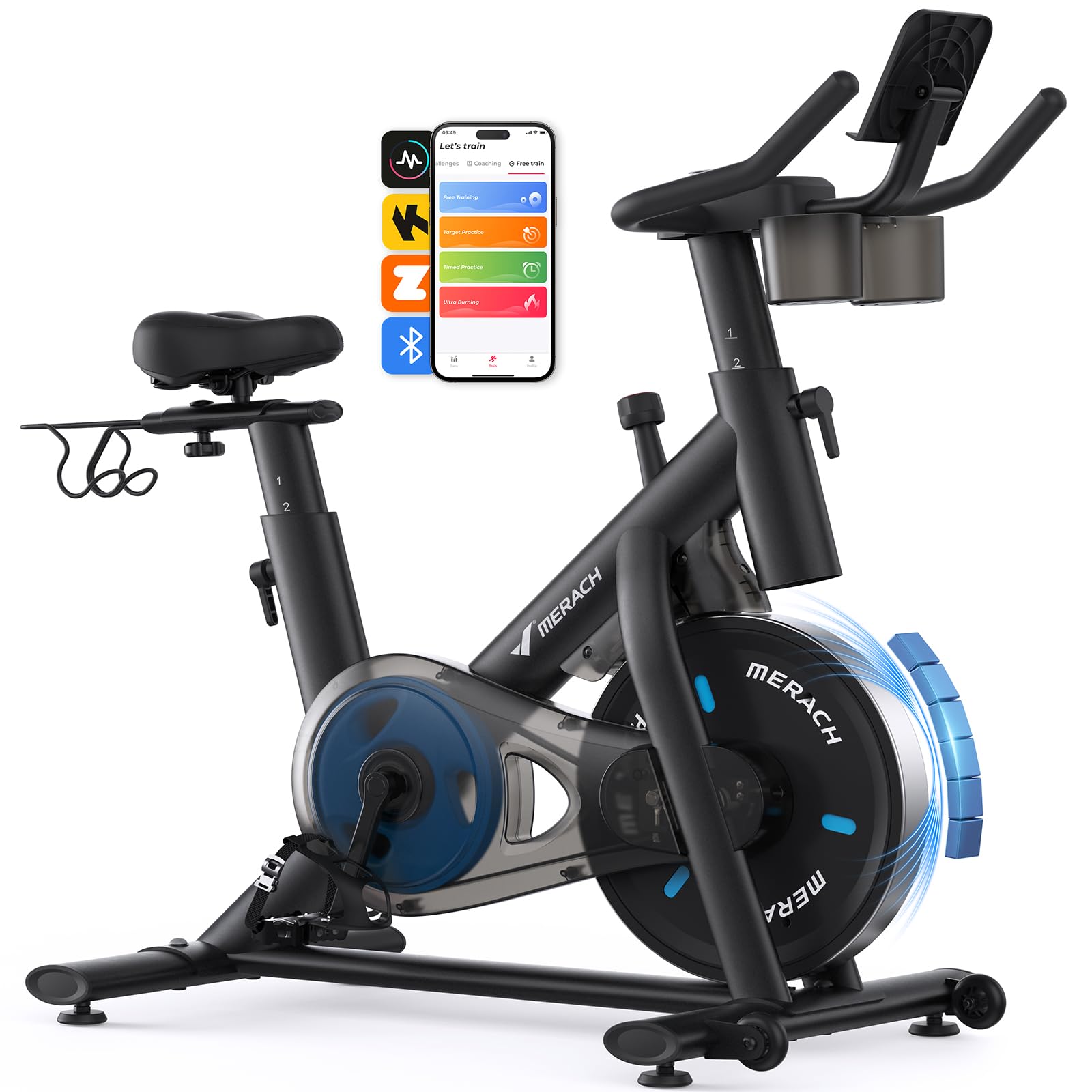
Merach built its own app for the S26, and it's more than a line on the spec sheet: coached sessions, a running log of your rides, and metrics pulled off the bike in real time. App compatibility usually means a paired number you look at once; this one actually runs the workout.

We point riders who want structure — someone who follows a coach rather than freestyling — at this one. Sixty-two pounds of reinforced inverted-triangle frame sits still under a standing effort, the belt drive stays quiet enough for a pre-dawn ride, and the two-way bars and four-way seat cover riders from 4-foot-8 to 6-foot-2.

What you're paying for beyond the app is a bike that behaves: a 300-pound rating, a battery-powered monitor so there's no cord to route across the floor, and a frame that doesn't wander when you stand up. The app keeps the record — sessions, time, the metrics the bike reports — so a 20-minute ride leaves evidence you can look back at instead of disappearing.

Bottom Line

For a rider who wants a coach in the room rather than another screen of numbers, this is the bike we recommend first.

Check Latest Price

Best for Small Spaces

Our Score 9.0/10
YPOO BC710 Exercise Bike

YPOO

YPOO BC710 Exercise Bike

  • Footprint 32.9"D x 19.3"W
  • Resistance Magnetic, 16 levels
  • Item Weight 44 lb
  • Weight Capacity 300 lb
Check Price on Amazon

The smallest, lightest full-featured bike here; it fits a one-bedroom and moves easily.

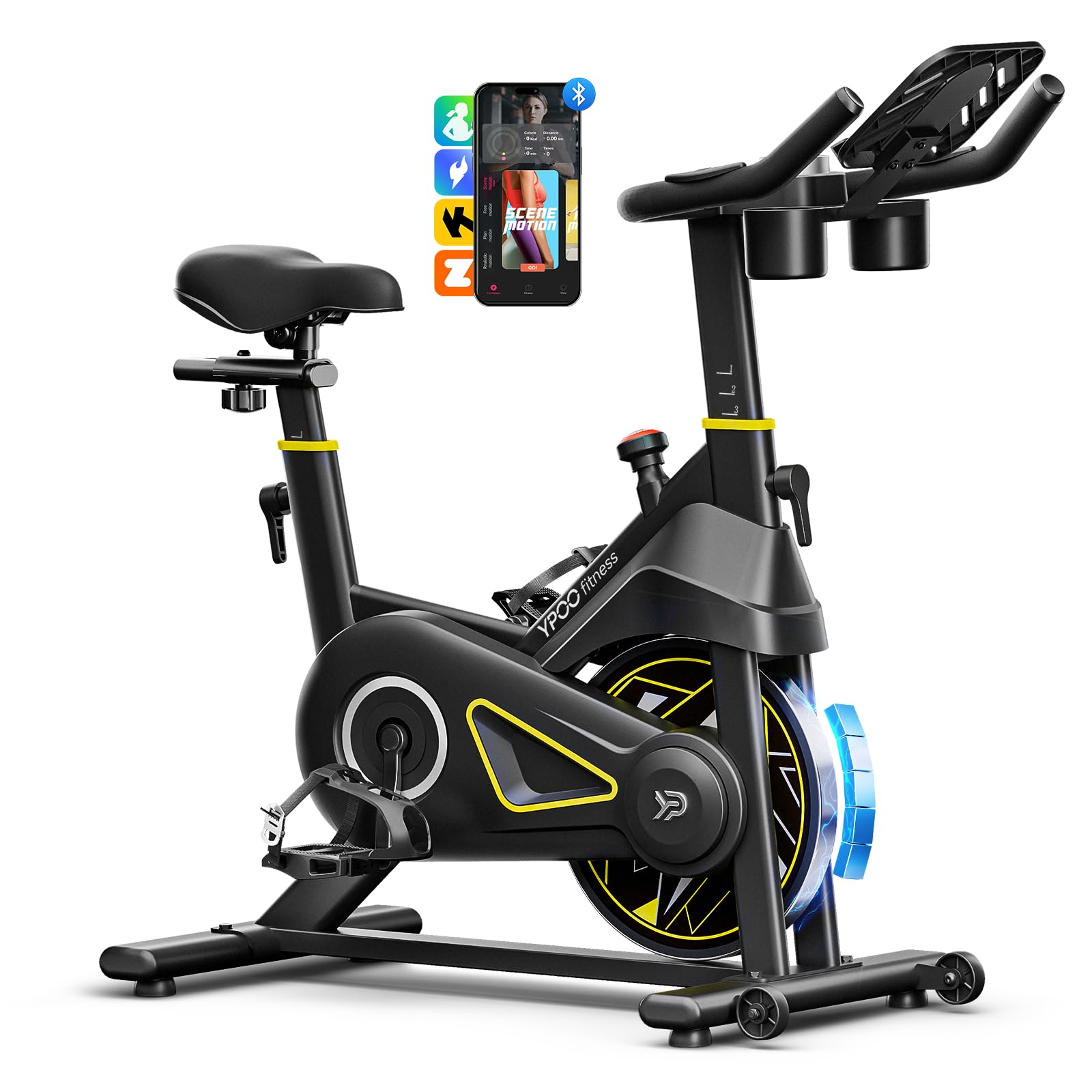
At 32.9 by 19.3 inches and 44 pounds, the BC710 is the smallest and lightest bike here that still has a full spin-bike layout, and that's the entire case for it: it goes where a 112-pound studio bike can't, and one person can lift it onto its wheels and tuck it beside a dresser.

What we didn't expect at this weight is how complete the spec is. Sixteen magnetic resistance levels, a 300-pound rating, a belt drive rated to run under 25 decibels, and support for both YPOO's own app and Kinomap or Zwift. It ships 80 percent assembled, so the remaining work is a short round of bolts.

Forty-four pounds doesn't plant like a hundred and twelve, and if your sessions are mostly standing climbs at heavy resistance, one of the bigger bikes here will feel better under you. For seated intervals and steady efforts the difference is small, and the payoff is a bike that doesn't permanently claim a corner of the room.

Bottom Line

For an apartment where the bike has to share a room with everything else, this is the one we choose — light, small, and still properly equipped.

Check Latest Price

Best for Heavier Riders

Our Score 8.8/10
SLUNSE 509A Exercise Bike

SLUNSE

SLUNSE 509A Exercise Bike

  • Resistance Magnetic, 100 levels
  • Item Weight 59.5 lb
  • Weight Capacity 350 lb
  • Rider Height Range 4.8 to 6.1 feet
Check Price on Amazon

The highest rider weight rating here, paired with magnetic resistance and a low price.

Start with the number that decides this one: 350 pounds is the highest rider rating in this group, higher than bikes that cost several times as much. That's a steel frame doing real work rather than a marketing flourish, and it's the reason to look here first.

If you're a heavier rider shopping on a tight budget, this is where we point you. The frame carries 59.5 pounds of its own weight and stays put through a standing climb, magnetic resistance runs through 100 levels on a belt drive, and the seat and handlebars cover riders from roughly 4-foot-9 to 6-foot-1. Front-mounted wheels mean one person can tip it and roll it out of the living room.

Ignore the six-in-one framing in the listing — upright riding, standing work, and a pair of resistance bands clipped to the frame. The bands add nothing a set of dumbbells doesn't, and they are not why anyone should buy this bike. It does pair with Zwift and Kinomap, the console covers the basics, and at this size it stays quiet enough that the pedals are what you hear.

Bottom Line

If you need a bike rated for a heavier rider and the budget is tight, this is the one we'd put at the top of your list.

Check Latest Price

Best for Beginners

Our Score 8.6/10
CURSOR CBE10 Exercise Bike

CURSOR

CURSOR CBE10 Exercise Bike

  • Assembly Under 30 minutes, tool-free
  • Resistance 100 levels of adjustment
  • Item Weight 39.7 lb
  • Weight Capacity 300 lb
Check Price on Amazon

Tool-free assembly in under half an hour, a 300-pound frame, and the lowest price here.

The CBE10's pitch is that you'll be riding within half an hour of opening the box, and the tool-free design backs it up: the main assemblies arrive together and the rest is a short round of bolts. At the bottom of this list's price range, it's the bike we suggest to a first-time buyer who has never assembled anything heavier than a bookshelf.

You're not giving up the essentials. The frame is rated to 300 pounds, resistance runs through 100 steps of adjustment on a belt drive, and there's a mount on the bars so a phone or tablet can do the coaching. The four-way seat gives you seven height settings and fore-and-aft travel, which matters more than any number on the box.

Fit is where cheap bikes usually fall apart, and this one goes lower than most: the seat post starts at 32.2 inches, so shorter riders have somewhere to sit rather than perching on the highest setting. Check your leg extension at the bottom of the stroke before you settle a position, then mark the posts with tape — the second rider in the house will thank you.

Bottom Line

The cheapest bike here is also the easiest to live with on day one, which makes it the pick for a first spin bike.

Check Latest Price

Best For Light use

Our Score 8.6/10
GOFLYSHINE Indoor Cycling Bike

GOFLYSHINE

GOFLYSHINE Indoor Cycling Bike

  • Console LCD, miles only
  • Resistance Friction, 100 levels
  • Item Weight 50 lb
  • Weight Capacity 200 lb
Check Price on Amazon

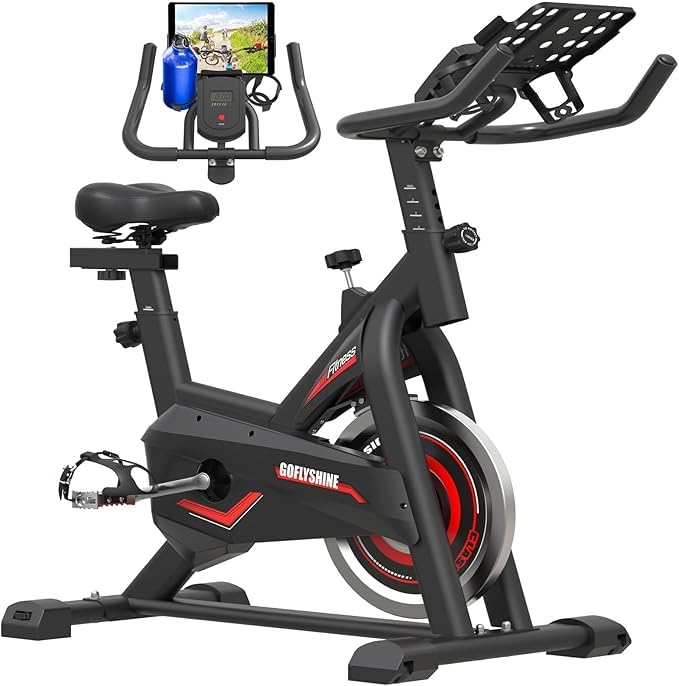
Built-in arm and elbow rests on the handlebars are the one part of the GOFLYSHINE that doesn't feel like a budget decision — they let you drop into a long, low position and take the weight off your wrists on a longer ride. The bars adjust for height, and the frame is 50 pounds of alloy steel.

The rest is honest entry-level equipment: friction resistance across 100 steps, a belt drive, a height-adjustable saddle, a mount for a tablet, and an LCD that reads time, speed, distance, calories, and miles. Miles only, no kilometers — the sort of quirk you discover after the first ride rather than before.

As a first bike for a lighter rider in a small apartment it works, and we were happy to keep it in the corner for seated intervals and steady climbing. Where it runs out of road is intensity: this is a bike for building a habit and holding a rhythm, not for training to a power target, and the frame has less headroom than the rest of this group.

Bottom Line

A serviceable first bike for a lighter rider with limited space, as long as you read the rider limit before you order it.

Check Latest Price

Best For Adjustable fit

Our Score 8.4/10
RELIFE Friction Exercise Bike

RELIFE

RELIFE Friction Exercise Bike

  • Assembly Arrives 80% pre-assembled
  • Resistance Friction, 0-100%
  • Seat Adjustment 6-way adjustable
  • Handlebar Adjustment 6 height levels
Check Price on Amazon

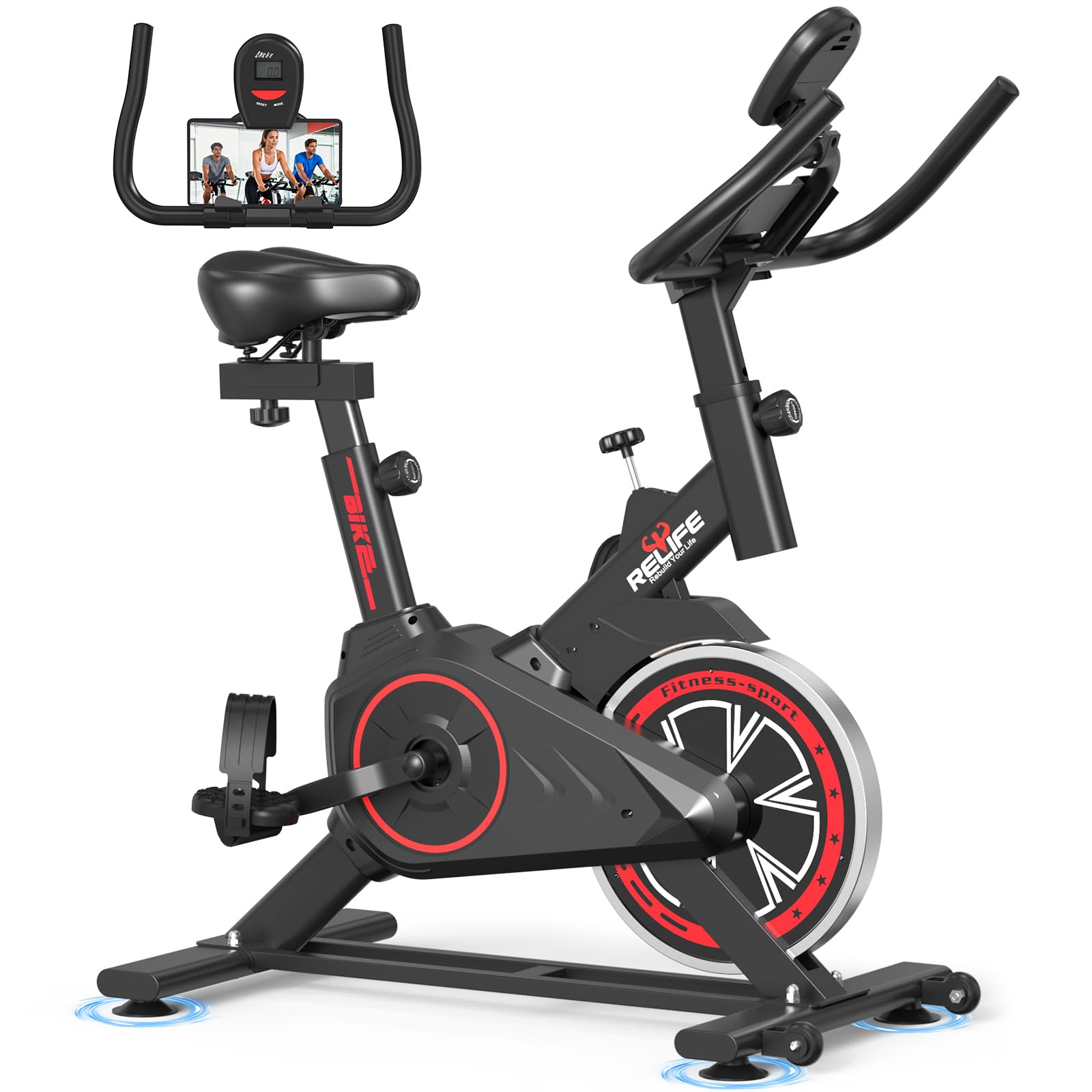
Adjustment is the RELIFE's whole argument: a six-way seat and handlebars with six height settings, more travel than most of the bikes in this roundup give you. That isn't a luxury feature. It's what makes a shared bike tolerable and what keeps a rider with an unusual inseam from perching.

The rest is plain in the way a good tool is plain: a belt-driven flywheel, resistance that runs from nearly free to a full clamp, a base widened and braced into a triangle, and 80 percent of the assembly done before it ships. The resistance dial is the only thing you touch during a ride, and there's nothing to configure before you start.

This is the one we choose when two or three people of different sizes share a bike on a small budget, because the adjustment does the sharing work. Note each rider's numbers once — seat height, seat fore-and-aft, bar height — and resetting between riders takes seconds instead of a fifteen-minute negotiation with a knob.

Bottom Line

For two or three people of different sizes sharing one bike on a small budget, the adjustment range here does the work nothing else at the price does.

Check Latest Price

How We Tested These Spin Bikes

We started by narrowing the field to seven bikes that made sense for a home setting, filtering out models with vague spec sheets, cramped adjustment ranges, or prices that seemed out of step with their components. Then we built each one ourselves in a normal living room, timing the assembly solo and noting where the instructions got confusing or where a second person would have helped. Once assembled, we set the seat and handlebars for riders of different heights, marked the settings, and checked whether they stayed put through repeated rides.

Over six months, every bike stayed in rotation for 45-minute rides, early-morning sessions while the rest of the house was asleep, and standing climbs where we could feel any flex in the frame. We listened for chain, belt, and resistance noise at low and high effort, wiped each bike down after sweaty rides, and checked bolts and pedals weekly to see what loosened. We also paid attention to the seat: width, padding, and whether it stayed comfortable past the halfway point, since that is where cheaper seats tend to announce themselves.

We compared each bike’s ride feel and finish with its price, not just its feature list, and noted which ones felt like a long-term purchase rather than a temporary fix. The bikes that scored best were the ones that stayed quiet, solid, and comfortable after months of use—not the ones that impressed only on day one.

How to Choose

Magnetic or Friction Resistance

Two mechanisms do the work here. Magnetic bikes pull magnets toward a spinning flywheel: silent, with no wearing surface, and easy to divide into as many steps as the maker wants — the Schwinn's 100 levels are the finest in this group. Friction bikes press a pad against the flywheel, which feels smooth but wears and eventually needs replacing.

Step count matters more than mechanism if you follow classes that call resistance out loud. With eight or 16 levels you spend the hard parts of an interval working between clicks; with 100 you can add a hair and hold your cadence. If you ride by feel alone, fewer steps cost you very little.

Frame Weight and Floor Space

A heavier bike feels planted when you stand up: the Schwinn's 112 pounds anchors it, while the 44-pound YPOO still rides well from the saddle. The trade is placement, and placement is the thing people get wrong. Measure the depth you can spare before anything else — the IC4 needs about four and a half feet front to back — then add clearance to swing a leg over and to stand beside the bars.

Treat 'compact' in a listing as a claim about corners, not about ride quality. A bike you have to drag across a rug before every session stops getting used long before it wears out.

Fit and Adjustability

Published height ranges are a starting point, not a promise, because they assume average proportions. What actually matters is how far the seat post travels and whether the saddle slides fore and aft; a four-way seat is worth more than a wide height range, and adjustable handlebars let you change posture on longer rides.

Set the saddle so your knee is almost straight with the pedal at the bottom of the stroke, then watch your hips in a mirror: rocking means the saddle is too high, and reaching means it is too far forward.

What You Need From a Console

Bluetooth that talks to Peloton or Zwift is worth paying for, because it turns a bike into a class. A proprietary app is worth paying for only when it runs decent coached sessions, which Merach's does. Anything else on the screen becomes decoration the moment you set a tablet on the mount.

Decide which rider you are before you spend. Someone who follows classes needs connectivity and a stable frame underneath it; someone who watches television while pedaling needs a quiet belt drive and nothing more.

Budget for a New Saddle

Nearly every bike here arrives with a firm, narrow saddle, and the discomfort of the first weeks is usually break-in and fit rather than a defect. Standard rails mean almost any replacement fits, so plan on swapping if a week of regular riding does not settle things, and try padded shorts first.

The rest of the upkeep is small: re-check every bolt after the first week, then once a month, because a loose handlebar collar is the usual source of a wobble.

Frequently Asked Questions

Final Verdict

If you're going to ride to a class, the Schwinn IC4 is the one: 100 magnetic steps, Bluetooth into Peloton or Zwift, and a 330-pound frame that doesn't flinch when you stand up. Its console is dated and its footprint is the biggest here, and neither has ever made us want a different bike.

On a tighter budget, the CHAOKE 520A gets the resistance and the quiet right for a fraction of the price. If the rider is closer to 350 pounds than 300, start with the SLUNSE 509A instead — that rating is the reason to choose it.