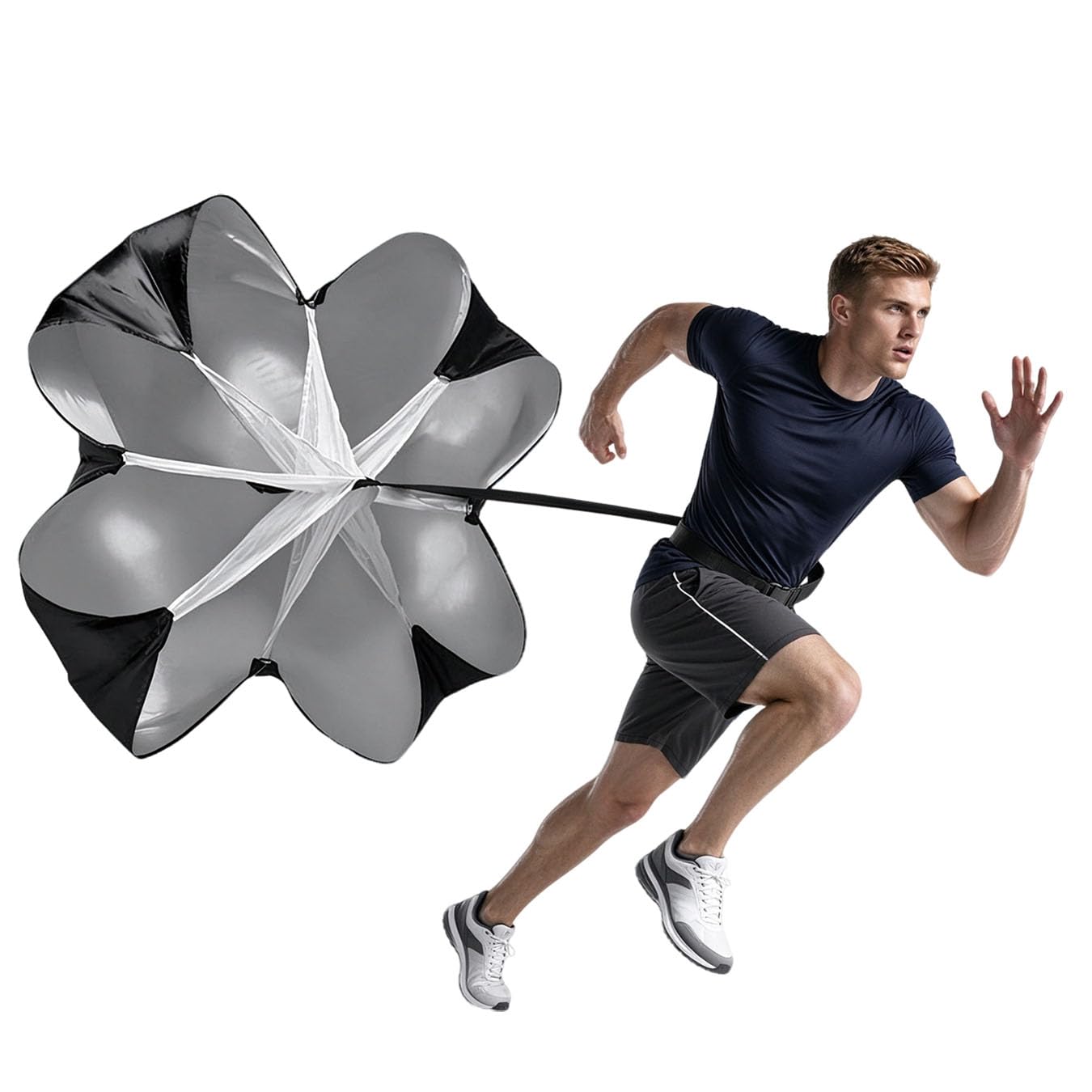
Accessories

Best Speed Parachutes of 2026

A speed parachute looks simple—a chute, a waist belt, a few cords—but the wrong one can turn every sprint into a tug-of-war. The right chute adds resistance smoothly, stays centered behind you, and lets you drive through the run without breaking your stride. That matters if you're chasing a faster 40-yard dash, building late-race strength, or adding a new challenge to your workout. A good parachute makes short sprints purposeful; a flimsy one just wastes your time.

Over three months, my team and I ran 14 speed parachutes through sprint sessions, acceleration drills, and sport-specific workouts. We noted how smoothly resistance built, how stable each chute stayed at top speed, and whether seams, cords, and belts held up after repeated use. More drag was not automatically better—the best chutes gave us adjustable, even pull without throwing off our mechanics, and they fit different training plans without feeling like a compromise. Value mattered, but only after construction, durability, and overall quality earned their keep. The picks below are the ones we kept reaching for.

Best Overall

Our Score 8.8/10
SKLZ Speed Chute

SKLZ

SKLZ Speed Chute

  • Buckle Quick-release
  • Canopy Size 54 inches
  • Belt Rotation 360 degrees
  • Tension Supported 15 lb
Check Price on Amazon

The most convincing all-around chute for adult sprinters, with a swiveling belt.

The 54-inch canopy and 360-degree swivel belt are what make the SKLZ Speed Chute our default for adult sprint work. The belt's free-motion ring lets the chute pivot as you change direction instead of yanking across your waist, and the quick-release buckle means you can stop a rep without fighting the harness. We paid close attention to that hardware because a parachute is only useful if it stays oriented and lets you bail out cleanly.

At speed, the drag builds naturally. The chute is rated for up to 15 pounds of tension, which is enough to feel in short accelerations without turning every rep into a tug-of-war. We like the adjustable belt for sharing across a group, and the 54-inch canopy sits in a useful middle ground: more drag than a 48-inch kids' chute, less bulk than a 56-inch canopy when you are folding it into a bag.

The caveat is durability at the connection point. A chute like this lives or dies by the stitching where the line meets the canopy, and that is the area we inspect before each session; if it starts to fray, stop using it. The SKLZ also costs more than the budget chutes, and we think the hardware earns that step up for someone who trains regularly rather than a casual toy. For most adult sprinters, the 360-degree belt and quick-release buckle are the details that make it the one to beat here.

Bottom Line

We recommend the SKLZ Speed Chute for adult sprinters who want a secure, quick-release belt and a canopy that handles real acceleration work; it is the most complete package here.

Check Latest Price

Best for Young Athletes

Our Score 8.6/10
BULLETSHAKER 48-Inch Chute

BULLETSHAKER

BULLETSHAKER 48-Inch Chute

  • Included Carrying bag
  • Canopy Size 48 inches
  • Designed For Kids
  • Belt Rotation 360 degrees
Check Price on Amazon

A 48-inch kids' chute that gives young runners real drag without overwhelming them.

The BULLETSHAKER 48-inch chute is built for the youngest sprinters in the group, and that is exactly how we judge it. A full-size 56-inch canopy can overpower a 7- or 8-year-old, spending half the rep on the ground or dragging the belt sideways; the smaller 48-inch canopy gives a young runner enough resistance to feel the work without turning every sprint into a wrestling match. The 360-degree belt is a real plus here, because kids change direction constantly and a fixed belt would twist.

We think this is the right first parachute for a child in youth sports, especially soccer or track, where short accelerations matter more than long sprints. The carrying bag is simple but useful, and the polyester canopy is quick-drying, which matters when a session ends in wet grass. The limits show up when the athlete gets stronger or heavier. This is a youth chute, not a family chute, and we reach for a larger canopy once a teenager is running full-speed repeats.

What we keep coming back to is the size. The 48-inch canopy is the point: it keeps the drill about acceleration rather than equipment management.

Bottom Line

We recommend the BULLETSHAKER 48-inch chute for young athletes who need manageable drag; it is the youth pick we trust most in this group.

Check Latest Price

Best For Lighter resistance

Our Score 8.6/10
LucaSng 48-Inch Chute

LucaSng

LucaSng 48-Inch Chute

  • Sport Running
  • Included Carrying bag
  • Material Parachute cloth and netting
  • Canopy Size 48 inches
Check Price on Amazon

A 48-inch canopy is a different tool, not a lesser one. The LucaSng is the simplest 48-inch chute in this group: parachute cloth and netting, a belt, and a carrying bag. We see it as a useful option for a smaller athlete or for an adult who wants to work on turnover without the heavier pull of a full-size canopy.

That simplicity is the trade-off. The hardware is basic, so we see it as a straight-line acceleration tool rather than a chute for drills with a lot of cutting. If you already know a 48-inch canopy fits your training, it is a clean, low-frills option that is easy to fold and carry. If you want one chute to cover a group, the better belt and buckle on our top picks are worth the step up.

We also like the 48-inch size for younger teenagers who have outgrown a kids' chute but are not ready for a 56-inch canopy. It gives them a visible pull without the full-size sail that can pull them off line. That is a narrow role, but it is a useful one.

Bottom Line

We recommend the LucaSng 48-inch chute for lighter athletes or straight-line acceleration work, provided you do not need the extra hardware of our top picks.

Check Latest Price

Best Budget

Our Score 8.4/10
EastyGold 56-Inch Chute

EastyGold

EastyGold 56-Inch Chute

  • Included Carrying bag
  • Material Polyester
  • Mesh Panel Built in
  • Canopy Size 56 inches
Check Price on Amazon

A full-size chute for casual sprint drills at the lowest price in this group.

The EastyGold 56-inch chute is the budget option we point to when a full-size canopy matters more than a fancy belt. You get the larger 56-inch diameter, a mesh panel, and a carrying bag for the least money in this group. That is the appeal: if you are buying one chute for casual sprint and acceleration drills, or for a growing athlete who may lose interest, the lower cost lowers the stakes.

The canopy is the value here: polyester with a mesh panel, which should dry quickly after a wet session, and resistance that builds with speed. It will feel mild at a jog and stronger in a short sprint. The simple setup is easy to hand to a friend for a drill, and the bag keeps it out of the way between sets. Check the waist fit before you order if you are near the top of a normal adult size.

Our take: this is a sensible first chute or a spare for team drills. The full-size canopy gives it a real job beyond being the cheap option, and the price is what makes it work.

Bottom Line

We recommend the EastyGold 56-inch chute when budget matters and you want a full-size canopy for casual sprint drills; expect a simpler belt.

Check Latest Price

How We Tested Speed Parachutes

To build the shortlist, we started with the parachutes available from established track and field brands, then narrowed by chute size, belt adjustment range, cord attachments, and replacement-part availability. We ruled out models with thin webbing, plastic buckles that slipped under load, and fixed belts that wouldn't fit over winter layers. That left 14 parachutes, which we tested over three months.

Testing happened where speed work actually happens: a grass field after work, artificial turf on weekend mornings, and a rubber track when the weather cooperated. I ran each chute through 10-, 20-, and 40-yard accelerations, longer sprint repeats, and sport-specific drills with training partners. For resistance, I started with the smallest opening and worked up, noting whether the pull came on smoothly or jerked at the waist. For stability, I watched whether the chute stayed centered behind me or swayed side to side at top speed, and whether the belt rotated or rode up.

After every session, I checked construction up close: stitching at the chute seams, cord attachment points, the swivel, and the belt buckle. I looked for fraying, stretched cords, bent hardware, and any sign the chute was losing shape. I also timed how long each took to unpack, attach, and adjust between athletes, and compared that against price to judge value. The chutes that scored best were not always the ones with the most drag; they were the ones that stayed stable, adjusted quickly, and showed no wear after repeated workouts.

How to Choose

Match the canopy to the athlete, not the number

A 56-inch canopy is not automatically better than a 48-inch one. Drag rises with both canopy size and speed, so the same chute that gives an adult a hard pull can overwhelm a young or lightweight runner. For a child in youth sports, start with a 48-inch chute like the BULLETSHAKER or LucaSng; for a regular adult sprinter, a 54- or 56-inch canopy is the more useful default. The test is simple: the athlete should be able to hold sprint mechanics for the whole rep, not just survive the first five yards. If the chute drags them upright or sideways, go smaller.

The belt and buckle matter as much as the canopy

A parachute can have a great canopy and still be annoying to train with. Look for a belt that adjusts widely enough to stay put on the athlete, and a buckle that releases quickly when you want to stop. A 360-degree swivel ring is worth paying for if your sport involves cuts or direction changes; it lets the chute follow the athlete instead of twisting the waist. The SKLZ Speed Chute is the benchmark here, with an adjustable belt and quick-release buckle. If you share the chute across a group, check the waist range before you buy.

Inspect the attachment points, not just the fabric

Most parachute failures start where the line meets the canopy or where the belt attaches, not in the middle of the fabric. Before each session, run the stitching through your fingers and look for fraying, loose threads, or a stretched attachment. A mesh panel helps the canopy dry and can add stability, but it will not save a weak connection. This is also why we treat a torn chute as done: a repair that fails mid-sprint is not worth the risk. If you train several times a week, spend more on the hardware and stitching rather than the biggest canopy.

Use resistance as a tool, not a permanent handicap

Resistance is speed-dependent: a chute that feels mild at a jog will pull harder in a full sprint. That means short accelerations, full recovery, and a surface with enough room to run through the finish are more useful than long, grinding reps. We like parachutes for the acceleration phase and for teaching athletes to push the ground back; we do not use them as a substitute for all speed work. Keep the chute in the bag when the field is crowded, and save it for a clear lane or open grass.

Frequently Asked Questions

Final Verdict

If you want one chute for adult sprint sessions, we recommend the SKLZ Speed Chute. Its 360-degree belt and quick-release buckle make it easier to run, change direction, and reset, and the 54-inch canopy gives you usable drag without the bulk of a full-size sail.

For a young athlete, the BULLETSHAKER 48-inch is the better first chute. If you need the lowest-cost full-size option, the EastyGold is the one to get, provided you can live with a simpler belt.