Tech & Wearables

Best Running Watches of 2026

The worst time to find out a running watch can't keep up is mile 18, in the rain, when the screen fogs over and the battery warning appears. A good one should disappear on your wrist: it locks onto GPS quickly, reads clearly at a glance, survives sweat and showers, and has enough battery for the long run plus the recovery days after. What you're really buying is fewer interruptions — not a second phone strapped to your arm.

Over the past ten months, I've worn eight running watches through easy mornings, track sessions, and weekend trails, and the pattern is clear: the best models get the basics right before adding extras. Battery life you can trust, a case that suits your wrist, a screen you can read with sweaty fingers, and reliable phone and headphone pairing matter more than a long feature list. Build quality and looks count too — a watch that feels cheap or clashes with everything won't stay on your wrist — and value comes down to whether the features you'll actually use justify the price. Below are the ones that earned a permanent spot.

Best for Racing

Our Score 9.4/10
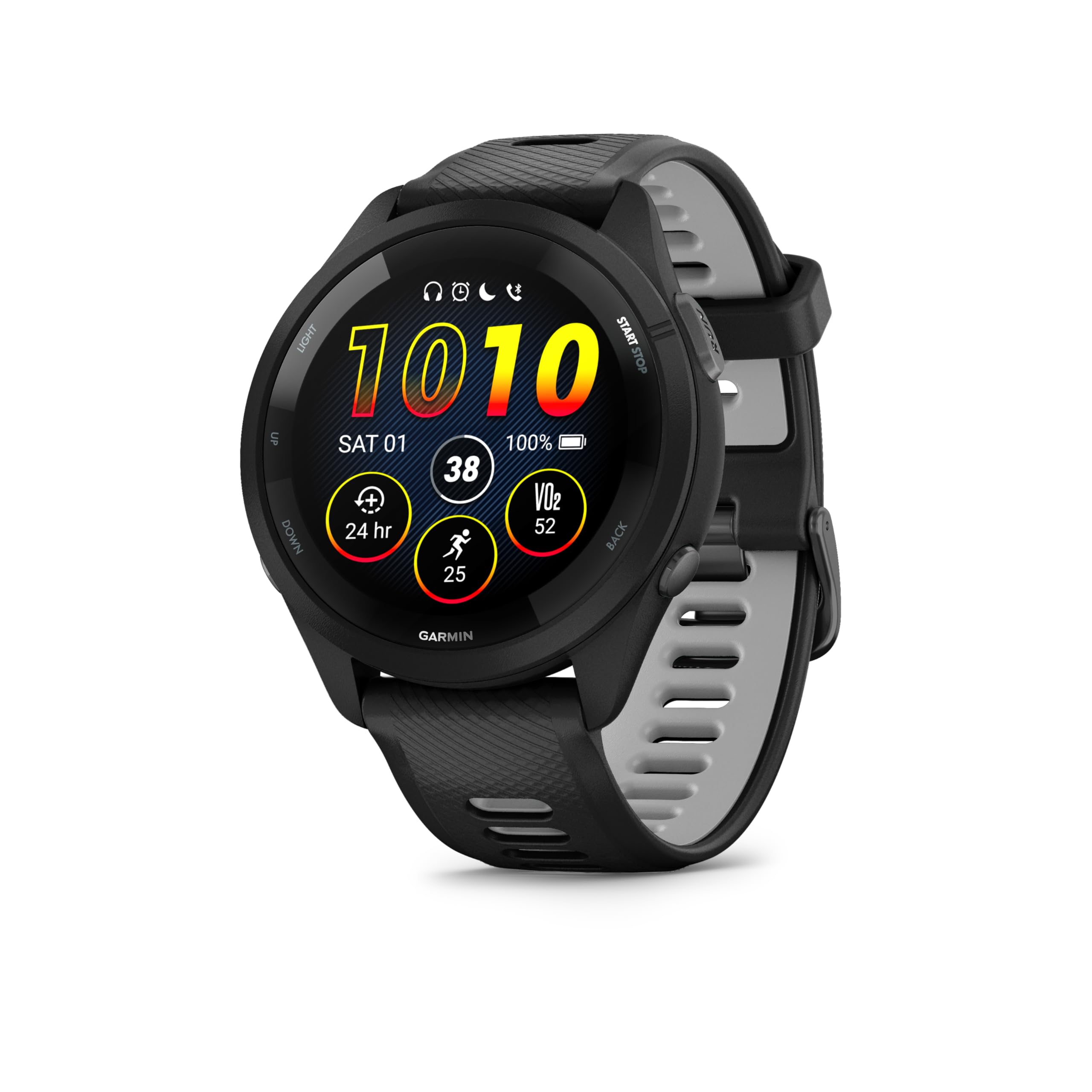
Garmin Forerunner 265

Garmin

Garmin Forerunner 265

  • Display 1.3-inch AMOLED touchscreen
  • Satellite Multi-band GPS
  • GPS Battery Life Up to 20 hours
  • Daily Battery Life Up to 13 days
Check Price on Amazon

Multi-band GPS and training readiness for runners chasing a personal best.

Multi-band GPS is the headline, and it is a difference you notice without staring at the screen: the 265 holds a line through tree cover and between buildings where a GPS-only watch can wander, and the trace afterwards looks like the route you actually ran. The 1.3-inch AMOLED display is a size up from the 165's and readable in low winter sun, and 8 GB of storage carries music so the phone can stay home.

Where it earns the premium is the week before a race. Training readiness folds sleep, recovery, training load and HRV into one number that tells you whether to attack the session or shuffle it, and the race widget lets you load a course and see the splits you need. We found the readiness score the most useful thing on the watch during a build; it is the difference between a data dump and a coach in your ear.

The settings go deep, which is either the appeal or the problem. We spent the first week hunting for lap alerts in sub-menus, and more than one run started with a fumbled button press. The defaults are sensible enough that you can ignore most of it, and 13 days in smartwatch mode, about 20 with GPS, means you are not charging nightly while you learn.

Bottom Line

Worth the step up if you race: multi-band GPS, a readiness score and race-day splits, in a heavier 46 mm case.

Check Latest Price

Best Overall

Our Score 9.2/10
Garmin Forerunner 165

Garmin

Garmin Forerunner 165

  • Weight 1.38 oz
  • Display 1.2-inch AMOLED touchscreen
  • GPS Battery Life Up to 19 hours
  • Daily Battery Life Up to 11 days
Check Price on Amazon

The best all-rounder here: bright AMOLED, guided workouts, and a week-plus of battery.

Plenty of watches will tell you how far and how fast. The Forerunner 165 is the one we point runners toward because it also tells you what to do tomorrow. Enter a race and a date in the Garmin Connect app and the watch starts serving daily suggested sessions that shift with your sleep, heart-rate variability and recent training load; take an easy week and it eases off with you. That coaching is why it takes the top spot here rather than a cheaper watch that only logs distance.

The hardware holds up its end. The 1.2-inch AMOLED panel stays readable at arm's length in direct sun, and Garmin keeps physical buttons alongside the touchscreen, a detail we appreciated most once the weather turned and our fingers were wet. At 1.38 ounces it disappears on the wrist, and sweat, rain and the odd splash are no concern.

Battery is the number to go in with your eyes open. Garmin quotes up to 11 days in smartwatch mode but about 19 hours with GPS recording, the shortest figure among the dedicated watches here. At five or six hours of running a week that works out to a charge roughly weekly, with sleep and HRV data still logging overnight. A run occasionally takes a second attempt to sync to the phone; a manual refresh in the app has sorted it every time.

It is not running-only either: 25+ activity profiles cover swimming, cycling, strength and HIIT, so the days you skip a run still land in the same training-load picture. And the 20 mm band is a standard width, which makes swapping in a nylon strap for race day an easy errand.

Bottom Line

The one we recommend to most runners: guided workouts that adapt to your training, a bright AMOLED screen, and 1.38 ounces on the wrist.

Check Latest Price

Best Battery Life

Our Score 9.0/10
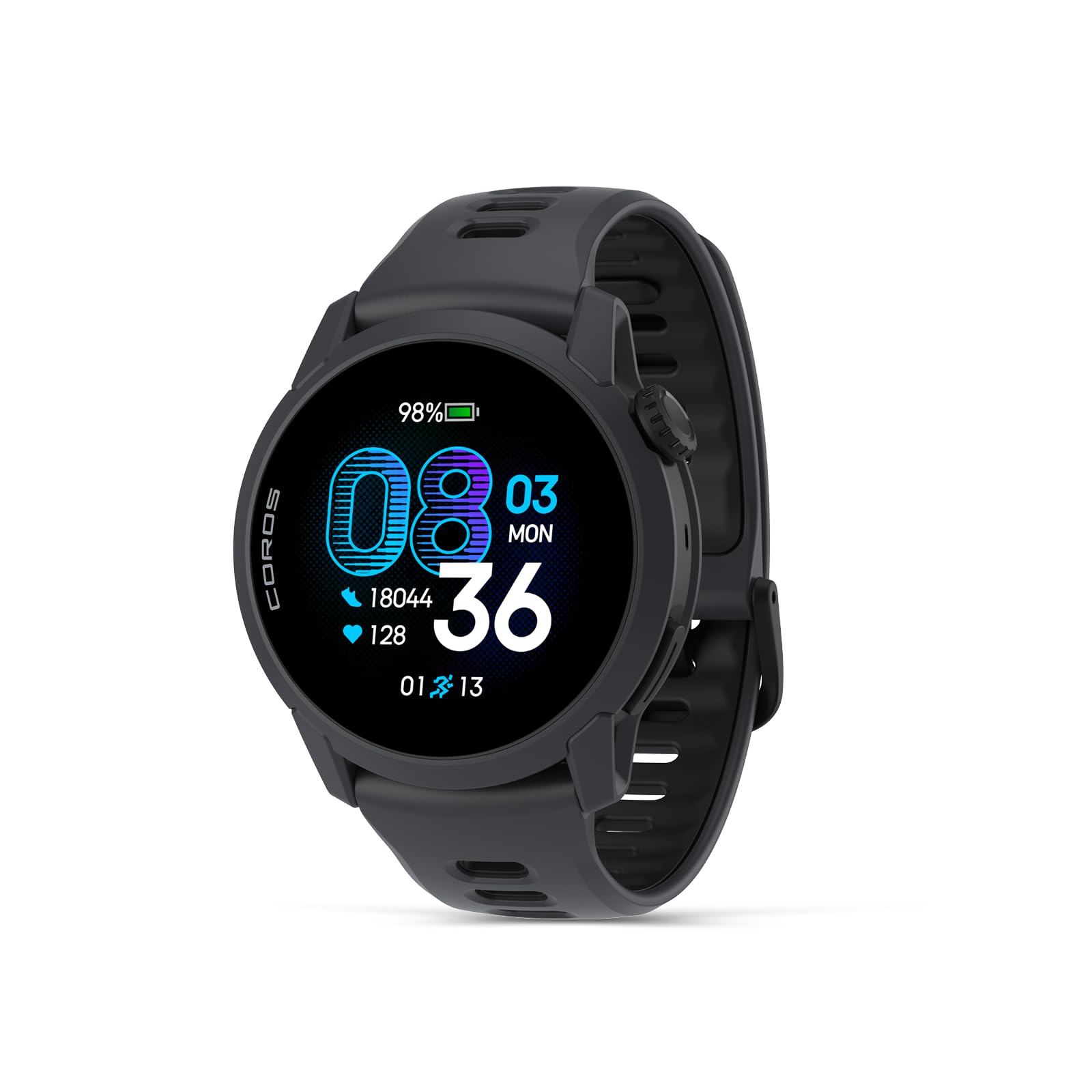
COROS PACE 4

COROS PACE

COROS PACE 4

  • Display 1.2-inch AMOLED touchscreen
  • Case Thickness 11.8 mm
  • GPS Battery Life Up to 41 hours
  • Daily Battery Life Up to 19 days
Check Price on Amazon

41 hours of GPS and 19 days of daily wear in an 11.8 mm case.

Forty-one hours of GPS recording is the figure that stops people mid-sentence: enough for a hundred-mile race with daylight to spare, and more than double what either Garmin here manages. Around the house it runs up to 19 days between charges, which in practice meant we stopped thinking about the charger altogether and plugged it in mostly out of guilt.

The rest of the package is built for the same runner. The case is 11.8 mm thick and light enough to vanish under a jacket cuff; COROS quotes 32 grams with the nylon band, and the silicone version we wore feels barely more. The 1.2-inch AMOLED screen auto-adjusts brightness and stayed legible on a bright morning, and a rotating crown, two buttons and a touchscreen let us change fields with a thumb without breaking stride.

There is a voice-note tool for logging how a session felt, which sounds like a gimmick until you are three hours into a long run and cannot face typing into a phone afterwards. What we have not found is a compromise worth warning you about: GPS traces came back clean, the interface stayed out of the way, and the battery numbers held up.

If your training is already mapped out by a coach or a plan, this is the one here that will not ask to be charged in the middle of a big week.

Bottom Line

Buy it if your longest days outlast everything else here: 41 hours of GPS, 19 days between charges, and almost nothing on the wrist.

Check Latest Price

Best For Casual daily wear

Our Score 8.4/10
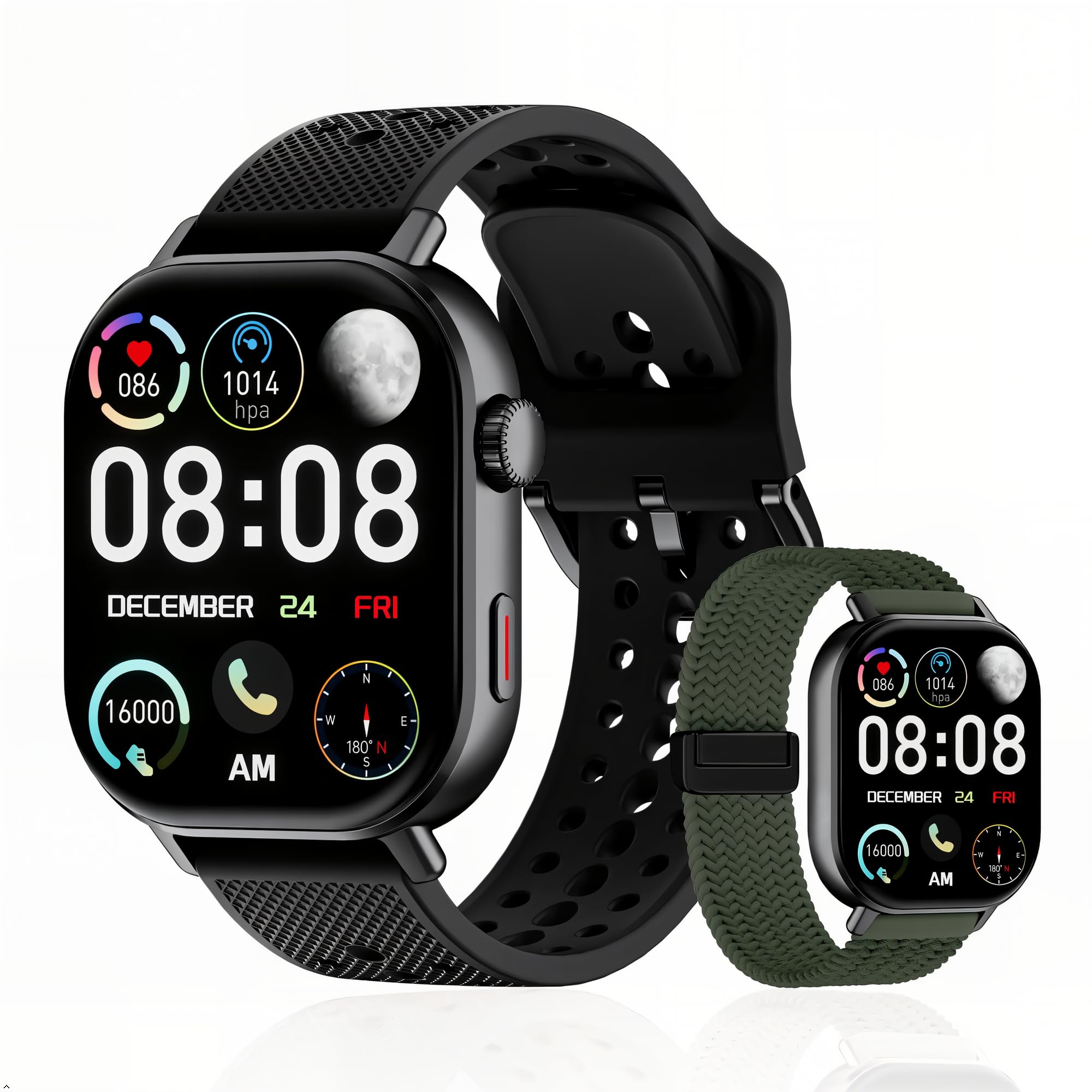
Moutarlier P131

Moutarlier

Moutarlier P131

  • Display 2.06-inch AMOLED touchscreen
  • Sport Modes 170+
  • Charging Time 2.5 hours
  • Water Resistance 50 meters
Check Price on Amazon

The 2.06-inch display is the biggest here by a wide margin, and that is the pitch: giant numerals you can read at a glance, a bright AMOLED panel, and room for notifications that do not get cut off. It is also the first thing you notice on a smaller wrist. The case is bulky and thick, and it wears like a piece of equipment rather than something you forget about.

For a budget watch the feature list is genuinely long: calls and texts on the wrist, an SOS function, 170+ sport modes, GPS pace and distance, 50-meter water resistance and an aluminum case. For someone who wants one big screen for steps, notifications and the odd logged jog, it covers a lot of ground for very little money.

Running is where it thins out. Pace and distance suit a steady jog far better than intervals, and the side button often needs two or three presses to wake the screen, which is exactly the wrong behavior when you are standing at a start line with a watch already running late.

One practical note: a full charge takes about 2.5 hours, so it is an overnight job rather than a top-up before you head out. Plan for that and it keeps up with daily wear without drama.

Bottom Line

A big, bright screen and basic run logging for very little money, best kept for casual wear rather than structured training.

Check Latest Price

How We Tested the Best Running Watches

We started with a shortlist of watches based on specs, price, case size, and the features runners actually ask about — GPS accuracy, battery claims, workout programming, phone notifications, and music controls. From that list, we tested eight watches over ten months. Each one spent at least three weeks on different wrists, from narrow to wide, and we wore them for morning easy runs, track intervals, long weekend trail runs, treadmill sessions, and the ordinary hours in between.

Battery life was logged, not guessed: we recorded the percentage drop on a ten-mile GPS run, noted how many days each watch lasted between charges with daily runs and notifications on, and checked standby drain. To judge the interface and usability, we started, paused, and lapped workouts mid-run with sweaty fingers, read the screen in direct sun, and timed how many taps it took to begin a run. We paired each watch with a phone and headphones, synced activities to training apps, and noted any dropped connections.

Appearance and build quality got the same scrutiny: we checked bezels and straps for scratches, fraying, and odor after sweaty sessions, wore each watch to a desk and out to dinner, and noted whether the case felt bulky under a sleeve or while sleeping. Features were judged by use — programming intervals, following routes, checking heart rate — and value by whether the extras earned their place against simpler models. The watches that scored best were the ones we forgot we were wearing until we needed them.

How to Choose

Decide How Accurate Your GPS Needs to Be

The receiver decides whether your splits mean anything. A standard GPS watch holds a clean line on open roads and park loops; in dense city blocks or under heavy tree cover the trace can zigzag, and you end up with a short mile and a pace you never ran. Multi-band GPS, which the Forerunner 265 carries, is the fix in exactly those places.

If your routes are open and your pacing is broad, the simpler receiver is money better spent on battery. Most runners overbuy here and never notice the difference.

Read the Battery Spec Twice

Nearly every watch here quotes two battery figures that differ by a factor of ten. The big one is smartwatch mode, with notifications on and no GPS. The small one is GPS recording, and that is the number that governs your longest day out.

Add up your weekly running hours and compare them to the GPS figure, then hold the smartwatch figure against your charging habits. Nineteen hours of GPS covers a marathon; forty-one covers a hundred-miler. The trap is buying on the days figure alone and finding out the truth three hours into a long run.

Weight and Case Size Matter More Than They Look

Weight shows up late. A 47-gram watch and a 39-gram watch feel nearly identical in the shop and quite different at mile 20, when the gap turns into an ache or a strap that rubs. Case diameter matters just as much: a 46 mm body on a narrow wrist can overhang the arm and snag on a jacket cuff.

Between two sizes, take the smaller and lighter one. You give up screen area, not training features.

Match the Coaching to How You Train

Every watch here records distance, pace and heart rate. What separates them is what happens between runs. Adaptive daily workouts paired with a readiness score suit runners following a plan who want to be told what to do next, and that pairing is what makes the Forerunner 165 our default.

If you already have a coach or a training app that sets your week, you are paying for advice you will not open. Be honest about which runner you are before you pay for the coaching layer.

Controls and Water Resistance

Touchscreens are fine until your fingers are wet, cold or gloved, which is why the better running watches keep real buttons next to the glass. Look for a start/stop button your thumb can find without looking down, and a lap button that does not need a double press.

On water, 50 meters is the rating to look for if you swim laps. Rinse the watch in fresh water afterwards and keep your fingers off the buttons while you are submerged.

Frequently Asked Questions

Final Verdict

For most runners, the Forerunner 165 is the answer: guided workouts that adjust as you get fitter, a screen you can read in sunlight, and 1.38 ounces that stay out of the way, all at a midrange price. Step up to the Forerunner 265 if you race and want multi-band GPS and a readiness score to plan around.

And if your long days run past 19 hours, the COROS PACE 4 is the one that keeps recording after everything else here has stopped.