Strength & Weights

Best Reflex Punching Bags of 2026

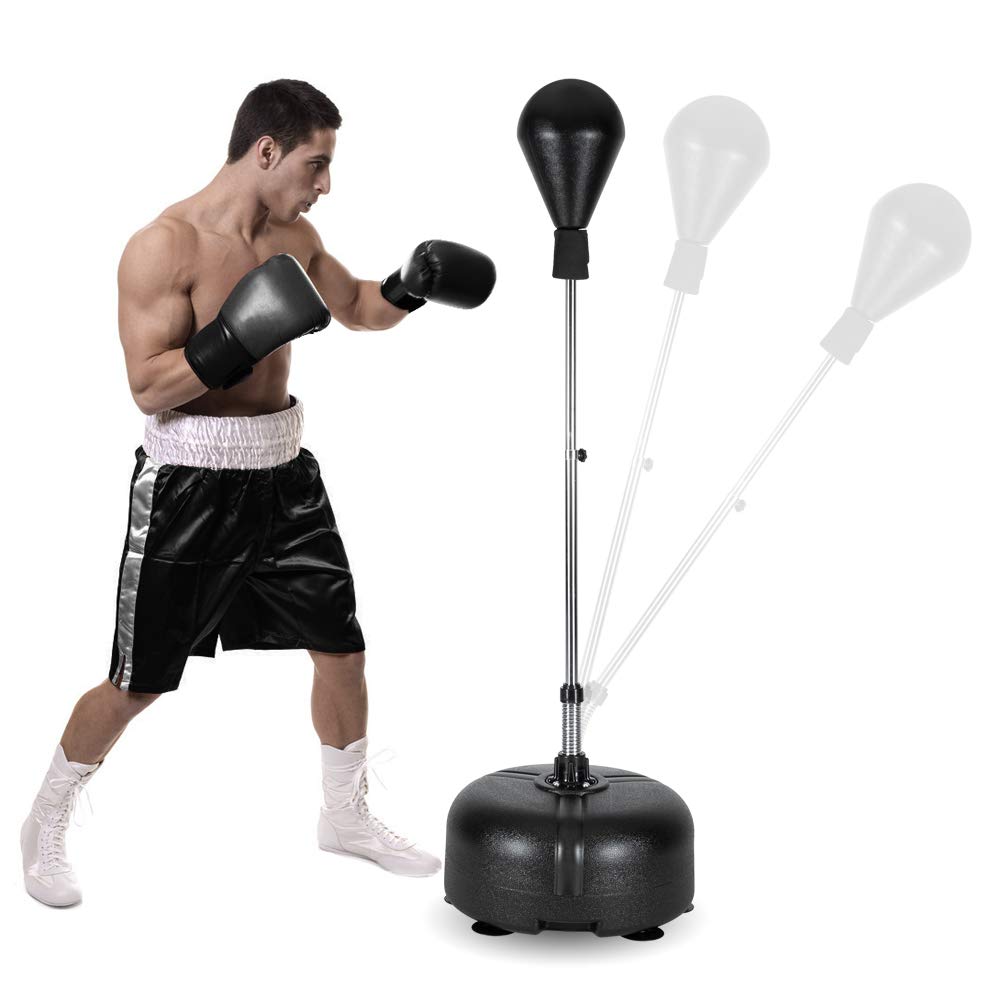
A reflex bag is a simple machine: a spring-loaded arm with a padded target that comes back at you faster the harder you hit it. That return is the whole point — it trains you to keep your hands up and fire again on rhythm instead of resetting between combinations. What separates a good one from a frustrating one isn't the concept. It's whether the base stays put when you sit down on a hook, whether the spring returns on a predictable line, and whether it's still tight after a week of rounds. Get that right and fifteen minutes in a garage beats an hour on a bag that never moves.

I've burned through a couple of cheap ones, and they fail the same way every time — the base creeps, the spring softens, the target starts leaning. My team and I spent six months with 12 bags, filling bases with water and sand, running timed rounds on garage concrete and living-room carpet. The surprise: maximum stability isn't the goal. A bag that can't move gives you nothing to chase.

Best For Small spaces

Our Score 9.0/10
Jukestir Coordination Bag

Jukestir

Jukestir Coordination Bag

  • Length 70 in
  • Diameter 3 in
  • Warranty 10 years
  • Item Weight 3.46 lb
Check Price on Amazon

The first punch doesn't come back the way you expect. The Jukestir hangs from a top tether and is drawn taut by a bottom one, so it slips away from your hand and returns from a slightly different angle every time. It's the only bag here that genuinely feels unpredictable, and that unpredictability is the entire product.

Setup is a five-minute job: an eye screw, two quick links, a top tether and a bottom one, with no sand, water or air to deal with. It costs you no floor space at all. What it does cost you is an anchor, and that rules out a rental, a room with a ceiling you don't want to drill, or anywhere without solid structure above and a fixing point below.

At roughly three and a half pounds with a three-inch foam body, there's no mass behind it. You can't sit down on it with power — the bag gives rather than absorbs — so it trains accuracy, hand-eye coordination and timing rather than conditioning. Bare hands are fine; shoes and knees are not.

Where it wins is as a second trainer. A base-mounted spring bag teaches you to hit a target that comes back on a line; this one teaches you to hit a target that doesn't, which is closer to what a partner does. The ten-year warranty is far and away the longest here, though the foam skin is what rips when it goes, so keep it away from anything with an edge.

Bottom Line

The most fun and least predictable bag here, and the one to choose if you have solid anchors and no floor to spare — not if you rent or want to hit hard.

Check Latest Price

Best for Fast Reflex Work

Our Score 8.8/10
Hayabusa Cobra Reflex Bag

Hayabusa

Hayabusa Cobra Reflex Bag

  • Height Up to 70.9 in
  • Spring High-tension
  • Item Weight 23.5 lb
  • Ball Material Polyurethane
Check Price on Amazon

A high-tension spring and dense ball for experienced boxers chasing hand speed.

The Hayabusa is the most expensive bag in this group, and what the money buys is speed. The spring is high-tension, the ball is dense polyurethane, and the return is quick enough that a lazy jab gets punished. If you already train — even a couple of shadowboxing sessions a week — that's the difference worth paying for.

We spent most of our time with it at chest height, then raised it to see how the target changes. The pole runs up to about 71 inches and adjusts so the ball sits where an opponent's head would be, which sounds like a gimmick until you're working head movement against something at eye level. The ball's density also means bare knuckles are fine; you get a solid, satisfying pop instead of a hollow thud.

It's the heaviest of the freestanding bags at 23.5 pounds, and it sits like it — nothing flexes or rattles when you land clean. The polyurethane cover is denser than the faux leather on cheaper bags, and that cover is the part that usually splits first, so the density should buy you time.

The catch is who it's for. A faster return is harder to read while you're still learning to sit down on a punch, and the softer Ringside is easier to grow with. Buy this one when the reflex bag is replacing gym time, not introducing it.

Bottom Line

An expensive, fast, heavy reflex bag for people who already hit things regularly — the speed is real, and beginners should spend less and learn on something softer.

Check Latest Price

Best for Family Use

Our Score 8.8/10
Everlast Reflex Bag

Everlast

Everlast Reflex Bag

  • Design Spring-mounted pole
  • Warranty 120 days limited
  • Outer Material Faux leather
Check Price on Amazon

Sturdy, quick to assemble, and the one kids and casual users gravitate toward.

Everlast sells this as a reflex bag for boxing and MMA training, but look at how it actually gets used and it's closer to a cardio machine with a target on top. Kids take swings at it, someone does three minutes between sets, and it comes back for more.

We think that's a good thing, and it's why this is the pick for a household rather than a single trainee. The base takes sand and stays put, assembly takes minutes, and the rebound is forgiving enough that a ten-year-old and a parent can both use it without relearning the timing. It's also the easiest of these to talk yourself into for a five-minute session on the way past.

The rebound is the slowest of the freestanding bags here: the ball floats back rather than snapping, which is lovely for bobbing, weaving and footwork and less useful for sharpening hand speed. You can't kick it, and the cover is where wear shows — the ball can start to split from the inside after months of steady use, so a spare bag in the budget is not a silly idea.

What we can't do is check it against your room before it arrives, because Everlast publishes almost nothing about this bag — no height range, no base capacity. You're buying on the reputation and on how many of these are already in garages, which is less than we like on something priced with the premium picks.

Bottom Line

The family bag: sturdy, quick to assemble, forgiving enough for kids and casual cardio, and slow enough that serious boxers should look at the Hayabusa instead.

Check Latest Price

Best Overall

Our Score 8.4/10
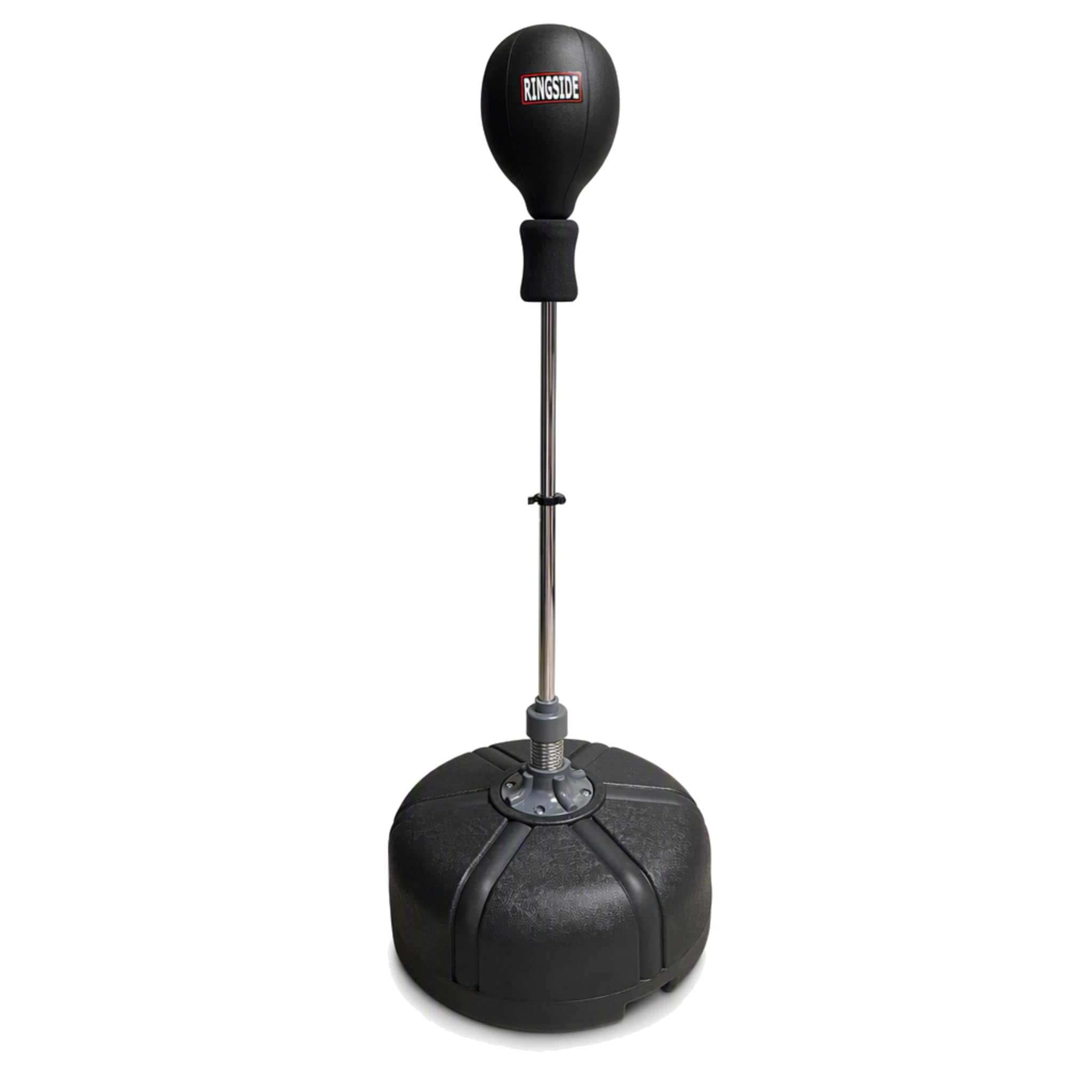
Ringside Cobra Reflex Bag

Ringside

Ringside Cobra Reflex Bag

  • Spring Base-mounted
  • Base Fill Up to 125 lb water or 240 lb sand
  • Item Weight 22 lb
  • Height Range 49–69 in
Check Price on Amazon

The steadiest freestanding bag, with a height range that fits most households.

The spring on the Ringside Cobra sits at the bottom of the pole rather than directly under the bag, and that placement explains how the whole thing behaves. The bag leans away from your punch and swings back on a steady, repeatable arc instead of whipping at your face. The steel pole adjusts from 49 to 69 inches, and the base takes up to 125 pounds of water or 240 pounds of sand.

That combination is why we point most people here. The sand figure is more ballast than any other freestanding bag in this group states, so the base stays put on a garage floor, and the height range means a teenager and a six-foot adult can share it without hitting at waist level. Ringside builds it for light-contact rhythm and aerobic work, which is the right brief: you're training timing and accuracy, not seeing how hard you can hit.

The trade-off is speed. If you already box and want a bag that snaps back before you've reset your guard, this return will feel soft and slow. We also keep an eye on the collar where the spring meets the base — it can work loose over a few sessions and takes seconds to snug back down. That is the entire maintenance list.

Setup itself is quick; filling the base is the slow part, and sand takes patience through a funnel. Do it once in the spot where the bag will live and you won't think about it again. After that the Cobra asks for floor space, a re-tightened collar now and then, and nothing else.

Bottom Line

We recommend the Cobra as the default home reflex bag: a height range that fits a whole household, the heaviest stated base here, and a steady rebound that teaches timing before it tests it.

Check Latest Price

Best Adjustable

Our Score 8.2/10
MaxxMMA Advanced Cobra Kit 2.0

MaxxMMA

MaxxMMA Advanced Cobra Kit 2.0

  • Height Range 52–65 in
  • Base Diameter 17.7 in
  • Balls Included Two sizes
  • Tension Settings Two
Check Price on Amazon

Two ball sizes and two tension settings let one bag follow you as you improve.

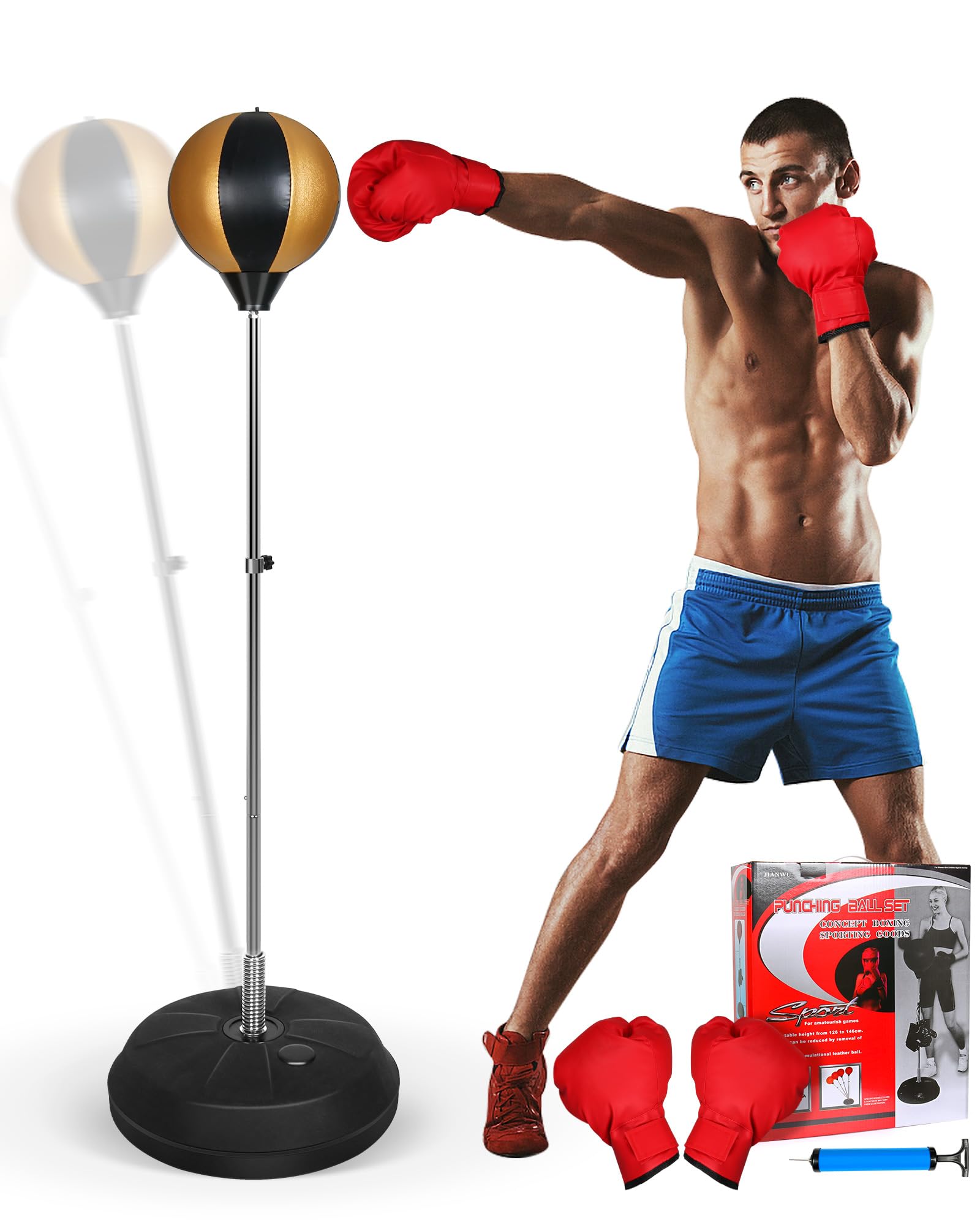
Two inflatable balls come in the box, one smaller and quicker than the other, and the frame takes a matching tension setting for each. It's the only bag here designed to be reconfigured rather than replaced as you get faster, and that's the reason it earns a place.

The height runs from 52 to 65 inches and the base is 17.7 inches across. The core weight bag that ships with the kit sits on the base for extra ballast and can be used as a small training bag in its own right, which is a genuinely useful bit of doubling up rather than a line on the box.

We like this one for the household that can't decide how serious it wants to get. Start on the larger ball with the looser setting, move to the smaller one when your hands catch up, and the bag changes with you instead of sitting in the corner being too easy. That kind of adjustability is rarer than it should be in this category.

Two practical notes. The balls are inflatable, so they need checking, and a soft ball changes the rebound more than any tension setting will. On smooth vinyl or tile the base can creep under hard combinations — a rubber mat underneath fixes that and protects the floor at the same time.

Bottom Line

The most adjustable reflex bag here: two ball sizes and two tension settings let one bag follow you from your first session to fast hands, as long as you keep the balls properly inflated.

Check Latest Price

Best Budget

Our Score 8.2/10
PEXMOR Reflex Bag

PEXMOR

PEXMOR Reflex Bag

  • Ball Solid EVA foam
  • Base Fill Up to 30 lb water or 55 lb sand
  • Base Grip Six suction cups
  • Height Range 53–61 in
Check Price on Amazon

A solid foam ball that never needs a pump, on a fillable suction-cup base.

The ball is what makes this one worth buying. It's solid EVA foam under a PU cover rather than an inflatable bladder, so there's no pump, no slow leak and no deflation halfway through a round — the three things that quietly retire most cheap reflex bags.

Everything else is modest but sensible. The pole runs 53 to 61 inches, the base takes up to 30 pounds of water or 55 pounds of sand, and six suction cups underneath help it hold a smooth floor. That's less ballast than the bigger bags here, so on a hard garage floor use sand rather than water. It's also a light-contact bag: rhythm and accuracy, not power.

At 61 inches fully extended it suits teenagers and most adults, but a tall boxer will be punching down at it. The joint where the pole meets the base is the piece to inspect when the box lands, and the included tools make assembly a job of minutes.

Bottom Line

The budget pick we're comfortable recommending: a solid foam ball that never needs air, a fillable base, and a height range that fits most teenagers and adults.

Check Latest Price

Best For Kids and storage

Our Score 8.0/10
INNOLIFE Fitness Reflex Bag

INNOLIFE Fitness

INNOLIFE Fitness Reflex Bag

  • Includes Gloves and pump
  • Stored Size 17 x 6 x 20 in
  • Height Range 47.2–59.1 in
Check Price on Amazon

Broken down, this fits in a box about 17 by 6 by 20 inches, which is the whole argument for it. It's the only bag here you can put on a shelf between sessions, and it ships with a pair of gloves and a pump, so nothing else is needed to start.

The pole adjusts from 47.2 to 59.1 inches and the maker pitches it at ages six and up, which is honest. At full height the ball sits around chest level on an adult, so the person who gets the most out of it is a kid or a teenager. The base is plastic and needs filling; expect it to be lighter under you than the sand-filled bases on the bigger bags.

We see it as a low-risk way to find out whether a reflex bag actually gets used in your house before you commit real space and money to one. The ball is inflatable, so it wants checking, and the stitching on the cover is the weak point — inspect the seams when it arrives and keep the ball at the pressure the manual specifies.

Bottom Line

A cheap, packable way to test whether anyone in the house will use a reflex bag; buy it for a kid or a small room, not for serious training.

Check Latest Price

How We Tested a Dozen Reflex Bags

We built the shortlist by working through retailer listings and customer reviews for reflex and freestanding bags with adjustable height and a base you fill yourself, then cut anything with a thin record on replacement parts or a base that only accepted sand. Twelve made the cut, spanning budget starters to sturdier mid-range units, and every one of them got the same treatment.

Assembly came first. I laid the parts out against the manual before touching a wrench, noted anything missing or mis-drilled, and timed how long one person needed to get it standing. Then I filled the base — water where the maker allowed it, sand where it didn't — and timed how long it took to drain and haul the unit into another room, because a bag you can't relocate ends up in a corner.

The bulk of the testing was six months of three-minute rounds, three or four sessions a week, split between garage concrete and living-room carpet. I worked hooks, straights, and slip-counter combinations, watching for a base that walked across the floor, a spring that returned the target on a different line each time, and padding that bottomed out under a hard cross. I also dropped the height for a shorter tester and ran the same rounds, since a bag that only fits one person isn't much of a bag.

At the end I went back over every unit: seams, padding compression, hairline cracks around the base, and how much spring tension had gone soft. Weighed against what each one cost, the bags that held their shape and stayed fun to hit — the ones I kept reaching for when nobody was keeping score — are the ones that made the list.

How to Choose

Match the Rebound to Your Level

Every bag here returns the ball with a spring, but where that spring sits changes the whole feel. A base-mounted spring, as on the Ringside Cobra, produces a slower, steadier return you can learn to time — good for building accuracy from scratch. A high-tension spring, as on the Hayabusa, snaps back fast enough to punish a dropped hand, which is exactly what an experienced boxer wants and exactly what frustrates a beginner.

Adjustable designs split the difference. The MaxxMMA ships two ball sizes with two tension settings, so you buy once and tighten the return as your hands catch up.

Buy Height for the Tallest User

Ranges here run from 47.2 inches on the INNOLIFE to about 71 on the Hayabusa. A bag that tops out too low makes you punch downward, drilling a habit you'll have to unlearn later. Measure the tallest person's shoulder height and pick a bag whose top setting reaches at least that high.

If a child will share it, the bottom of the range matters as much as the top: the INNOLIFE drops to 47 inches, while the Jukestir hangs at a fixed 70 and is an adult's tool.

Decide Between a Filled Base and an Anchor

Freestanding bags trade floor space for ballast. Fill figures vary widely — the Ringside base takes up to 125 pounds of water or 240 of sand, the PEXMOR 30 or 55 — and more weight means a bag that stays planted and a base that is slow to drain when you move house.

Anchored bags work the other way. The Jukestir needs a fixing point above and below and no floor at all, which suits a small room and rules out most rentals. Be honest about which constraint you actually have before you fall for a design.

Check the Ball and the Joint

Solid EVA foam, as on the PEXMOR, cannot leak. Inflatable bladders, as on the MaxxMMA and INNOLIFE, need pressure checks and can arrive soft. Foam over a mount, as on the Jukestir, wears at the skin first.

On any freestanding bag the pole-to-base joint carries the load, so inspect it on arrival and keep the hardware snug. Warranty length tracks the risk: 120 days on the Ringside and Everlast, a year on the MaxxMMA and PEXMOR, ten years on the Jukestir.

Frequently Asked Questions

Final Verdict

Buy the Ringside Cobra. It pairs the widest height range of the freestanding bags here with the heaviest stated base, and its return is slow enough to learn on and steady enough to keep using — the closest thing in this group to one bag for a whole household.

If you already train and want the bag to beat you back to your guard, the Hayabusa is the step up worth paying for. If you're not yet sure anyone will use it, the PEXMOR gets you a solid foam ball and a fillable base with the least commitment.