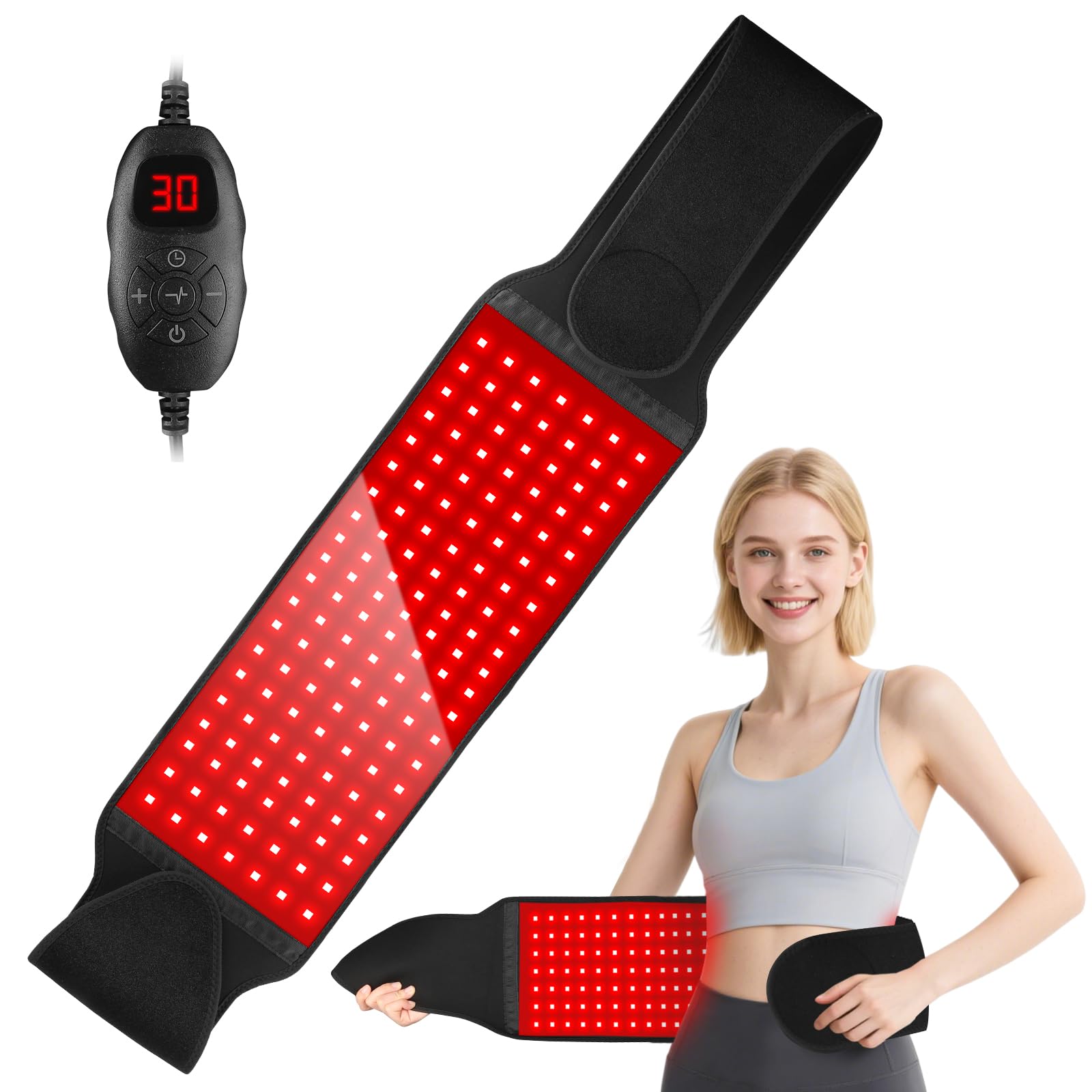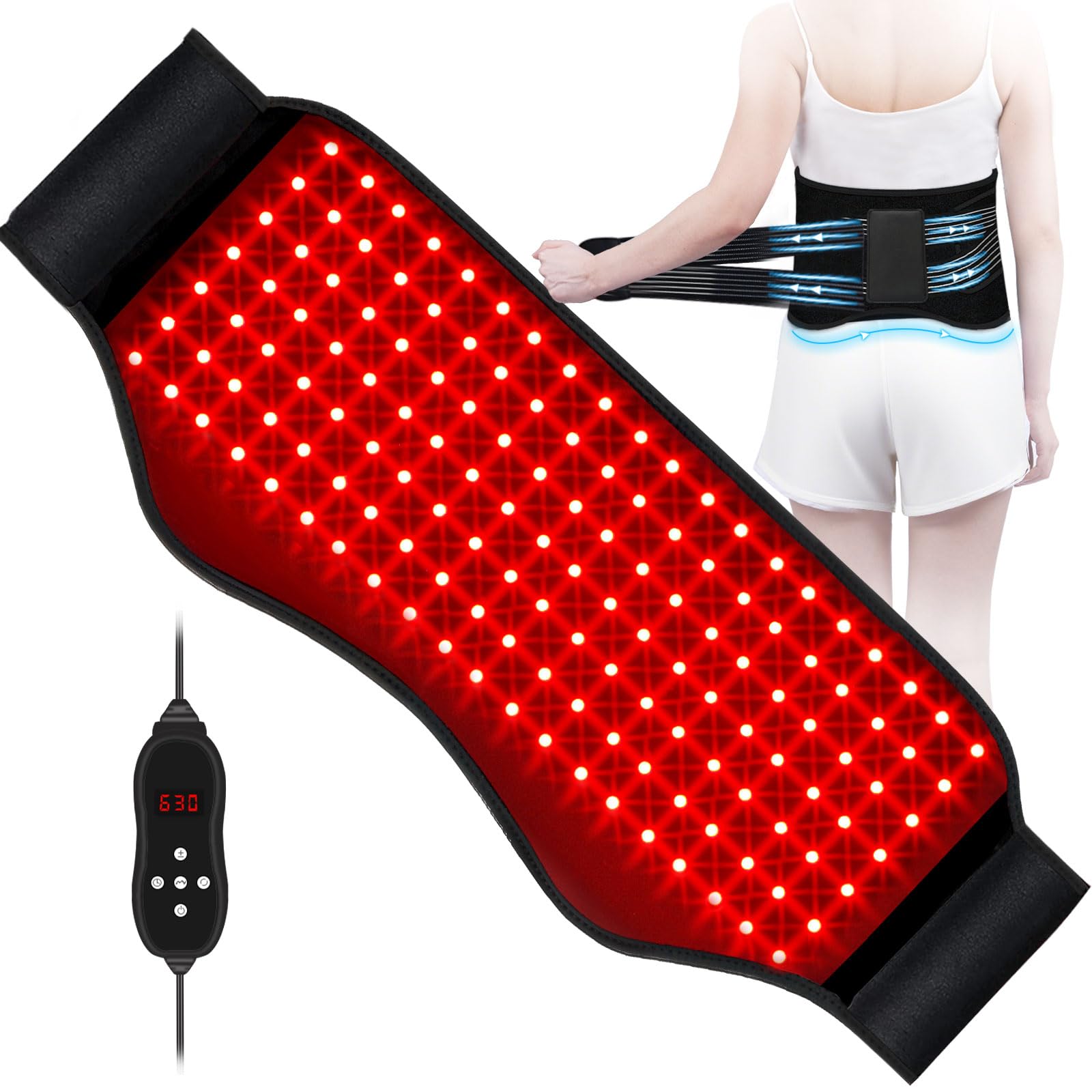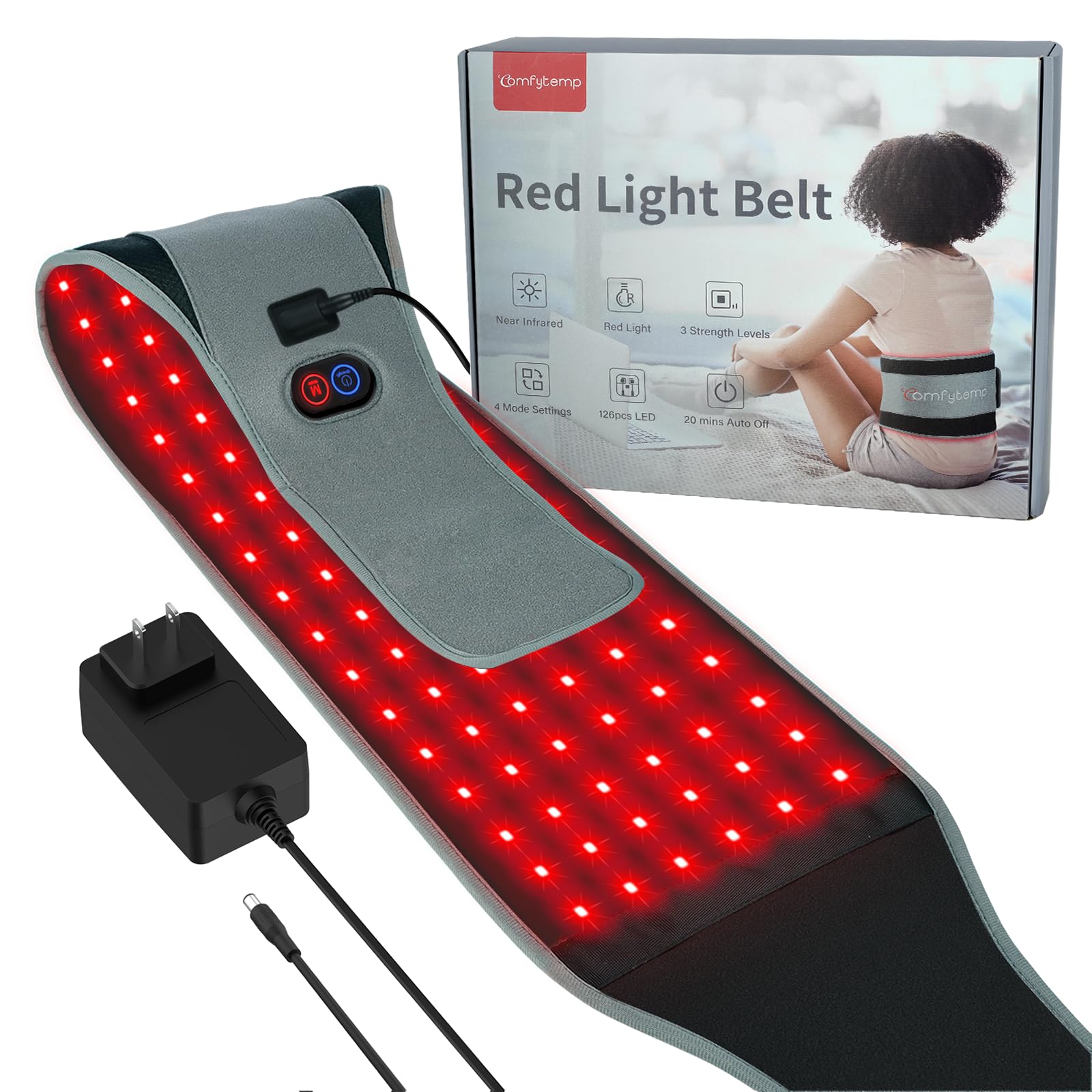
Recovery

Best Red Light Therapy Belts of 2026

A red light therapy belt is a strap of LEDs you wrap around whatever hurts — a lower back, a knee, a shoulder that stiffened up at a desk — and it sends red and near-infrared light into the tissue underneath. The device itself is simple; the choices between models are not. Output strength, how tightly the diodes are packed, battery life, and whether the strap stays where you put it once you start moving are what decide whether a belt becomes a habit or a drawer ornament.

I've been wearing these on a cranky lower back and a shoulder that complains after long days, and my team and I spent eight months with nine belts in desk chairs, on the couch, and after workouts. Price predicted almost nothing — a few mid-priced belts with dense diode arrays and honest battery specs outdid the expensive ones. Here's what nobody tells a first-time buyer: a strap that's even slightly too short for your waist will fight you every session, no matter how good the LEDs are. The picks below are the ones that never did.

Best Overall

Our Score 8.8/10
Comfytemp 126-LED Corded Belt

Comfytemp

Comfytemp 126-LED Corded Belt

  • LEDs 126 dual-chip (660nm + 850nm)
  • Modes 4 modes, 3 levels
  • Power Corded, 22W
  • Light Area 22 x 8 in
Check Price on Amazon

A dense dual-wavelength panel, real warmth, and onboard controls with no app or charging routine.

The number that matters here isn't 50. The strap measures 50 inches, but the part that lights up is a 22-by-8-inch panel, and knowing that changes how you use it: this is a belt for a lower back, a hip, a thigh, or a shoulder, not something that covers a whole torso. Inside that panel the output is serious — 126 dual-chip LEDs, each pairing a 660nm red emitter with an 850nm near-infrared one, at 22W.

That density is why we kept coming back to it. The panel runs warm within a couple of minutes and holds there, closer to a heating pad than to a bare LED array, and three brightness levels let you drop it down if your skin is sensitive. Setup is about as simple as it gets: four modes on buttons built into the belt, no app, no remote, nothing to pair. Plug it in, wrap it, press a button.

The outlet does decide where you sit. This is a belt for a desk chair, a couch, or a bed within reach of a socket; the cable gives you room to shift around but not to wander into the kitchen. For a daily twenty minutes in front of a screen, that's a fair trade for never thinking about charging — and it's the reason we reach for the cordless Comfytemp on days when we want to keep moving.

What earns it the top spot is how little it asks. It's slim enough to sit against a bare back under a loose shirt, the buttons are legible without glasses, and at about a pound and a half it stays where you put it instead of sliding down your spine. If you want a lit area that runs the full length of the belt, the KingPavonini covers more; for a back or a single joint, the 22 inches you get here are the 22 inches you needed.

Bottom Line

For a first belt or a daily back routine, this is the one we recommend: a dense dual-wavelength panel, real warmth, and controls you can work without a manual.

Check Latest Price

Best Cordless

Our Score 8.8/10
Comfytemp 5000mAh Cordless Belt

Comfytemp

Comfytemp 5000mAh Cordless Belt

  • LEDs 660nm + 850nm, 13W
  • Battery 5000mAh, 80–250 minutes
  • Settings 4 modes, 9 levels
  • Waist Fit Up to 70 in
Check Price on Amazon

A big battery and nine settings let you run a session away from any outlet.

Twenty minutes is a session, and the 5000mAh battery is rated for 80 minutes at full power and up to 250 at the lowest settings — enough for several sessions between charges. We kept it topped up between uses and never ran out halfway through one.

What we like most is what it removes: the outlet. It pushes 13W through 660nm and 850nm LEDs, offers nine settings across four modes, and reaches a 70-inch waist with the included extension strap. You can wear it while you make coffee, answer email, or walk to the mailbox, and that's the kind of use that turns a device into a habit instead of a chore you schedule.

Fit is the thing to check before you order. The belt closes with Velcro plus a 20-inch extension that's there for larger frames; on a smaller waist you'll have a long tail to tuck, and the top edge can gap when you sit down. Wearing it a little higher than feels natural, across the lower back rather than the hips, keeps the panel in contact and makes the whole thing work better.

Against our top pick it gives up a stated lit area — the corded Comfytemp spells out its 22-by-8-inch panel, while this one is sold on runtime — and it gives up the certainty of wall power. What it buys is the twenty minutes you'd otherwise skip because the nearest socket is in another room. That trade has been worth it more often than we expected.

Bottom Line

For anyone who wants to move during a session, this is the cordless belt we recommend: the battery covers days of short sessions and the wrap fits up to a 70-inch waist.

Check Latest Price

Best for Adjustable Intensity

Our Score 8.8/10
LITDUCK 140-LED Belt

LITDUCK

LITDUCK 140-LED Belt

  • LEDs 140 triple-chip
  • Timer 5–30 min
  • Waist Fit Up to 70 in
  • Brightness 5 levels, steady or pulse
Check Price on Amazon

Five brightness levels and two pulse rates for anyone easing into light therapy slowly.

Five brightness levels is the reason to look at this one. Most belts here give you three, and the lowest setting on the LITDUCK is genuinely low — dim enough to sit against thin or sensitive skin without the prickle of heat that can make a first week of red light therapy uncomfortable. Add steady and pulsed output at 10Hz and 40Hz, three wavelength modes, and a timer that runs 5 to 30 minutes or stays on, and it's the most adjustable belt in this guide.

The hardware keeps up. 140 triple-chip LEDs, a 50-by-7-inch belt, and a 20-inch extension strap that takes it to a 70-inch waist, all at 1.3 pounds. That's the same LED count as the KingPavonini with less weight and no separate compression straps, which makes it the easier of the two to wrap around a thigh or a calf — the better choice if your target area is a limb rather than a spine.

Where it gives ground is history. It hasn't been around as long as our top pick, and the failures that do show up are the kind that matter: rows of LEDs going dark a couple of months in, which turns a full panel into a patchy one you can't trust to cover the same area twice. Buy it where the return window is straightforward, and check that the whole panel lights evenly during your first few sessions rather than after the window closes.

Bottom Line

The belt for anyone easing in slowly: five brightness levels, two pulse rates, and 140 LEDs for a fraction of what the premium picks cost.

Check Latest Price

Best Build Quality

Our Score 8.6/10
LifePro Allevared Belt

LifePro

LifePro Allevared Belt

  • LEDs 105 triple-chip (660nm + 850nm)
  • Power USB-powered
  • Timer 1–30 min
  • Wrap Size 49.5 x 7.7 in
Check Price on Amazon

The lightest, best-finished wrap here, with red-only and infrared-only modes and a flexible timer.

The Allevared is the most expensive belt we recommend, and the money doesn't buy more light. It buys a better-made wrap. At just over 14 ounces it's the lightest belt here, and at 0.39 inches one of the thinnest, so it follows the curve of a knee, an elbow, or a shoulder instead of standing off it and throwing output into the gap. If you've tried a stiff, blocky pad and given up on the idea, this is the one that feels different.

Construction is where it separates itself. The finish, the stitching, and the strap hardware sit a step above the budget belts in this guide — which is what the price is for — and that matters most on small joints, where a wrap has to bend tightly and stay bent for half an hour. Three modes let you run red only, near-infrared only, or both together, and the timer adjusts from 1 to 30 minutes instead of locking you into fixed blocks.

Two practical notes. It's USB-powered, so it runs from a wall adapter or a power bank, but the cable is short enough that a distant socket becomes irritating; a longer cord or a pocket battery solves it. And the premium here is construction, not a stronger light engine: 105 triple-chip LEDs is a smaller count than several cheaper belts in this guide, so if raw coverage is what you're after, the KingPavonini gives you more lit area for a fraction of the money.

The reason to spend is the wrap itself — it sits flat, adjusts finely, and doesn't need re-strapping halfway through a session. Whether that's worth several times the price of our top pick is a personal call. Daily use on a bad knee, yes. The occasional stiff back, probably not, and the cheaper belts here handle that just fine.

Bottom Line

If the best-made wrap here is what you want, and you're treating knees, elbows, or shoulders, this is it — you're paying for construction, not more light.

Check Latest Price

Best Coverage

Our Score 8.6/10
KingPavonini 140-LED Belt

KingPavonini

KingPavonini 140-LED Belt

  • LEDs 140 triple-chip
  • Modes 12 modes, 6 timers
  • Power Adapter or USB power bank
  • Light Area 48 x 8.6 in
Check Price on Amazon

Wide lit panel, held firmly by elastic compression straps, with adapter or power-bank power.

Most of these belts hold themselves on with Velcro and hope. This one adds two elastic compression straps over the top, and that's the detail that makes it the pick for a back: the panel stays pressed to skin instead of bowing away at the spine, which is exactly where output gets lost.

The rest of the belt follows the same logic. 140 triple-chip LEDs put out 660nm red and 850nm near-infrared across an 8.6-inch-tall panel that runs 48 inches, so there's coverage above and below the spot you're treating, and it takes power from the included adapter or a USB power bank. Twelve modes, six timers, and five brightness levels give you more adjustability than anything else here in its price range.

We defaulted to steady light at a middling brightness every time and never found a reason to leave it, so treat the pulse modes as a bonus rather than the reason to buy. What we did use constantly was the coverage: on a lower back, the extra height means you're not chasing the panel up and down your spine between sessions, and the compression straps mean it's still in place when the timer ends.

The cost is bulk. At just under two pounds it's the heaviest belt in this guide, and straps plus an 8.6-inch panel add up to something that feels like a piece of equipment rather than a wrap — fine on a couch, less appealing if you wanted to wear it under a shirt. On a smaller waist the tail runs long and can be trimmed, which is the fix if it bothers you.

Bottom Line

Buy this one if you want a wide lit area held firmly against a back or shoulder and you don't mind a belt that stays home.

Check Latest Price

Best For Budget back coverage

Our Score 8.4/10
GMOWNW 105-LED Belt

GMOWNW

GMOWNW 105-LED Belt

  • LEDs 105 triple-chip
  • Power Adapter or power bank
  • Timer 5–30 min
  • Light Area 50 x 7 in
Check Price on Amazon

The controller cord is the weak point: shift position and the plug at the belt can work loose, and the session ends without you noticing. The fix is a USB power bank in a pocket — this belt takes either the wall adapter or a battery — which also gets you off the outlet entirely. We treated the power bank as the default rather than the accessory.

What you get in return is lit area. The working section runs 7 inches tall and a full 50 inches long, more than twice the length of the panel on our top pick, and 105 triple-chip LEDs fill it with 660nm red and 850nm near-infrared. Laid across a lower back and a hip, or wrapped around a thigh, it covers a long strip in one pass, and three modes with a 5-to-30-minute timer keep the operation simple.

Build is where it gives ground. The same cord-and-controller arrangement that makes a power bank necessary also makes this the least refined belt we kept: the material is thinner, the closure feels basic next to the KingPavonini's straps, and it's the one to treat as a first belt rather than a long-term one.

That's the honest case for it. If you're curious whether light sessions do anything for your back and you don't want to spend much finding out, a long lit area with both wavelengths at the low end of the price range is a reasonable way in. If you already know it works and you'll be using it every evening, put the money into the KingPavonini or the LifePro instead.

Bottom Line

For a long lit section on a tight budget, this is the one — add a power bank and treat it as a first belt rather than a last one.

Check Latest Price

How We Chose and Tested the Best Red Light Therapy Belts

To build the shortlist, I went through the spec sheets on more than 40 belts and set aside anything that couldn't clear basic hurdles: a stated red and near-infrared wavelength, enough diodes to cover the length of the strap rather than clustering in one hot spot, an adjustable band that would fit a waist well past the model-photo standard, and a return window long enough to try it properly. That left nine belts, which my team and I used for eight months.

We wore them where these things actually get used: through a full desk workday, on the couch during an evening of TV, and on a stiff lower back after a run. Since a belt only works if it stays put, I measured each strap end to end and noted the usable span of diodes, then wore them over a t-shirt and against bare skin to see whether the pad crept upward or the controller flopped around. We timed how long each took to get from box to first session and checked whether the controls were reachable without peeling the belt off — a small thing that gets irritating by week two. The charging cable got its own test: we measured it, then plugged in from the couch, because a cable that only reaches the kitchen counter changes how often you'll bother.

Battery claims got checked against real sessions — highest setting until it died, then a timed recharge — and I kept a log of how each belt felt on a bad back day versus a good one, since that's the only honest way to judge whether the light is doing anything. At the four- and eight-month marks we went back over every strap looking for stretched elastic, hook-and-loop that had stopped gripping, and diodes that had dimmed or quit. Price came last: we weighed what was in the box, like an extender strap or a proper wall adapter, against what the belt actually delivered, because a cheap belt that needs a separate accessory isn't cheap.

How to Choose

Red and Near-Infrared Do Different Jobs

Every belt worth buying here pairs 660nm visible red with 850nm near-infrared. The red end is absorbed close to the surface, which is why it gets used on skin and superficial tissue, while 850nm is invisible and travels deeper toward muscle and joint. Most belts run both wavelengths at once; the better ones let you switch to red-only or NIR-only when you want to concentrate on one, as the LifePro does with three modes.

Check that both wavelengths are listed per LED rather than as a general claim, and that the controller gives you a mode switch at all. A belt sold only on chip count without naming the wavelengths is the one to skip.

Corded or Cordless Decides Where You Sit

Start with the outlet. A corded belt gives steady output with no charging routine and is the cheaper way into the category — our top pick is corded — but it ties you to a seat near a socket for the length of a session. Cordless buys movement and a battery you have to manage: plan on roughly an hour at higher settings and several hours to recharge, which is what the cordless Comfytemp asks of you.

The middle path is a belt that will run from USB. Plug a power bank into the KingPavonini, the LITDUCK, or the GMOWNW and it becomes portable for the price of the battery, which is often the smarter buy if you only occasionally want to move.

Read the Lit Area, Not the Strap Length

Belt length is not coverage. Our top pick is 50 inches of strap around a 22-inch lit panel; the KingPavonini lights 48 inches of an 8.6-inch-tall belt; the GMOWNW states a 50-by-7-inch working area. Before you order, measure the patch you actually want lit. A lower back wants height across the spine and a bit of length either side; a thigh, calf, or shoulder wants length to wrap.

LED count alone won't settle it either, because beads are spaced differently from belt to belt. A high count on a short panel means dense light; the same count spread thin means you may need to move the belt mid-session.

Fit Is What Keeps Light on Skin

Output falls off quickly with distance, so a belt that bows away from your back is throwing away most of what it emits. Look for an adjustable closure plus an extension strap if you're near the top of the stated range, and something that holds the panel flat: the KingPavonini's separate compression straps are the most secure arrangement in this guide, and the cordless Comfytemp and the LITDUCK both reach a 70-inch waist with their extensions.

On a small waist, a long belt bunches and stands off at the top. Overlap it or trim the tail rather than letting it ride up, and check the fit sitting down, which is how most sessions actually happen.

Budget for a Replacement, Not Just a Purchase

These are small consumer electronics, and the failure points are consistent: controller cords, plugs, and rows of LEDs. A belt used several times a week can still quit within months, which is the strongest argument for buying where returns are easy and keeping the box through the return window.

It's also why we don't suggest spending up unless you're paying for construction. The LifePro is the one belt here whose price is about how it's made rather than how many LEDs it carries; the budget picks are the sensible way to find out whether daily light sessions earn a place in your routine.

Frequently Asked Questions

Final Verdict

Most people should buy the Comfytemp corded belt. The panel is dense, the warmth is real, and the controls don't need a manual — which is what makes a daily twenty minutes stick. Spend more only if the wrap itself is the problem: the LifePro's lighter, slimmer build is the one worth paying for, particularly on knees and shoulders.

And if an outlet is the thing that would stop you using a belt at all, the cordless Comfytemp removes that excuse for about what the top pick costs. Buy one of those three and you're getting the version of this category that earns its place in a routine.