Recovery

Best Mini Massage Guns of 2026

Mini massage guns should be the easiest recovery tool to live with: small enough for a gym bag, quiet enough to use on the couch, and strong enough to actually work out a knot. The problem is that shrinking the gun often shrinks the power, battery life, and build quality too, and a buzzy little toy won't do much for a sore calf no matter how portable it is. What you want is a mini that still feels effective — enough punch to reach deep tissue, a battery that lasts through more than one session, and a housing that doesn't rattle apart in your bag.

My team and I have tested a dozen mini massage guns over the past six months, using them after runs, during long desk days, and on weekend trips, and the gap between good and bad is obvious. The standouts delivered real pain relief, held their charge, and felt worth the money; the weak ones just vibrated against the skin. The picks below are the ones that actually performed.

Best Overall

Our Score 9.4/10
Opove M3 Mini

Opove

Opove M3 Mini

  • Speed Up to 3,000 ppm
  • Weight 1.3 lb
  • Runtime 2.5–8 hours
  • Amplitude 7 mm
Check Price on Amazon

The deepest-feeling stroke here in a body light enough to hold all session.

Seven millimeters is the number we check first on any mini gun. That's the amplitude, the distance the head travels on each push, and it decides whether a gun gets under the surface of a calf or just skitters across it. The M3 Mini has it, along with a listed 3,000 percussions a minute, in a body 5.16 inches long that weighs 1.3 pounds.

That combination is why it's our top pick. It hits with an authority the smallest guns here can't match, yet it's still light enough to hold one-handed through a full pass over both calves before your forearm starts filing complaints. The soft sponge head is the sleeper in the box: we expected to ignore it and ended up using it on the neck and around the jaw, where a hard ball is simply too much.

Everything else is sensible rather than clever, which is what we want from a tool that lives in a drawer. USB-C charging, a claimed 2.5 to 8 hours depending on the speed you run, and a rigid case that holds the gun and the spare heads. It's quiet enough to use in front of the television without reaching for the volume.

Battery capacity is the piece to keep an eye on. Runtime at the low speeds is generous, but small cells fade, and this is the component that will age first. Nothing about the motor worries us.

Bottom Line

We recommend the M3 Mini to most people: it delivers the deepest stroke in this set from a body light enough to hold for a whole session, and it ships with a hard case.

Check Latest Price

Best for the Gym Bag

Our Score 9.2/10
BOB AND BRAD Q2 Mini

BOB AND BRAD

BOB AND BRAD Q2 Mini

  • Noise Under 40 dB
  • Length 5.7 in
  • Weight 0.95 lb
  • Massage Heads 5
Check Price on Amazon

Under a pound with five heads and sub-40 dB operation — the bag pick.

At 5.7 inches long and 0.95 pounds, the Q2 Mini fixes the problem most massage guns have, which is that you leave them at home. It fits a water-bottle pocket on a backpack and vanishes into a gym bag, and at that size a gun stops being equipment you plan around and becomes something you grab.

Nothing collapses in the process. Seven millimeters of amplitude, five interchangeable heads, and a brushless motor rated under 40 decibels, which is quiet enough that we've used it in a room where somebody was on a call. USB-C with 15 W power delivery means it charges off the same brick as a laptop, and the 2,500 mAh cell keeps it going for weeks of short sessions.

We keep this one in the bag and the Opove on the shelf, and that's the honest split between them: the Opove runs longer per charge and ships in a hard case, while this is the one that's already with you when your back seizes up after a long drive. Five heads is more than anything else here gives you, and it's the small ones that reach between the shoulder blades.

Bottom Line

If the gun has to disappear into a gym bag or backpack, this is the one we take — near a pound, five heads, and quiet enough for a shared office.

Check Latest Price

Best Premium

Our Score 9.2/10
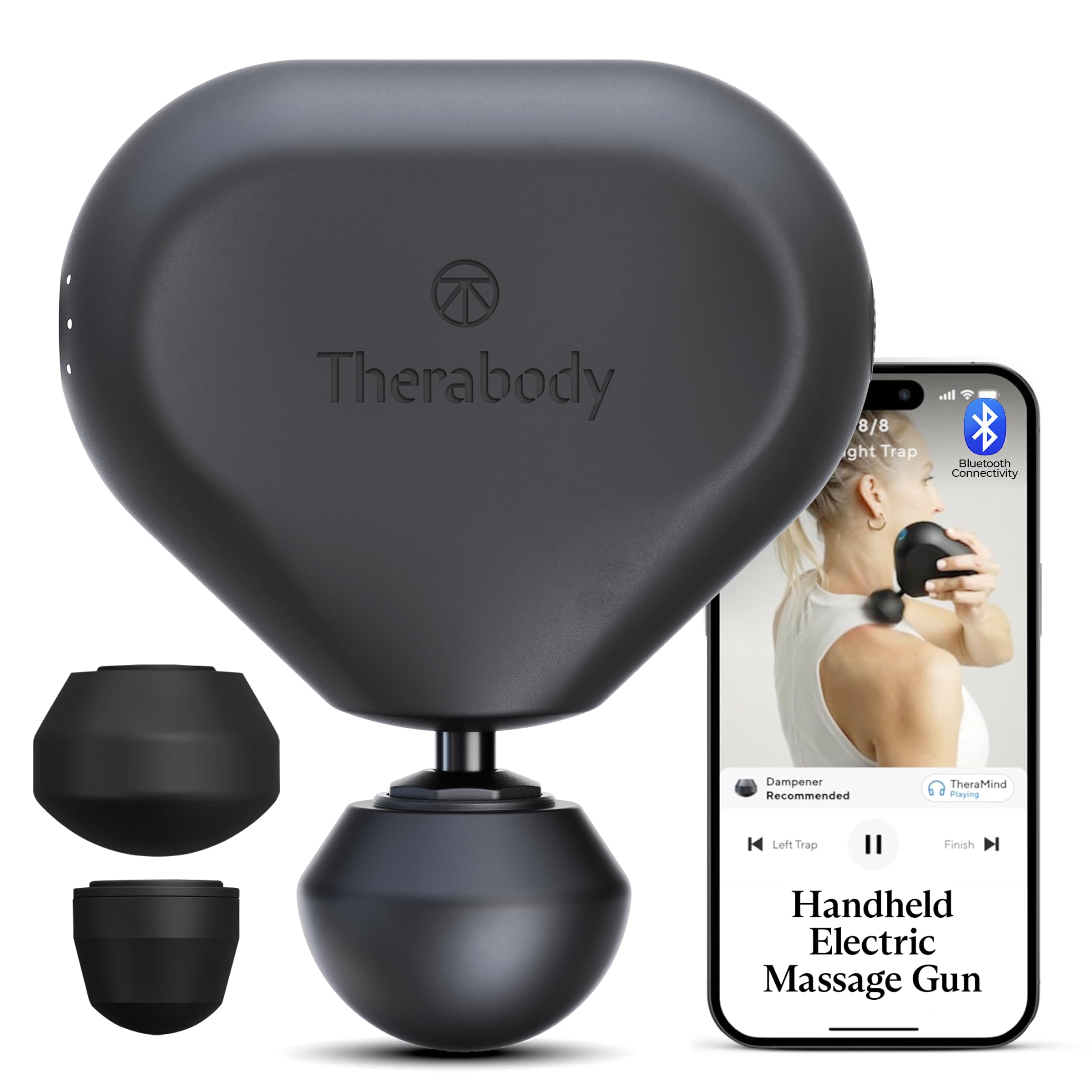
TheraGun Mini 3rd Gen

TheraGun

TheraGun Mini 3rd Gen

  • Speeds 3
  • Weight 15.9 oz
  • Attachments 3
  • Connectivity Bluetooth
Check Price on Amazon

The most comfortable grip here, plus app-guided routines — at the highest price.

The most expensive pick here justifies part of its price in your hand rather than on a spec sheet. The grip is shaped so the head follows your forearm, and the payoff, for us, is that your wrist stops doing the steering — the kind of thing that only shows up on the second pass over a tight calf, when cheaper guns have you regripping.

Three speeds, one button, and three heads take you most of the way. The ladder is shorter than the five-speed guns here, but the steps are well chosen and the lowest is genuinely gentle, which matters near a joint or on a neck. Pair it with the Therabody app and you get guided routines built around the device; ignore the app and you still have a very good one-button gun.

Battery is where the value argument gets harder. The charge is fine for a week of short sessions but not for a long trip with daily use, and that's a real gap against the Opove's claimed eight hours at low speed. What you're paying for is fit and finish — this feels like a finished object rather than a motor in a tube, and it's the one we hand to someone with a sore wrist.

Bottom Line

Buy it if the grip matters as much as the motor: this is the most comfortable handle here for smaller hands, and the app makes a routine obvious.

Check Latest Price

Best Budget

Our Score 9.2/10
arboleaf CM10C

arboleaf

arboleaf CM10C

  • Weight 13.4 oz
  • Charging USB-C
  • Speed Range 1,000–3,200 RPM
  • Massage Heads 4
Check Price on Amazon

A pressure-sensing fifth speed and a metal body for less than the midrange picks.

Most mini guns make you pick a speed and live with it. The CM10C's fifth setting reads how hard you lean on it and moves between 1,000 and 3,200 RPM on its own, and within a couple of sessions we stopped touching the manual buttons entirely — you press harder on a knot, the gun answers, and you get on with it.

The rest of the package is unusual for the money. A metal body that feels like a tool rather than a toy, four silicone heads shaped for broad muscles, knots, trigger points, and bone-adjacent spots, and USB-C charging. At 13.4 ounces it sits mid-pack on weight, heavier than the pocket guns and lighter than the Hyperice.

Where it earns its place is that automatic mode. If you've never used a percussion gun before, not having to think about speed while you learn where your knots are is worth more than an extra head or a fancier case. It's the one we hand to someone who says they don't know what setting to use.

Bottom Line

Our budget pick earns it: the fifth speed matches your pressure instead of making you choose, and the metal body feels sturdier than the price tier suggests.

Check Latest Price

Best for Heat and Cold

Our Score 9.0/10
RENPHO Thermacool

RENPHO

RENPHO Thermacool

  • Weight 1 lb
  • Amplitude 7 mm
  • Speed Range 1,800–3,000 spm
  • Temperature Settings 4
Check Price on Amazon

Heat and cold in one head, with four temperature settings and five speeds.

Every gun here does percussion. Only one does cold as well as heat, and that's the reason to look at this RENPHO at all. Four temperature settings, switchable in either direction, so you can warm a stiff shoulder before you work it or cool a puffy knee after a run without hunting for a second device.

The percussion underneath is respectable rather than special: a 7 mm amplitude, five speeds from 1,800 to 3,000 strokes a minute, and a brushless motor in a body that weighs a pound and measures 5.5 inches long. Four heads, a two-hour recharge over USB-C, and three 2,600 mAh cells inside.

Heat is where the thermal idea earns its keep in practice. A warm head loosens a muscle faster than percussion alone, and the cold setting is the one we reach for after a long run when everything is puffy. It isn't a deeper gun than the Opove — same 7 mm stroke — so you're paying for temperature, not for power.

So our verdict here is narrower than for the others: buy it because the thermal head is the feature you came for, and treat it as the warm-up and cool-down tool rather than the only gun in the drawer.

Bottom Line

Nothing else here gives you heat and cold in the same head, which is why this is our pick for loosening up before a workout and settling down after one.

Check Latest Price

Best For Pocket carry

Our Score 9.0/10
HEYCHY Super Mini

HEYCHY

HEYCHY Super Mini

  • Speeds 5
  • Weight 0.6 lb
  • Amplitude 7 mm
  • Attachments 4
Check Price on Amazon

At 0.6 pounds, the Super Mini is the only gun here you can carry without a bag. It's a short T-shaped body that sits in your palm, so you steer with small movements of the wrist instead of swinging a handle around — which is exactly what you want on a shoulder or the side of a neck.

The specs are decent for the size: a 7 mm amplitude, five speeds, four heads, and a battery the brand says discharges three times faster than a standard cell, a claim we can't check and didn't need to. It arrives in a drawstring cloth bag rather than a case, and it is not a quiet gun at the top speeds.

For a weekend away it's the one that goes in the jacket, and the low weight means you'll actually finish the session instead of switching hands every thirty seconds. It's the smallest thing here that still gets a knot to let go, and it costs less than most of the field.

Bottom Line

For a jacket pocket or a desk drawer, this is the lightest thing here that still moves real muscle — 0.6 pounds, five speeds, four heads.

Check Latest Price

Best for Air Travel

Our Score 8.8/10
Hyperice Hypervolt Go 2

Hyperice

Hyperice Hypervolt Go 2

  • Motor 40 W brushless
  • Speeds 3
  • Weight 1.5 lb
  • Runtime 3 hours
Check Price on Amazon

Rated for carry-on, with three speeds, three hours, and a quiet 40 W motor.

Hyperice lists the Go 2 as TSA-approved carry-on, and that claim explains the rest of the design: three speeds, one button, a 40 W brushless motor behind QuietGlide damping, and a claimed three hours of runtime. For anyone who has left a massage gun at home rather than pack it, that's most of the pitch.

In the hand it feels like a shrunken full-size gun rather than a toy — steady against the muscle instead of buzzy, and quiet enough that a roommate won't look up. Three speeds is a shorter ladder than the five-speed guns here, though the steps are usable and the top one is strong enough for a glute.

Sort one thing before your first trip: there's no charging brick in the box, only a USB-A to USB-C cable, and Hyperice asks for a 5 V USB-A source with the cable it supplied rather than whatever fast charger is in your drawer. Pack a brick you already own and the rest of the routine is a single button.

Bottom Line

The Go 2 is for the traveler who wants a name they trust: three speeds, a claimed three hours, and a design Hyperice rates for carry-on luggage.

Check Latest Price

How We Tested Mini Massage Guns

To build the shortlist, we started with research: owner reviews, spec sheets, and the small details that matter in a mini, like whether the attachments lock in without wobble and whether the case actually fits in a gym bag. We filtered out anything that was too bulky to be pocketable, too cheap to trust for daily use, or missing basic extras like a second head or a warranty. That left 12 guns, which we rotated through six months of normal use.

Each gun went through the same rough routine: a two-minute pass on tight calves after a run, a session on shoulders and neck after a long desk day, and a spot in a gym bag for weekend trips. To judge pain relief and effectiveness, we noted whether the muscle actually softened or just buzzed on the surface, and whether we still felt looser the next morning. For power, we pressed the head into a tight calf and watched for stalls; for quality, we checked for rattles, heat, and loose heads after every few sessions.

Battery life got logged the old-fashioned way: full charge, then a tally of sessions until the light went dead. Durability meant living in a bag with water bottles and shoes, getting dropped on gym floors, and still holding together. We weighed value last — what came in the box, how it performed, and whether it felt worth the money — because a cheap mini that dies in a month is no bargain. We'll keep using these and update if anything changes.

How to Choose

Stroke Depth, Not Speed, Tells You How Deep It Goes

The headline figure on most listings is percussions per minute, but two guns running at the same speed feel completely different if their strokes differ. A 7 mm amplitude — the distance the head travels on each push — is the working standard in this class, and it's what gets a head under the surface of a calf or a glute. A short stroke at high speed mostly vibrates the skin.

Check amplitude before RPM, and if a listing doesn't state one, treat any depth claim as unproven. It's also the spec that separates the picks here from a cheap buzzing device.

Weight and Grip Decide Whether It Leaves the Drawer

You hold a massage gun for minutes at a time, often reaching behind your back, so half a pound is a real difference. Our picks run from 0.6 to 1.5 pounds, and the gap between those ends is the gap between a jacket pocket and a gym bag you have to plan around.

Two traps. Listings often quote a body measurement that ignores the head, so compare the length against the bag you'll actually use. And grip shape matters more than the number — an angled handle keeps your wrist straight, which is what lets you finish a second pass instead of handing the gun to someone else.

What the Battery Claim Leaves Out

Runtime figures are quoted at the lowest speed, and a mini at full power drains far faster than the box suggests. Look for USB-C, ideally with fast-charge support, so you can top up from the cable you already carry for your phone.

Accept that the cell is the part of a small gun that ages first. A model with a stated two-hour recharge and a clear charging indicator is easier to live with than one that leaves you guessing.

Heat, Cold, and the Heads You'll Actually Use

Thermal heads are worth the premium only if you use them: warmth to loosen a stiff shoulder before you work it, cold after a run to settle swelling. The RENPHO Thermacool is the only pick here that does both, and it charges for it elsewhere.

Otherwise four or five heads cover nearly everything — a broad ball for big muscles, a cone or bullet for knots, a soft or sponge head for the neck and face. Bluetooth and guided routines pay off only if you'll follow a session on screen; skip them if you won't.

Where a Mini Stops Working

Small motors bog down when you lean into a large muscle, and no number of speed settings fixes that. Working a dense glute or a big quad means pressing firmly and feeling the stroke shorten; if that's most of what you need, a full-size gun is the right tool and a mini is the second one you buy.

The other limit is noise. Mini doesn't mean quiet, so a gun rated at 40 decibels or under is the one you can run in a shared room without apologizing.

Frequently Asked Questions

Final Verdict

The Opove M3 Mini is what we point most people to. It has the deepest stroke in this set, a genuinely gentle head for necks and faces, and a rigid case, and it stays comfortable to hold through a full session rather than half of one. For a first mini gun, that's the whole decision.

If the gun has to live in a bag rather than on a shelf, take the BOB AND BRAD Q2 Mini: it shaves roughly a third of a pound off and adds two more heads, and that's a trade most travelers should make. Buy the RENPHO Thermacool only if heat and cold are the reason you're shopping.