Strength & Weights

Best Leg Curl Machines of 2026

Every home gym hits the same blind spot eventually. You squat and press until the plates rattle, but the back of your legs quietly falls behind — and that imbalance surfaces later as cranky knees and a squat that stalls halfway up. A leg curl machine fixes that, whether it's a standalone unit or an attachment for the bench you already own. It's also the fussiest thing in the room to buy, because the pad has to land above your heel and the seat has to put your hips exactly where the machine expects them.

I have a short torso and long shins, so plenty of machines put my hips somewhere the design never intended — a detail no spec sheet mentions. My team has spent the past six months running eight leg curl machines through actual leg days in a garage gym and a spare bedroom, and the ones that held up shared a few traits: pads that adjust far enough to matter, a base that doesn't walk across the floor, and an arm that swings without a hitch. The picks below are the ones worth the floor space.

Best For Multi-station setups

Our Score 9.2/10
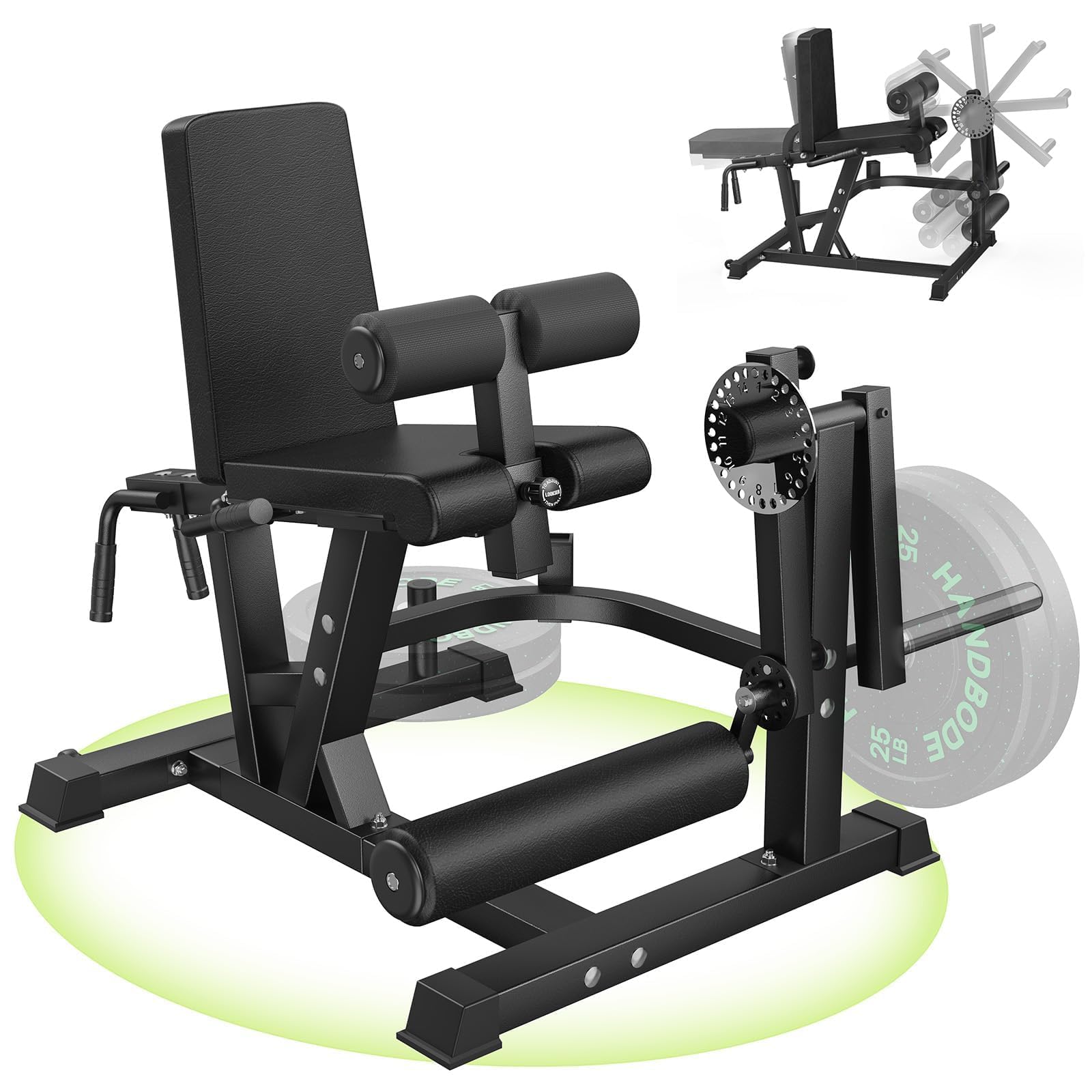
HANDBODE 8-in-1 Leg Extension and Curl Machine

HANDBODE

HANDBODE 8-in-1 Leg Extension and Curl Machine

  • Exercises Eight in one station
  • Footprint 40.16"D x 34.84"W x 40.16"H
  • Plate Fit 1-inch and 2-inch
  • Tension Supported 1000 lb
Check Price on Amazon

One pin moves the working arm from the lower position to the upper, and that single piece of hardware is what turns this into eight exercises: seated extensions, prone and seated curls, hip thrusts, crunches, bicep curls, tricep extensions and preacher curls. Whether you want a leg machine or a one-station gym is the real question this product asks, and it's worth answering honestly before you order.

The frame is a 91-pound alloy-steel build with a 2.8-by-2.0-inch load column, 2mm members, a wide stance and non-slip feet, and the lever rides on linear bearings. The loading posts take both 1-inch standard and 2-inch Olympic plates, which matters if your plates came from two different sources over the years.

Adjustment is where it beats the leg-only machines: a 28-position main roller on a 360-degree mount, a nine-position foam roller, a backrest that runs from flat to upright in four steps, and a six-position thigh brace. The marks are numbered, so a second person in the house can find the same settings without measuring or guessing.

It's the highest-rated machine in the group, and also the one whose case rests most on its specification. If you want a single frame that handles legs, hips and arms, and you'd rather buy once than add stations, this is the interesting bet of the roundup.

Bottom Line

Our pick if you want one frame to do everything: eight stations, numbered adjustments, and the strongest spec sheet here.

Check Latest Price

Best Overall

Our Score 9.0/10
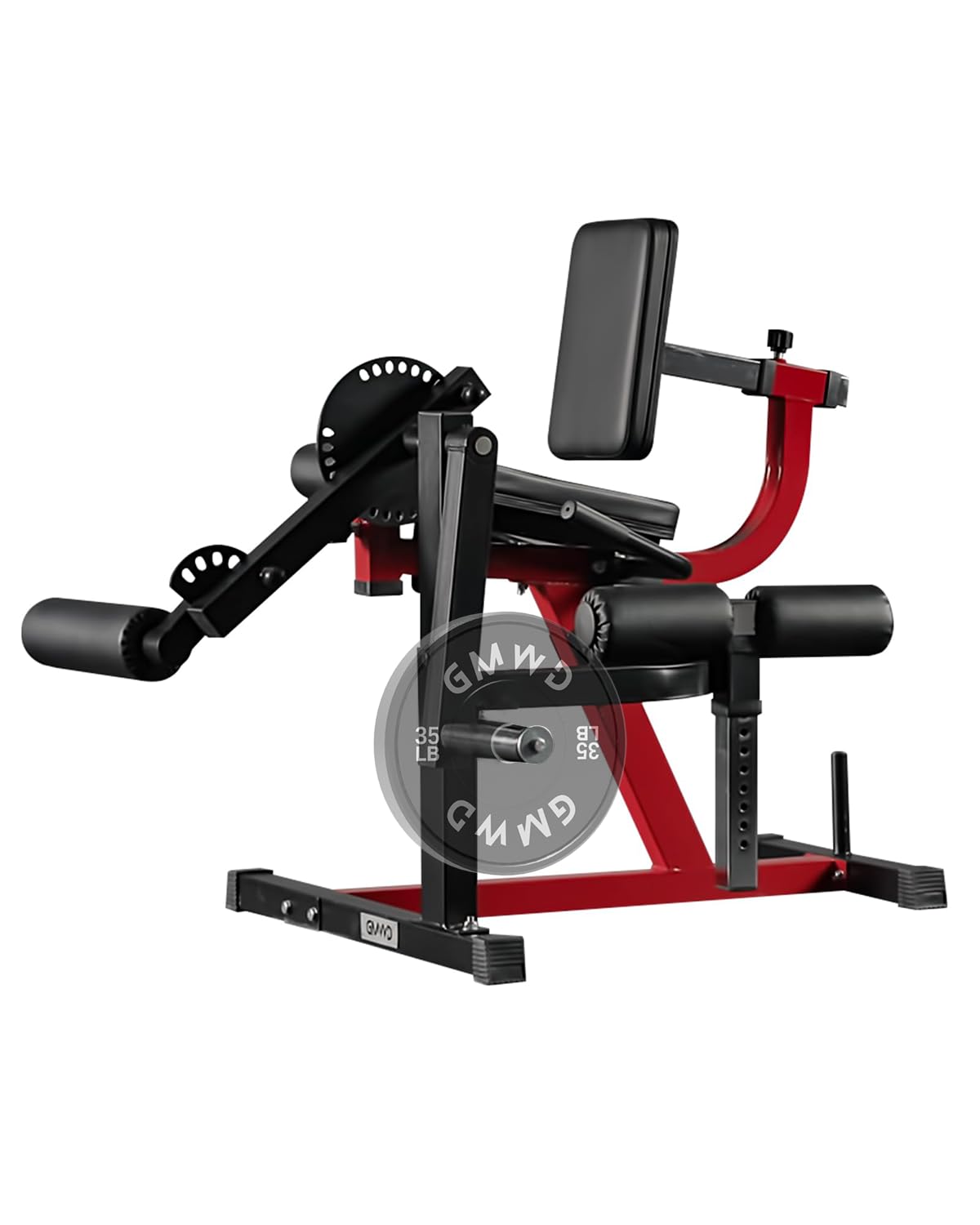
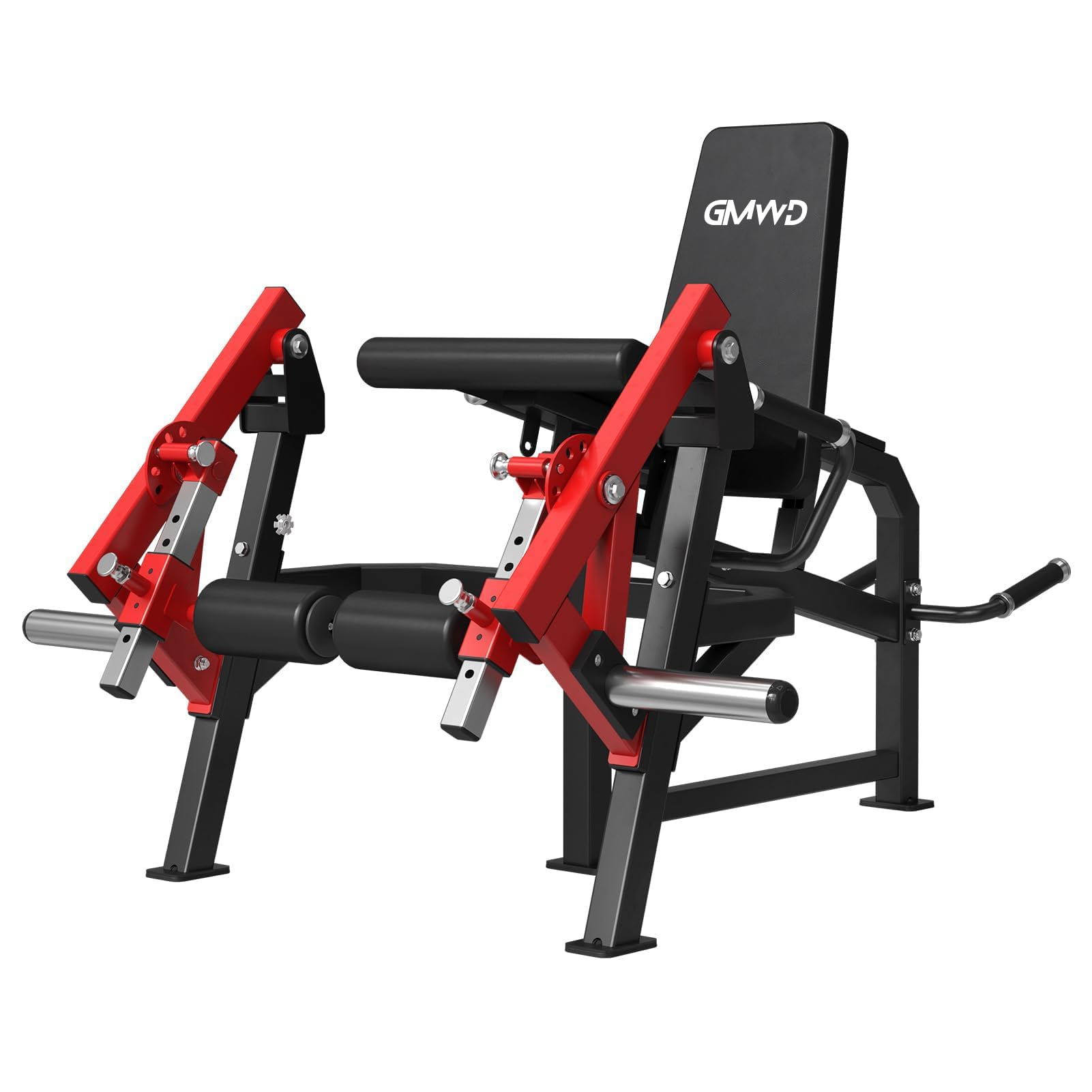
GMWD LE02 Leg Extension and Curl Machine

GMWD

GMWD LE02 Leg Extension and Curl Machine

  • Footprint 34"D x 36"W x 37"H
  • Adjustment 28+5 leg, 8 back, 4 seat positions
  • Unit Weight 95 lb
  • Tension Supported 300 lb
Check Price on Amazon

Compact, plate loaded, and adjustable enough to fit most home gyms and most bodies.

Thirty-four inches deep and 36 inches wide is the whole footprint, and that's the number that put this machine at the top of our list. A leg station you can drop where a compact bench would sit changes what a spare room can be. At 95 pounds the frame is heavy enough to stay planted without turning setup into a two-person job, and plates go straight onto the post, so there's no cable to fray or replace.

The switch between extension and curl is a set of removable pins rather than a wrench, and the pins double as a lock once the arm is seated. There are 28 plus five leg positions, eight backrest angles and four seat depths, which is more range than most people will ever use, but it's what lets a short lifter and a tall one share the same machine. The seat pad is built up at the edges so the frame doesn't dig into your thighs on curls.

What settled it for us is the combination rather than any single figure: the smallest footprint of any full-featured machine here, the widest adjustment range, and a plate-loaded design with nothing to wear out. It handles extension, curl and a glute bridge, so it covers the whole lower-body isolation job rather than half of it. If you're buying one machine and you don't have a specific reason to choose another, start here.

Two things are worth knowing. The adjusters carry no numbers, so mark your settings with tape the first time you find them, and you'll save yourself a minute of hunting every session. And this is a 95-pound frame with a 300-pound plate rating: it stays planted in normal use, but it isn't the machine for someone chasing maximum loads on a curl.

Bottom Line

Our default pick: it fits more rooms and more bodies than anything else here, with nothing in the resistance path to wear out.

Check Latest Price

Best for Load Progression

Our Score 8.8/10
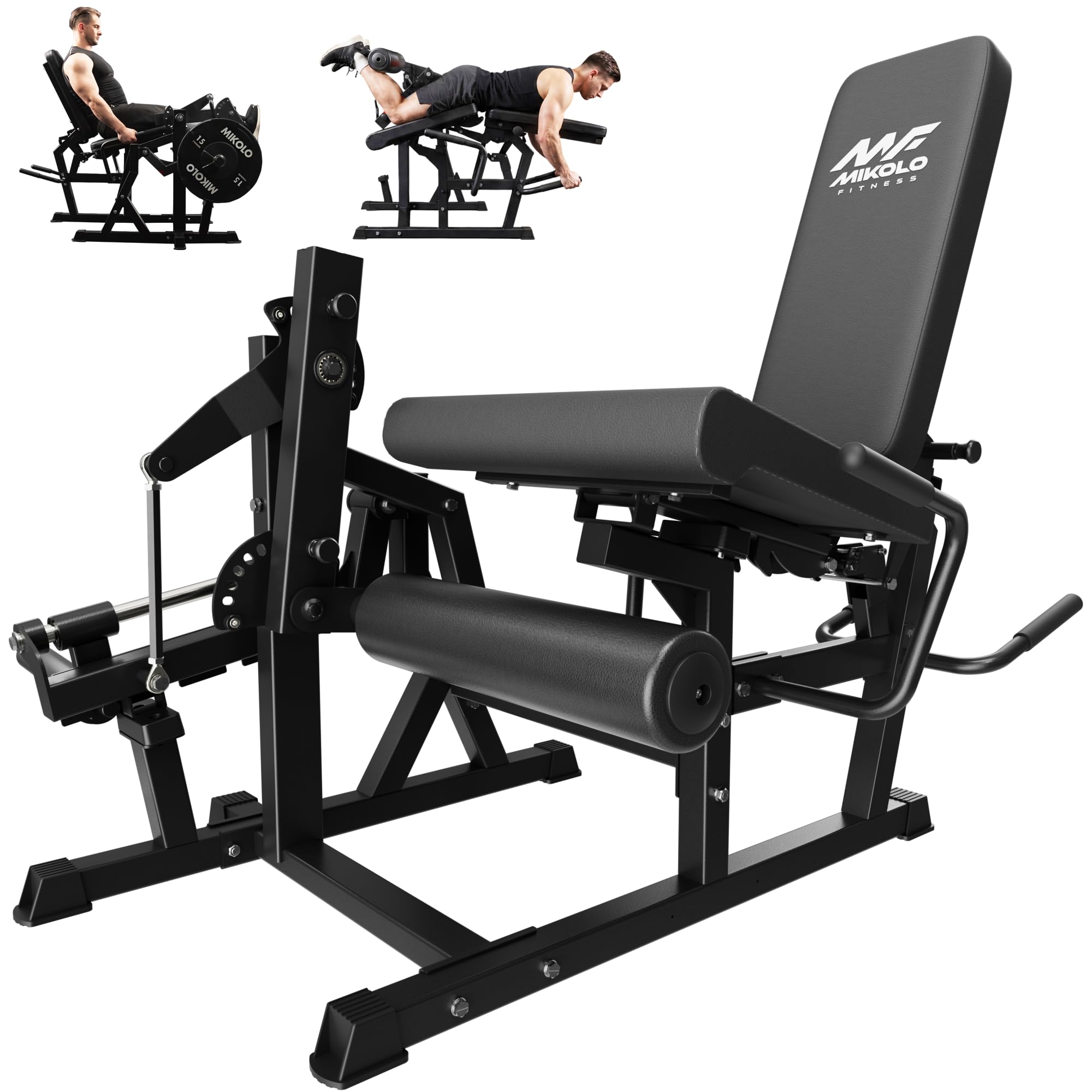
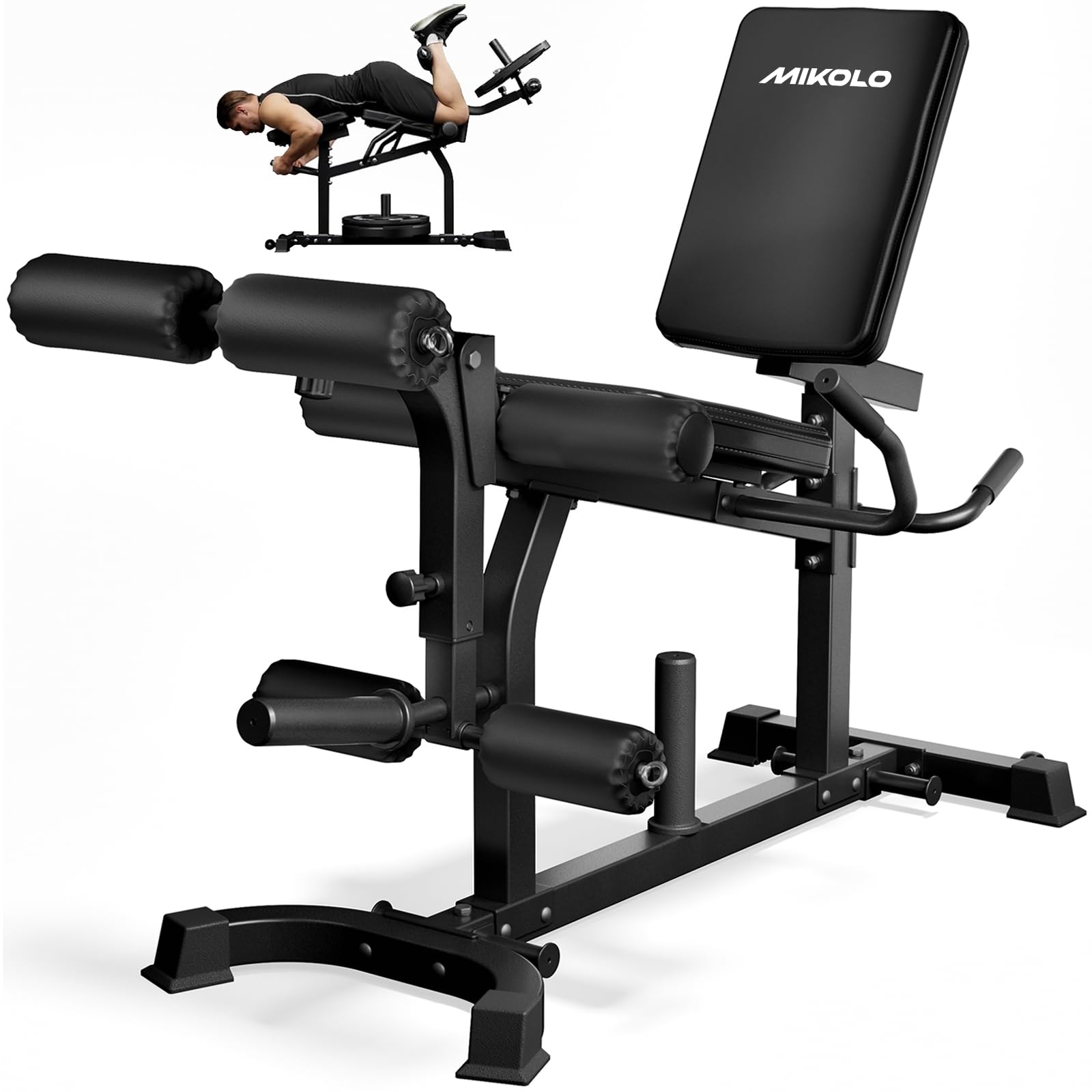
Mikolo LE12 Leg Extension and Curl Machine

Mikolo

Mikolo LE12 Leg Extension and Curl Machine

  • Footprint 56.5"D x 51.18"W x 47.24"H
  • Resistance 100 lbs to 120 lbs
  • Unit Weight 136 lb
  • Max User Weight 400 lb
Check Price on Amazon

A resistance dial lets you add small load jumps without stopping to change plates.

On a plate-loaded machine, dropping ten pounds usually means stripping a 45 and putting it back. The LE12 sidesteps that with a three-step load ratio, 1.0, 1.1 and 1.2, which moves the effective resistance between 100 and 120 pounds without touching the plates. It's a small thing until you're on the last set of a hamstring curl and the jump you actually needed was ten pounds, not forty-five.

At 136 pounds it's the heaviest machine here, and we think that weight is the point. The base doesn't shift when you push the final rep and the arm tracks cleanly through the whole sweep, so the resistance stays where you set it instead of hunting. Eight starting positions place the arc where your knee wants it, and the 12-degree V-pad with its abdominal gap keeps you from folding around your own diaphragm on lying curls. This is the machine we suggest when someone's training is specific enough to care about small jumps.

Assembly is straightforward and the padding is the firmest in the group, which matters on lying curls where your shins take the load. The one thing to watch is the shin pad: it can drag rather than roll on the ankle, so set the roller height before you load it and check it again when you switch modes. Set up right, this is the quietest, most planted curl here.

Bottom Line

We point to this one when load progression matters and the floor can spare the space; the resistance dial earns its keep.

Check Latest Price

Best For Cable-smooth resistance

Our Score 8.8/10
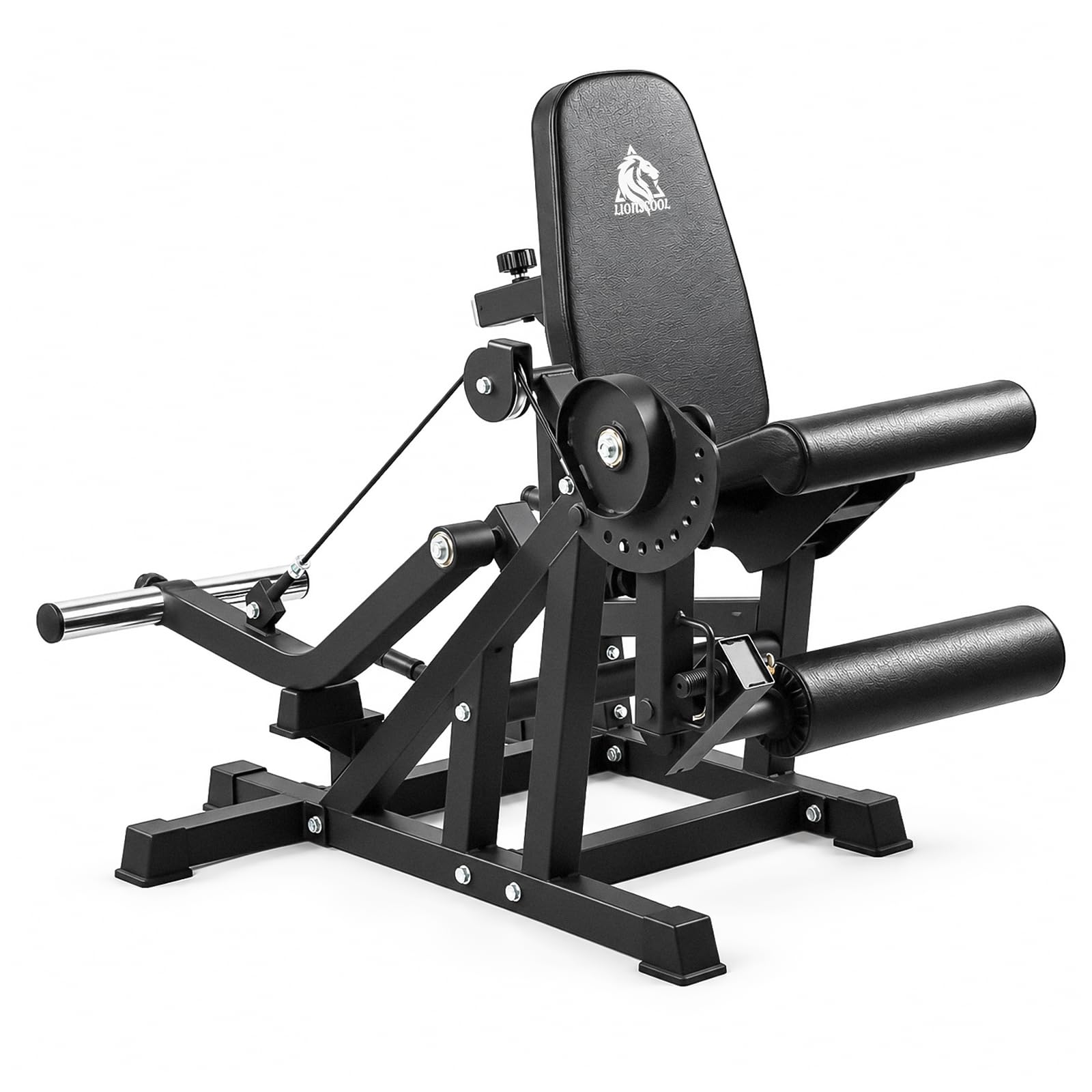
LIONSCOOL V4.0 Leg Extension and Curl Machine

LIONSCOOL

LIONSCOOL V4.0 Leg Extension and Curl Machine

  • Tension 400 lb
  • Footprint 57"D x 43"W x 40"H
  • Unit Weight 125 lb
  • Max User Weight 800 lb
Check Price on Amazon

A cable and pulley does something a plate post can't: the resistance tracks the strength curve instead of fighting you hardest where you're weakest. LIONSCOOL runs a 6mm cable over an aluminum pulley, so the curl loads up where the hamstring has leverage and eases where it doesn't. That's the first thing you notice in a set and the last thing you stop noticing.

The seat is the other half of the design. Three segments, seat, mid-section and backrest, and no knee holder, which means you sit down and stand up the way you would on a bench instead of threading a leg under a pad. Six seat-depth positions cover a spread of femur lengths, and the frame is rated to 800 pounds of user weight.

In use it's smooth and quiet, and it trains quads and hamstrings well enough that you stop missing the machine at the gym. Assembly is the weak point. The instructions are thorough, but the build takes a couple of hours, and the finish marks easily against a plate or a vacuum cleaner.

This is the one we suggest to someone who wants a cable feel, has 57 by 43 inches to give it, and would rather have a wide, easy-entry seat than another few degrees of adjustment. It's a machine you buy for the resistance, and the rest of it is a fair trade for that.

Bottom Line

We choose it for the cable feel and the easy entry; it rewards controlled, moderate training more than heavy loading.

Check Latest Price

Best Value

Our Score 8.6/10
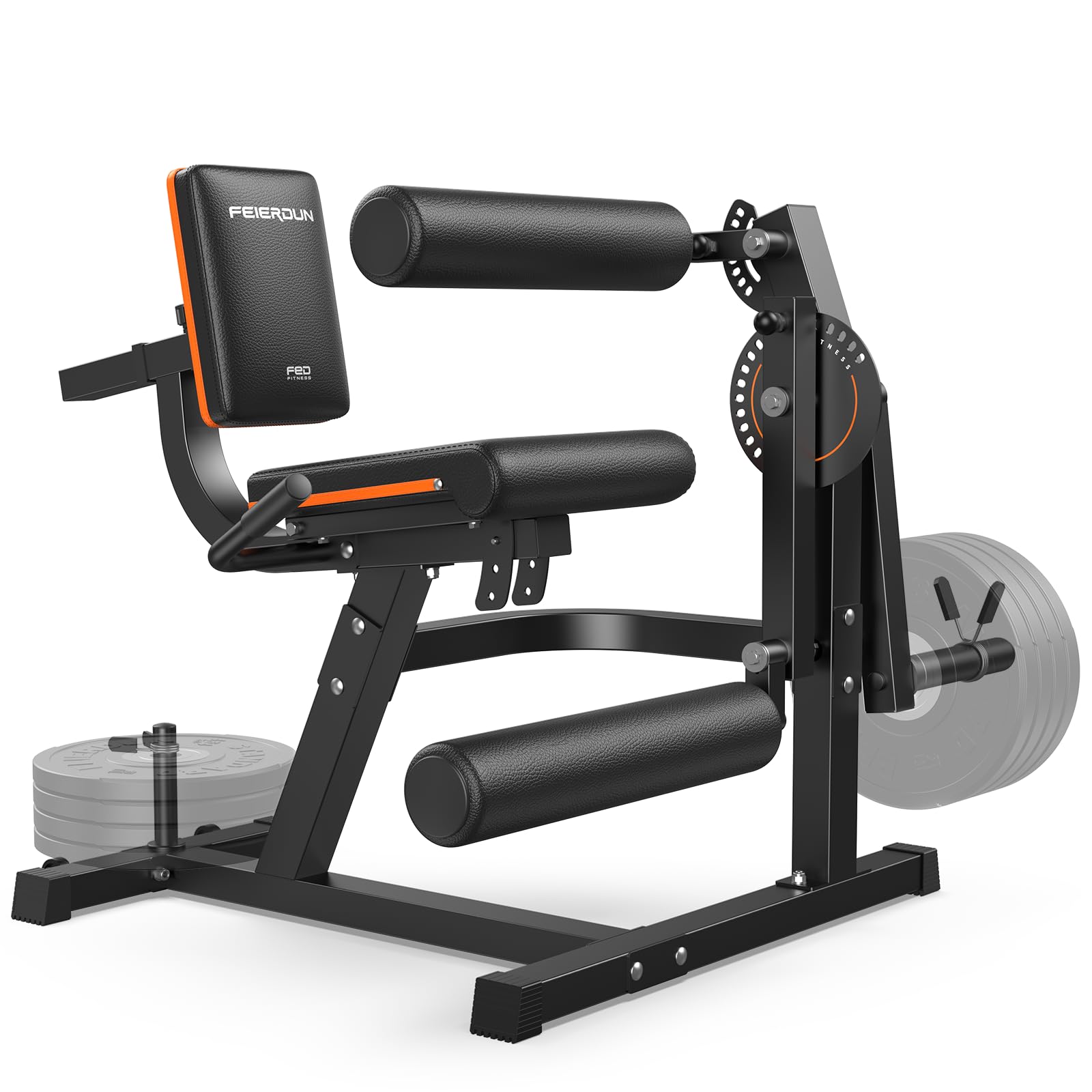
FEIERDUN 4-in-1 Leg Extension and Curl Machine

FEIERDUN

FEIERDUN 4-in-1 Leg Extension and Curl Machine

  • Motion Linear bearings
  • Footprint 38.5"D x 34"W x 38.5"H
  • Tension Supported 700 lb
Check Price on Amazon

Full adjustment and a smooth linear-bearing arc for the price of a midrange bench.

Linear bearings on a machine in this bracket are the detail that makes it worth a look. The arm rides on rails rather than a bushing, so the arc stays smooth when you slow the negative down, which is where cheap machines usually announce themselves. The frame is rated to 700 pounds of tension and the whole station is 38.5 inches deep, small enough to live beside a rack instead of replacing it.

The hardware comes bagged by assembly step and the instructions are good enough that most people won't need the video. Switching between extension and curl is a plug-and-play swap rather than a rebuild, and the seat and backrest move through enough positions to fit most heights. The seat pad curves up at the edges, which keeps your thighs from sliding forward on the way down.

Where it lands is the value pick: most of what the midrange machines do, for less, on a footprint that fits a corner. One thing to solve before your first heavy set: on a smooth floor the frame will walk once the load climbs, and parking a pair of plates on the rear foot settles it completely. Do that and it stays exactly where you put it.

Bottom Line

Our value pick: smooth linear bearings, a small footprint, and a plate post that fills faster than it should.

Check Latest Price

Best Compact

Our Score 8.6/10
Mikolo LE00 Leg Extension and Curl Machine

Mikolo

Mikolo LE00 Leg Extension and Curl Machine

  • Loading Plates, bands, cable clip
  • Footprint 48.3"D x 21.7"W x 39.2"H
  • Unit Weight 55 lb
  • Tension Supported 440 lb
Check Price on Amazon

A 55-pound frame one person can move, with three ways to add resistance.

Fifty-five pounds is light enough that one person can walk this machine into a spare room and set it against a wall without planning the afternoon around it. It's 21.7 inches wide and about seven square feet of floor, the smallest station here. Resistance comes three ways, through a plate post, band pegs and a cable clip, so you're not stuck if you already own bands but no plates.

The catch is that a frame this light needs help staying down, and the fix is genuinely a two-minute job: a couple of plates on the base and it stops moving entirely. Once it's weighted, the arc runs smoothly, the five extension and four curl positions cover most heights, and the included 2-inch adapter means the post takes Olympic plates as well as standard ones. For an apartment, a spare bedroom, or anyone who has to fold the gym away between sessions, this is the compact machine we point people to.

Bottom Line

Our compact pick: light enough to move alone, small enough to leave out, and easy to ballast with two plates.

Check Latest Price

Best Budget

Our Score 8.6/10
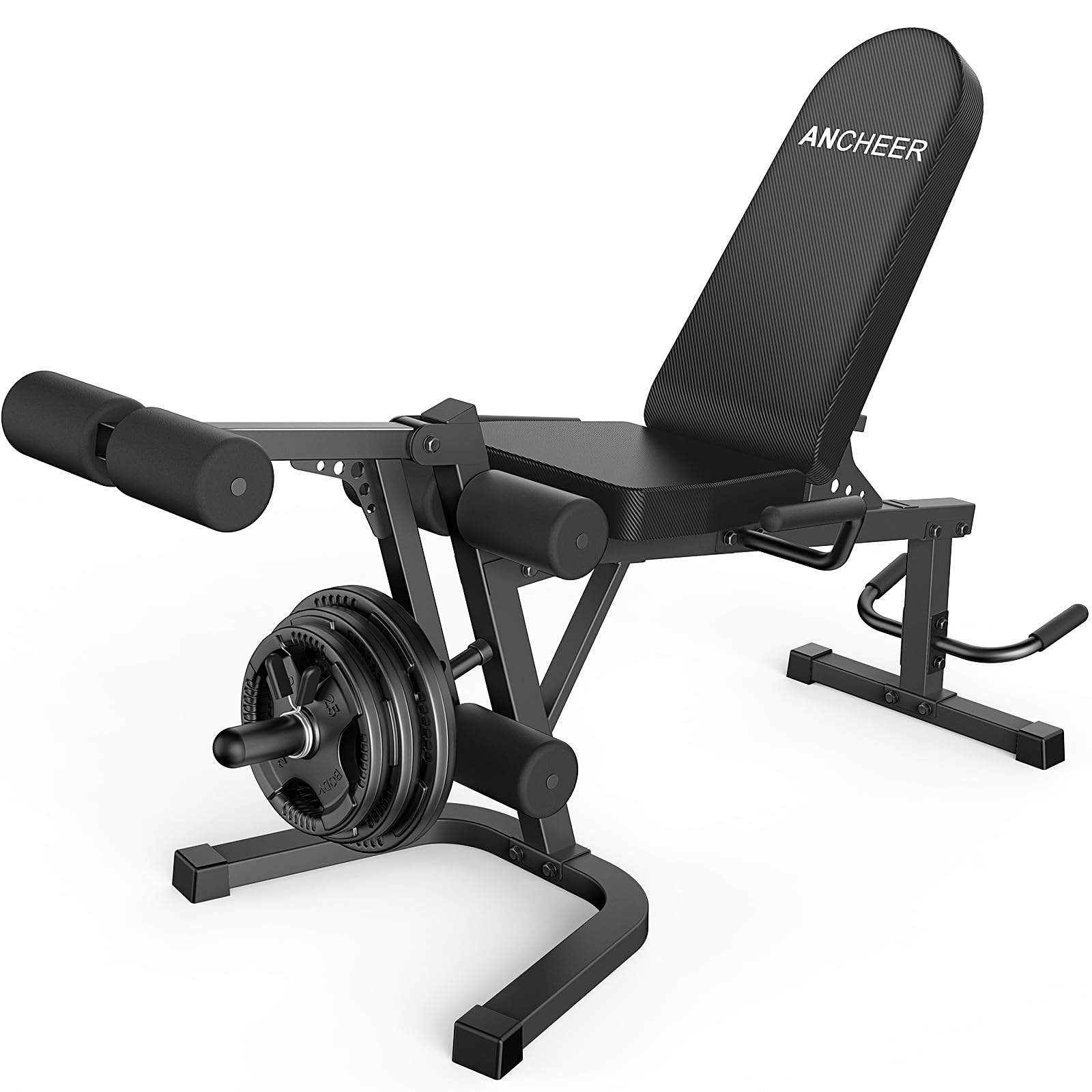
ANCHEER Leg Extension and Curl Machine

ANCHEER

ANCHEER Leg Extension and Curl Machine

  • Footprint 65.35" L x 20.87" W x 41.34" H
  • Plate Fit 1-inch and 2-inch
  • Adjustment 2 seat, 4 backrest positions
  • Tension Supported 880 lb
Check Price on Amazon

The narrowest frame here, and the least expensive way into the category.

At 20.87 inches wide, this is the narrowest machine in the group, narrow enough to sit in the strip of floor beside a car or at the end of a hallway. That's the whole case for it, and it's a good one if your gym is a slice of a room rather than a room. The frame runs 65 inches front to back, though, so it wants a wall rather than a corner.

The rest of the package is more than the price suggests. The 15-degree V-pad and abdominal gap are the same idea Mikolo uses, the notch system switches between extension and curl without tools, and the post takes both 1-inch and 2-inch plates. Fit runs to two seat positions and four backrest angles, fewer than the midrange machines offer but enough for most households.

Assembly is quick, the frame is sturdier than the tubing suggests, and the plate storage rides on the machine rather than the floor. What you're buying is the entry point to the category: two movements, a stable base, and a footprint that fits where a full station won't.

Bottom Line

We suggest it for a narrow room and a tight budget: the tightest fit across of anything here, with a curl stroke that ends early.

Check Latest Price

Best for Single-Leg Work

Our Score 8.4/10
GMWD LE03 Leg Extension and Curl Machine

GMWD

GMWD LE03 Leg Extension and Curl Machine

  • Leg Arms Independent left and right
  • Footprint 48"D x 32.5"W x 41"H
  • Unit Weight 115 lb
  • Plate Capacity 350 lb
Check Price on Amazon

Each arm loads and moves on its own, so the stronger leg can't take over.

The two arms on this machine work separately, and that's the whole reason to consider it. One leg at a time, each side loaded and moving on its own, so the stronger leg can't quietly take over the rep. That's the thing a shared axle hides and the thing that keeps a strength gap around for years. A pin locks the arms together when you want both legs on the same bar.

It covers seated extensions, lying curls and standing curls from one frame. The plate pin is rated to 350 pounds, the frame takes up to 700 pounds of user weight, and 115 pounds of steel means it doesn't walk across the floor between sets. Six ankle-roller positions, three seat settings and two backrest angles cover the height range on pop pins you can move mid-workout.

Build is where it asks for a little patience. Assembly runs about an hour and goes faster with two people, mostly because of the arm assemblies. Thread locker on the frame bolts is worth the ten minutes, since the hardware loosens with use, and a dab of lubricant inside the padded rollers stops the squeak that shows up after a few weeks. It's the kind of machine you tighten once a season and otherwise forget about.

Bottom Line

We recommend it when one leg is clearly stronger: independent arms make the gap obvious, and the frame stays put.

Check Latest Price

How We Tested Leg Curl Machines at Home

We started with a list of roughly 30 leg curl machines and bench attachments, then narrowed it by weight capacity, footprint, how far the ankle and back pads actually travel, and price, since this is a category where you can spend a fortune on a plate-loaded rig or a couple hundred on something that clamps to a bench. Eight made the cut. Each one lived in a garage gym or a spare bedroom and got used twice a week for six months by two testers, one 5-foot-2 and one 6-foot-3, because fit is the whole ballgame here.

Assembly came first: we built each machine solo with the tools in the box, timed it, and noted whether the hardware arrived sorted into bags or in one rattling pile. Then we got under the pads, curling slowly and watching whether our hips lifted off the seat at the top, where the pad landed above the heel, and how much the seat back could move — the machine that fits a shorter lifter often leaves a taller one curling with their hips in the air.

Stability got its own pass: a heavy final set to see if the frame rocked or crept across rubber flooring, and whether the base stayed put without being bolted down. We listened for chain slap, felt for a dead spot at the start of the curl, and tracked pad seams, vinyl creasing, and any bolt that worked loose over six months. We also taped each footprint on the floor, since most people are fitting one into a corner, and weighed what you get against what it costs.

How to Choose

Start With the Floor, Not the Feature List

Machines in this group run from 34 inches deep to 57 inches deep and from 21 to 51 inches wide, and the leg arm swings outside whatever rectangle the listing gives you. Tape the outline on the floor, add a couple of feet in front of the roller, and stand in the space. The difference between a machine you use and one you walk past is often two feet of clearance.

Narrow isn't the same as small. The ANCHEER is the tightest fit across at under 21 inches, but it runs 65 inches front to back, so it wants a wall rather than a corner. If space is genuinely short, the Mikolo LE00 is the better shape at roughly seven square feet.

Fit the Pivot to Your Knee

The joint that matters is where the machine's pivot sits relative to your knee. Get it wrong and the movement pulls at the joint instead of loading the muscle; get it right and the pad sits on the shin, not on the ankle. That's what backrest angle, seat depth and ankle-roller height are all adjusting toward.

Look for at least five roller positions and a backrest that reclines a long way. If two people share the machine, numbered marks are worth having, because matching a setting you found last week is harder than it sounds. Check the seat height against your own leg length before ordering; a seat that sits high leaves your feet dangling away from the roller.

Decide How You Want to Load It

Plate posts come in 1-inch and 2-inch, and a few machines here take both, which is worth checking if you already own a set. Post length matters more than the load rating: thick bumper plates eat roughly an inch each, and a short post fills up at three plates no matter what the frame claims.

Bands and cables are the other lever. The Mikolo LE00 has band pegs and a cable clip as well as a post, while the LIONSCOOL runs a cable and pulley. A pulley changes where the resistance peaks, which is why a cable machine feels different at the top of the curl. If you've never trained on one, that difference is the thing to try before committing.

Stability Is Half Your Floor

Every machine here is plate or cable loaded, which means what keeps it down is weight, not bolts. A 55-pound frame on a rubber mat will walk; the same frame with two plates parked on the base will not. Carpet is worse than rubber, and smooth concrete is worse than either.

Budget for ballast and for a hard, level surface, then re-torque the frame bolts after the first week. Frames in this group run from 55 to 136 pounds, and the heavier ones stay put with less help from you.

Pin, Notch, or Wrench

Switching between extension and curl is the thing you'll do most often, so it's worth knowing what it costs. The GMWD machines use pop pins you pull by hand, the ANCHEER uses a notch system with no tools, and the FEIERDUN is a plug-and-play swap. None of them needs a wrench, and that's the bar to hold any machine to: a switch that requires a tool is a switch you'll stop making.

Frequently Asked Questions

Final Verdict

Across the eight machines here, the GMWD LE02 is the one we hand to most people. It takes 34 inches of depth, adjusts from short to tall, switches between extension and curl on a pin, and puts nothing in the resistance path that can fray or stretch. That combination is why it sits at the top rather than a bigger or fancier frame.

If your program lives on small load jumps and the floor can spare 56 inches, the Mikolo LE12 is the better machine and we'd happily train on it. If the reason you're shopping is a strength gap between legs, the GMWD LE03's independent arms are the only ones here that answer the question directly.