Home Gym

Best Kettlebell Storage Racks of 2026

The first time a 35-pound kettlebell rolled off a shelf and landed a foot from my toes, storage stopped being an afterthought. Bells are awkward by design: round bottoms, thick handles, heavy enough that peeling one off the floor between sets gets old fast. A bad rack turns the corner of a garage into an obstacle course; a good one keeps every bell at hip height and exactly where you left it. Over the past eight months, my team and I have assembled, loaded, and lived with 12 racks and storage stands.

Here's what nobody tells you first: kettlebells aren't standardized. A rack advertised to hold five may only take four of yours once handle thickness and base width come into play, and a weight rating usually applies per shelf rather than to the whole unit. We checked all of that, in a garage and a spare room. The picks below run from a two-bell corner stand to a full floor rack.

Best for Big Collections

Our Score 9.6/10
JX FITNESS 3-Tier Weight Rack

JX FITNESS

JX FITNESS 3-Tier Weight Rack

  • Tiers 3 plus top platform
  • Dimensions 28.2"D x 39.4"W x 31.4"H
  • Item Weight 46.5 lb
  • Weight Capacity 1,100 pounds
Check Price on Amazon

The most capacity here, with tier spacing that adjusts around tall bells.

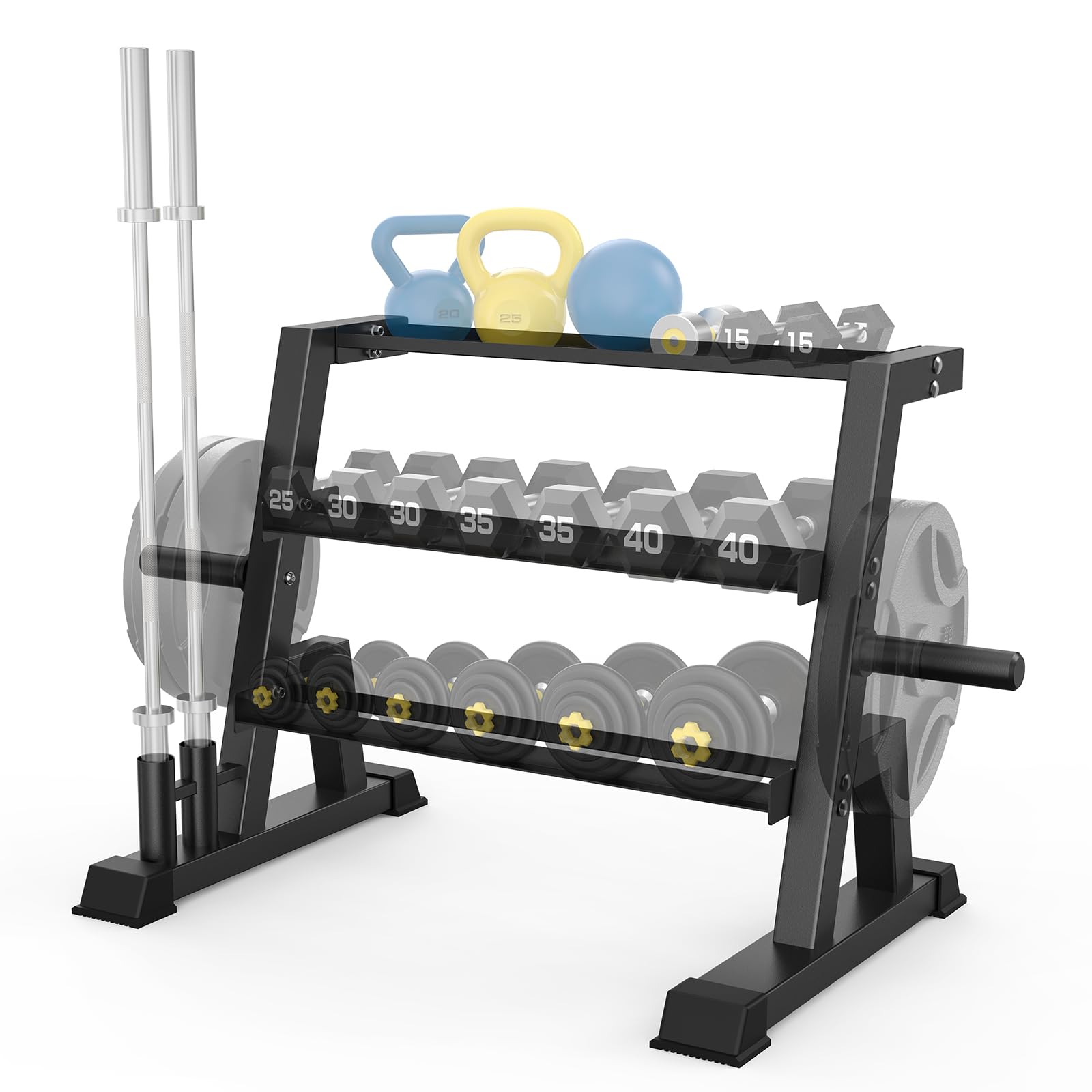
Eleven hundred pounds is the highest capacity in this guide, and it buys something specific: room for a full run of dumbbells and the kettlebells that go with them. Three tiers carry dumbbells across their length, the spacing between those tiers adjusts, and a flat top platform takes the bells, the medicine balls, or anything else too round to sit in a cradle.

We rank it second rather than first for a simple reason: kettlebells are guests here rather than residents. They live on the platform up top, which is flat and generous but finite, while the tiers below want handles. In a mixed gym that arrangement works well, and the adjustable spacing means a tall 44 does not have to fight a short 18 for the same gap. For a bells-only collection, the CAP gives you more shelf per bell.

The other cost is floor. At 28.2 inches deep it is the deepest rack here, several inches beyond anything else, and 39.4 inches wide is a real stretch of wall to give up. It also arrives at 46.5 pounds, so decide where it lands before you build it. In a garage or spare room none of that matters; in a bedroom corner, measure the depth first.

Bottom Line

If your collection keeps growing, this is the one we recommend: 1,100 pounds of capacity, tier spacing that adjusts, and a flat top platform for the heaviest bells.

Check Latest Price

Best Overall

Our Score 9.4/10
CAP Kettlebell Rack

CAP

CAP Kettlebell Rack

  • Dimensions 16"D x 24.6"W x 22.6"H
  • Shelf Length 20 inches
  • Weight Capacity 500 lb
Check Price on Amazon

Purpose-built shelves that hold round bells at knee height, not on the floor.

Round base, wide handle, nothing flat to stand on: a kettlebell is an awkward thing to store, and most racks solve it by handing you a flat shelf and hoping. This CAP rack is built around the shape instead. Twenty-inch shelves sit on a frame only 22.6 inches tall, which puts the handles at knee height rather than floor level, and that low height is the detail we appreciate most. You start a set by grabbing a bell, not by deadlifting one.

Five hundred pounds of capacity is enough for a normal home collection. Pairs from 15 through 30 sit on the shelves with room left over, and when a 53 joins them, flipping the top shelf gives the taller bell clearance. That flip matters more than it sounds: it means the rack keeps working as your collection gets heavier instead of topping out at the intermediate bells, which is exactly where a cheap two-tier gives up.

It is small, and that cuts both ways. At 24.6 inches wide it disappears into a corner, but the shelves are 20 inches, so two of everything from 10 to 53 will crowd long before you reach the weight limit. Buy it for a set you are still building rather than a showroom you already own. If the showroom is the situation, the JX below has the capacity and the width for it.

Bottom Line

The only rack here built around kettlebell shapes first, and the one we point most people to: 500 pounds of capacity, 20-inch shelves, and handles at knee height.

Check Latest Price

Best High-Capacity for Tight Floors

Our Score 9.4/10
BEKING 3-Tier Dumbbell Rack

BEKING

BEKING 3-Tier Dumbbell Rack

  • Tiers 3
  • Dimensions 20.9"D x 37"W x 32.3"H
  • Weight Capacity 1,000 pounds
Check Price on Amazon

Nearly the same capacity, folded into a 21-inch-deep frame.

Twenty and nine-tenths inches deep, 37 wide, 32 tall. The BEKING answers the question the JX raises: when your gym shares space with a parked car, this is the shape that fits. Three tiers and 1,000 pounds of capacity in a frame that stays near the wall is the trade most garage gyms want to make.

The layout is conventional in the best way: two lower tiers for dumbbells, a flat top shelf that takes kettlebells and dial-a-weights, and an anti-rust coating for a damp space. The hardware arrives bagged by assembly step with a wrench in the box, which is the difference between a rack that gets built on a Saturday and one that sits in its carton until spring.

The case for it is depth, and depth is what the extra money buys: 20.9 inches instead of 28.2 is the difference between a rack sitting against the wall and one jutting into the walkway, and it still holds a thousand pounds. We think that trade is worth the premium in a garage and harder to justify in a spare bedroom, where the top pick's smaller footprint does the same job.

Bottom Line

We recommend it when floor depth is the constraint: thousand-pound-class storage in a 20.9-inch frame that sits flat against the wall.

Check Latest Price

Best for Small Spaces

Our Score 9.2/10
Josmimic 2-Tier Dumbbell Rack

Josmimic

Josmimic 2-Tier Dumbbell Rack

  • Bar Width 2 to 6 inches
  • Dimensions 10"D x 20"W x 17"H
  • Weight Capacity 250 lb
Check Price on Amazon

A two-tier rack that disappears into a bedroom corner.

Two tiers, 20 inches wide, 17 tall, 2.8 kg on the spec sheet. This is a rack for the corner of a bedroom, not a garage wall. The bars adjust from roughly 2 to 6 inches across in four steps, which is the whole trick: narrow for a kettlebell to sit in the gap, wide for a pair of hex dumbbells to lie flat. We like how completely it commits to being small; nothing about it pretends it will hold a full set.

Two hundred and fifty pounds is the lowest ceiling here, and that is the honest limit. A pair of 15s, a pair of 20s and a kettlebell or two is about the working range; past that you are buying a second rack. Below it, there is little to argue with: leveling feet handle a floor that is not level, the little wrench comes in the box, and the whole thing goes together in minutes. If you are storing 35s, the CAP two-tier is the better shape.

Bottom Line

We like it for a bedroom corner and a few pairs of light weights: 20 inches of floor, bars that adjust, and assembly measured in minutes.

Check Latest Price

Best For Plates and bells

Our Score 9.2/10
Marcy Weight Storage Organizer Rack

Marcy

Marcy Weight Storage Organizer Rack

  • Storage 3 shelves, 4 posts
  • Dimensions 18.5"D x 54"W x 36"H
  • Weight Capacity 1,000 pounds
Check Price on Amazon

Three shelves and four storage posts: the Marcy is the only rack here that wants your plates as well as your bells. Fifty-four inches of frame spreads a mixed home gym along a wall, with plates on the end posts, dumbbells across the tiers and kettlebells up top where they are easiest to reach. A thousand pounds of total capacity gives you room to distribute that weight rather than piling it onto one shelf.

The hammertone finish is the detail we appreciate most. It is the coating you find on tool cabinets, and on a rack that lives in a garage it earns its keep by hiding scuffs; rubber caps on the feet keep the frame from marking concrete. Assembly is manageable, though the frame is long enough that a second pair of hands makes it much less annoying.

Width is what you are paying for. At 54 inches it is roughly twice the CAP kettlebell rack, and if kettlebells are all you keep, the plate posts are dead weight on both ends. Buy it when you genuinely have plates and dumbbells to house next to the bells. For a bells-only gym, the smaller rack uses the same stretch of wall twice as well.

Bottom Line

We recommend it for a mixed garage gym where plates and dumbbells need homes alongside the bells; for bells alone, the width is hard to justify.

Check Latest Price

Best For Starter sets

Our Score 8.8/10
CAP Barbell 24-Inch Dumbbell and Kettlebell Rack

CAP Barbell

CAP Barbell 24-Inch Dumbbell and Kettlebell Rack

  • Tiers 2
  • Dimensions 18"D x 24"W x 23.5"H
  • Weight Capacity 300 lb
Check Price on Amazon

Twenty-four inches wide, two tiers, 300 pounds across both. This is the plainest rack here, and for a first set of weights that is mostly a virtue. Rubber-trimmed cradles hold dumbbells and kettlebells without chewing up a finish or a floor, and there is nothing to adjust, which means nothing to get wrong.

We treat it as a starter rack. Three hundred pounds covers a couple of 25s, a pair of 35s and a 20 with room to spare, and it gets them off the carpet without claiming much wall. It is not the rack for a collection that is still growing: the shelves fill fast, and the horizontal bars are wide enough that very small hand weights do not sit cleanly.

Assembly is where to slow down. The base bolts are the ones that matter: if one does not seat all the way, the frame rocks, and tightening everything else will not fix it. Build it on a flat surface, check the base before you load it, and this is a sound place to start for a small gym.

Bottom Line

We treat this as a first rack: 300 pounds across two tiers gets a starter set off the floor without claiming a wall.

Check Latest Price

Best For Adjustable dumbbells

Our Score 8.8/10
niffgaff Adjustable Dumbbell Stand

niffgaff

niffgaff Adjustable Dumbbell Stand

  • Dimensions 16.1"D x 16.7"W x 25"H
  • Top Tray Fits Dumbbells up to 17" long
  • Weight Capacity 500 lb
Check Price on Amazon

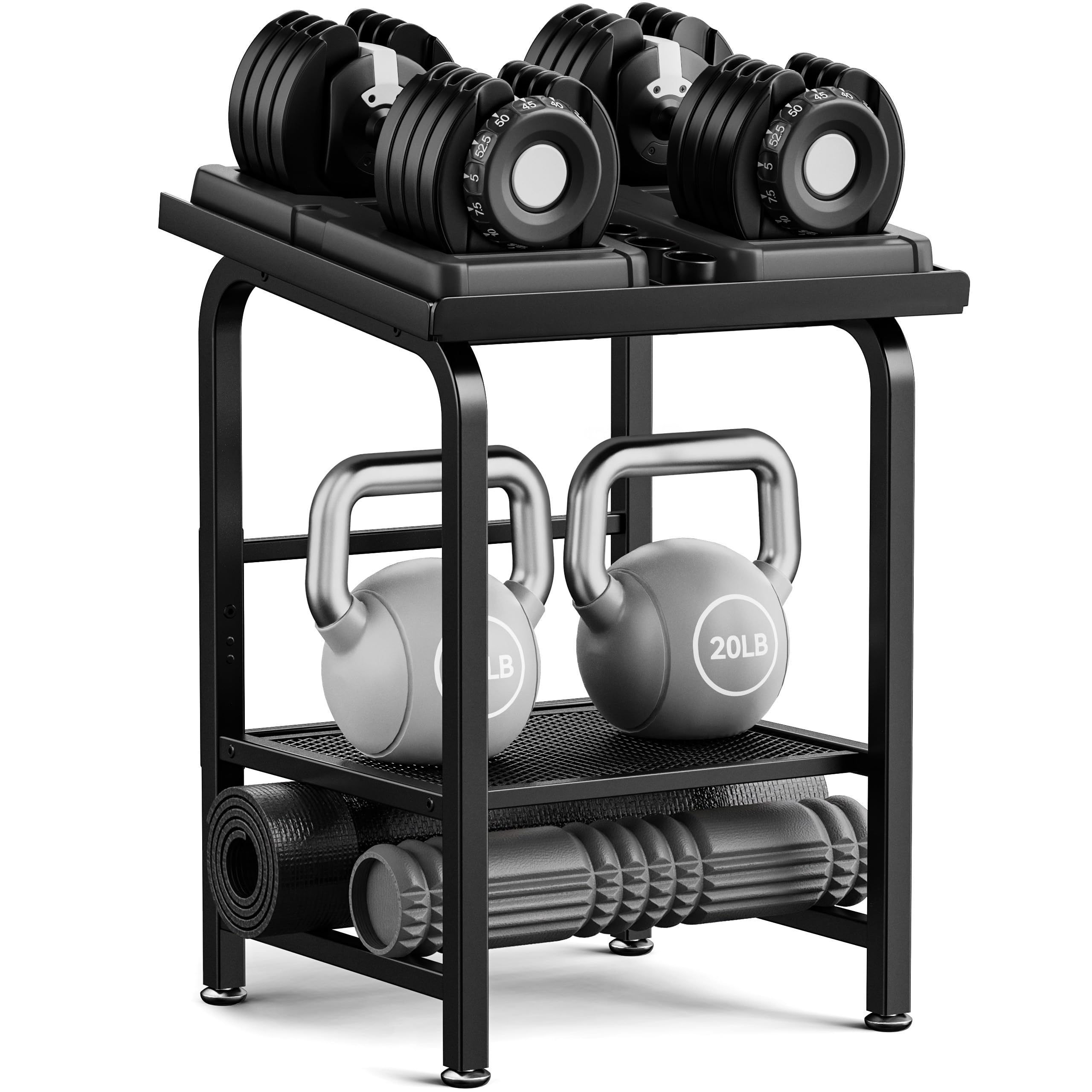
Seventeen inches long, 8.6 inches wide: that is the tray on top, and it tells you what this stand is for. Adjustable dumbbells, including Bowflex and PowerBlock sets, sit on the platform where you can reach them, and a couple of kettlebells go on the shelf underneath.

Five hundred pounds of capacity is generous for that arrangement, and the reinforced H-frame is aimed squarely at the problem these stands have: a garage floor or a carpet that is not level. The rotatable feet are the feature we appreciate most, because a twist of one foot stops the rock and lets the stand sit flat.

Two things to check before ordering. Measure your dumbbells against the tray, since a set longer than 17 inches will not sit properly. And look at the height: at 25 inches, the tray sits lower than the top shelf of a full rack, so heavy adjustable sets come up from nearer the floor.

For an adjustable-dumbbell owner with a couple of bells, this is the most space-efficient stand here at 16.7 inches wide. For a kettlebell collection, it is the wrong shape: one lower shelf will not hold a set, and the tray above is cut for dumbbells. That is the line. Buy it for the dumbbells and let the bells come along.

Bottom Line

We like it for adjustable dumbbells with a couple of kettlebells underneath; as a bells-only rack, it is not the right shape.

Check Latest Price

How We Tested Kettlebell Racks and Stands

We started with a list of anything actually sold as kettlebell storage rather than a generic weight tree, then narrowed it by footprint, published per-shelf weight ratings, and whether the manufacturer gave real dimensions instead of a vague bell count. Anything that couldn't tell us its own shelf depth or height got cut. Twelve units made it through, and we've had them in rotation for eight months.

Each rack went into one of two spots: a concrete garage floor and a carpeted spare room, because the same stand can feel rock-solid on one and shifty on the other. We assembled every one solo with only the included hardware, timing it and noting whether the holes lined up without persuasion. Then we loaded each to its stated capacity, pushed it with a hip, and watched for rocking, flex in the uprights, and shelves that bowed under the bottom row.

For weight accessibility, we ran circuits and reached for the lowest bell mid-set, marking down whether it took a squat, a bend, or nothing at all, and whether the handle of a tall bell clipped the shelf above it. We also measured footprints against a standard mat, checked which shelves adjusted or came fixed, and compared price against real usable capacity rather than the number on the box.

How to Choose

Match the Shelf to the Shape

Kettlebells do not sit in a dumbbell cradle. A hex dumbbell has a flat face and a straight handle you can trap between two rails; a kettlebell has a round base and a wide, curved handle, so it wants a flat shelf or a gap wide enough to swallow the bell. It is the mismatch to watch for in this category: racks whose adjustable bars are ideal for dumbbells and too narrow, or too V-shaped, for a bell.

Check shelf width before anything else, and if you store both kinds of weight, look for at least one genuinely flat level. The CAP kettlebell rack is built around the round base from the start; the JX handles bells on a flat platform above tiers meant for handles.

Add Up the Weight, Then Look at Where It Sits

A thousand-pound rack sounds future-proof until you notice the bells only fit on the top platform. Totals matter, but distribution matters more: a pair of 53s is 106 pounds, and a run from 10 to 45 comes close to 300. Work out what your own collection weighs, then check that those pieces physically fit where the rating applies.

The CAP kettlebell rack's 500 pounds is generous spread across shelves that take pairs; a figure like that concentrated on one tray would feel tight.

Measure Depth Before Width

Depth decides whether a rack fits the room you actually have. Most of the racks here stand 16 to 21 inches off the wall; the JX runs to 28.2, which is a different order of commitment. Tape that distance on the floor from the wall to where the front edge should land, stand in the gap, and only then check the width against your wall.

A rack four inches too deep turns a clear walkway into an obstacle every time you train, and it is the one error you cannot fix by rearranging the plates.

Plan for Stability and Access

Two things make a rack feel solid: a base that sits flat and weight loaded low. Leveling feet, on the Josmimic and the niffgaff, deal with a sloped garage floor or thick carpet and are worth having. If a new rack rocks, work through the base bolts before you load anything onto it.

Then load it deliberately. The heaviest bells belong on the bottom shelf, where the lift is easiest and the frame is least likely to be asked to save a bad decision.

Frequently Asked Questions

Final Verdict

For a kettlebell collection, the CAP kettlebell rack is the one to buy: shelves shaped for round bases, 500 pounds of capacity, and handles at knee height instead of floor level, all inside 25 inches of width. Measure your depth before ordering, because every rack here stands further off the wall than its width suggests.

If dumbbells share the room, the JX holds more weight than anything else in this guide and adjusts around tall bells, while the BEKING is the version that stays close to the wall.