Strength & Weights

Best Home Gym Pulley Systems of 2026

A home gym pulley system is gloriously uncomplicated: a cable, a pair of pulleys, a load pin, and something solid to hang it from. That simplicity is exactly why the differences between kits matter so much. Pick the wrong one and you get a cable that saws into a doorframe or runs out of travel halfway through a fly; pick the right one and a corner of the garage becomes a cable station you use four times a week. What you're actually buying is range of motion — lat pulldowns, face pulls, and triceps work without surrendering a whole wall to a weight stack.

Over the past six months, my team and I have hung, clamped, and loaded 12 different systems, and the pattern held: the ones that feel rock solid are the ones with fewer moving parts and better hardware, not the longest feature list. Here's the thing first-time buyers almost always get wrong — measure the entire path from your highest anchor point down to your lowest hand position, then add a couple of feet, because a cable that's only just long enough will quietly limit every overhead pull you attempt. The picks below are the kits that survived daily use, and there's one here whether you're anchoring to a door, a stud, or a rack.

Best Overall

Our Score 9.4/10
Concho Weight Pulley System

Concho

Concho Weight Pulley System

  • Cables Two 70 in, one 55 in, plus chains
  • Handles Three detachable
  • Max Load 350 lb
  • Loading Pin 12 inches
Check Price on Amazon

Three cable lengths and a 350-pound rating fit nearly any anchor height.

Cable length is where most of these kits fall down, and it's the first thing Concho gets right. The box holds two 70-inch cables, a 55-inch cable, and a set of extension chains, so the same pulley hangs high off a beam for lat pulldowns and short off a low bar for curls without a coil of slack trailing across the floor. If your garage ceiling is lower than your last gym's, that 55-inch cable is the piece you'll reach for most.

The hardware backs it up. The loading pin runs 12 inches, the dual pulleys rotate a full 360 degrees, and the rating is 350 pounds, the highest of the strap-hung kits here. Three detachable handles come in the box, including a straight bar and a triceps rope, which covers pulldowns, pressdowns, and face pulls without a second order. The pulleys run quiet as well, which we noticed most on evening sessions in a house where someone else is already asleep.

It is still a kit. Everything hangs from a strap, so you need a beam, a pull-up bar, or a rack, and the mount is only as solid as the thing the strap wraps. The handles are kit-grade rather than gym-grade, and at 8.8 pounds the whole assembly stuffs into a tote when you want the space back.

Bottom Line

This is the kit we recommend to most people: three cable lengths cover high and low anchors, and the 350-pound rating tops every other strap-hung set here.

Check Latest Price

Best Dual-Pulley Kit

Our Score 9.2/10
SERTT Dual Pulley System

SERTT

SERTT Dual Pulley System

  • Weight 11.3 lb
  • Handles Bars, ropes, straps
  • Pulleys Two
  • Max Load 330 lb
Check Price on Amazon

Two pulleys off one rack for crossovers, supersets, and single-arm work.

Two pulleys is the whole argument for this kit. Run both straps off the same rack and you can work crossovers, or clip one pulley high and one low and move between a pressdown and a row without re-rigging anything in between. That's the sort of convenience you notice two weeks in, when the new-toy shine has worn off and you still want to keep the session moving.

We rate it just behind the Concho for most people and ahead of it for anyone training on a rack. The 330-pound rating is honest for accessory work, the pulleys glide without snatching mid-rep, and the box includes bars, ropes, and straps for both stations, so you aren't hunting for a second handle. Packed down it weighs 11.3 pounds, light enough to hang on a hook between sessions.

The straps are the one thing to measure before you order. On a 3x3 rack with thick uprights they come up tight, and a strap that barely closes around the tube is not a mount we trust for heavy pulls.

Bottom Line

For a rack owner who wants two-sided cable work at home, this is the kit: dual pulleys, 330 pounds, and bars, ropes, and straps for both stations.

Check Latest Price

Best Budget

Our Score 9.2/10
FASPUP Pulley System

FASPUP

FASPUP Pulley System

  • Pulley Single
  • Weight 3.8 lb
  • Includes Rope, pin, strap, three carabiners
  • Max Load 300 lb
Check Price on Amazon

Under four pounds and rated to 300 pounds for basic pulls anywhere.

At 3.8 pounds this is the smallest thing on the list: one stainless pulley, one cable, a loading pin, a hanging strap, a triceps rope, and three carabiners. It's the kit that lives in a gym bag and comes out when you're travelling, or in a garage where a pull-up bar is the only structure you've got.

Nothing about it is fancy, and at the entry point that's fine. The 300-pound rating covers accessory work with room to spare, the pulley turns without complaint, and the rope is the same shape as the ones on a gym floor. You hang it, load a plate, and do pressdowns.

The limits are the design rather than a flaw. One cable means one length, so a low anchor leaves you managing slack and a high one may not give you the stretch you want; some people end up buying a shorter cable separately. A single pulley also can't give you the crossover angles a two-pulley kit can. For triceps, pulldowns, and face pulls off a bar, none of that matters much.

Bottom Line

The least expensive route to real cable work: light, complete, and rated to 300 pounds for solo sessions off a pull-up bar.

Check Latest Price

Best Freestanding Tower

Our Score 9.2/10
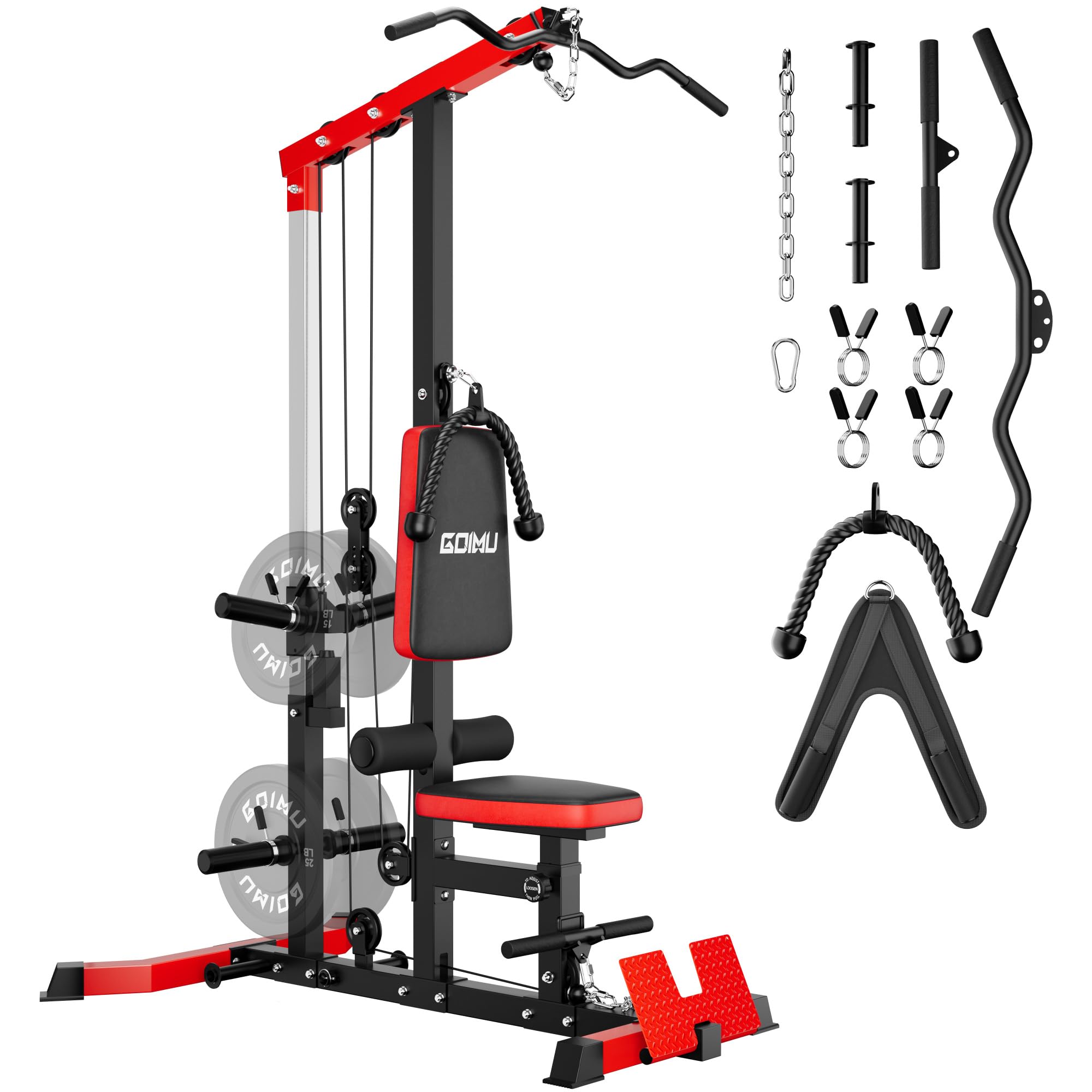
Goimu LS01 Lat Pulldown

Goimu

Goimu LS01 Lat Pulldown

  • Height 83.46 in
  • Max Load 800 lb
  • Stations Three
  • Footprint 3.12 sq ft
Check Price on Amazon

A full three-station cable tower in a 3.12-square-foot footprint.

A 3.12-square-foot footprint is the number that gets quoted, but the one that matters while you're standing in the garage deciding where it goes is 83.46 inches. This is a near-seven-foot tower: narrow enough to slot beside a car, not short enough to tuck under much of anything.

What you get for the height is three stations, a high pulley for pulldowns and overhead work, a low pulley for rows and curls, and an ab-crunch attachment. The seat adjusts through three heights, and the frame is 2mm steel tubing rated to 800 pounds, the highest number in this group by a wide margin. A lat bar, cable bar, triceps rope, and band pegs come with it.

Assembly is the part people dread, and it went better than we expected: bolts are bagged by step and every piece is labeled. At 80 pounds, build it where it will live rather than dragging it across the floor afterward. Once it's up, it sits still.

Where it gives up ground is adjustability of the pull itself. The pulleys are fixed high and low, so you're choosing between two angles rather than dialing in a height, and the leg hold-down could use one more setting for taller lifters. If you have no beam and no spare wall, though, this is the version that solves the problem outright.

Bottom Line

The answer when there's no beam and no spare wall: 800 pounds of capacity, three stations, and a seat that sets your row position.

Check Latest Price

Best For Compact two-mode kit

Our Score 9.2/10
Mikolo LAT and Lift Pulley

Mikolo

Mikolo LAT and Lift Pulley

  • Modes Two
  • Cables 70 in and 90 in
  • Weight 6.3 lb
  • Max Load 280 lb
Check Price on Amazon

The changeover is the interesting part. By re-routing where the hoist buckle meets the cable, you switch between a high-pulley setup for pulldowns and a low one for curls and rows, so a single pulley does two jobs instead of one.

Two sheathed cables come in the box, 70 and 90 inches, so you're picking a length rather than wishing for one. The alloy buckle is the load-bearing piece and it's built up properly, and the whole kit weighs 6.3 pounds, light enough to hang on the rack and forget about. The rating is 280 pounds.

Two things keep it out of the top tier. The cables run long, so a low anchor leaves slack to manage or a loop of cable hanging in the way. More seriously, the nut that secures the loading pin and the cable itself are the weak points, and both have failed under loads well below the 280-pound rating. We check both before every session and stay conservative with plates; if heavy loading is the plan, one of the higher-rated kits here is the smarter buy.

None of that rules it out for accessory work. It costs about the same as our top pick, fits where a tower won't, and the two-mode changeover is genuinely useful in a small gym. Load a couple of plates, do your pressdowns and curls, and it earns its place.

Bottom Line

The most popular kit here for good reason: two modes, two cable lengths, and a small footprint, with hardware that asks for a careful eye before each session.

Check Latest Price

Best Kit with a Warranty

Our Score 9.0/10
FitBeast Pulley System Gym

FitBeast

FitBeast Pulley System Gym

  • Cables 70 in and 90 in
  • Handles Rope, handle, lat bar
  • Max Load 330 lb
  • Warranty 2 years
Check Price on Amazon

Two cable lengths, three handles, and a stated two-year warranty.

The box covers a first cable setup properly: 70- and 90-inch cables, a triceps rope, a single handle, and an adjustable lat bar, plus a long loading pin for stacking plates. The cable is six strands of steel rope, the pulley turns a full 360 degrees so the rope doesn't twist on the way down, and the rating is 330 pounds.

For the money it's the most complete kit in the middle of this range, and the two-year warranty is the longest stated coverage of any strap-hung set here. The carabiners are the weak link: they're the lightest hardware in the box, and they're the part we check before loading the pin for heavier sets. Two cables also mean two anchor heights to work with, which keeps a low pull-up bar usable.

Bottom Line

A complete first cable kit: two cable lengths, three handles, 330 pounds, and a stated two-year warranty that no other strap kit here matches.

Check Latest Price

Best for Power Racks

Our Score 9.0/10
KORIKAHM Power Rack Pulley

KORIKAHM

KORIKAHM Power Rack Pulley

  • Mount Square rack tubes
  • Weight 6.7 lb
  • Pulleys Two, one swiveling
  • Max Load 300 lb
Check Price on Amazon

Clamps to square rack tubes and keeps the loaded plate from swinging.

Instead of a strap draped over a beam, this bracket clamps onto the square tube of a power rack with adjustable screws, and that changes how the whole system behaves. A fixed mount doesn't sway with the pull, so the plate tracks straighter and you spend less of each rep fighting the swing.

Two wheels sit on the bracket, one fixed and one that swivels, so an angled pull feels like a different exercise rather than a workaround. It's rated to 300 pounds, and at 6.7 pounds it's light enough that the rack doesn't notice it's there.

Two things to plan for. Installation is fussier than hanging a strap, because the clamp has to sit square on the tube and line up with where you actually pull from. And the cable can jump the pulley groove once it goes slack, so keep tension on the handle between reps instead of letting the plates settle.

Bottom Line

The tidiest way to add a cable to a square-tube rack: a bolt-on bracket, two pulleys, and less swing than any strap-hung kit here.

Check Latest Price

Best For Wall-mounted setups

Our Score 9.0/10
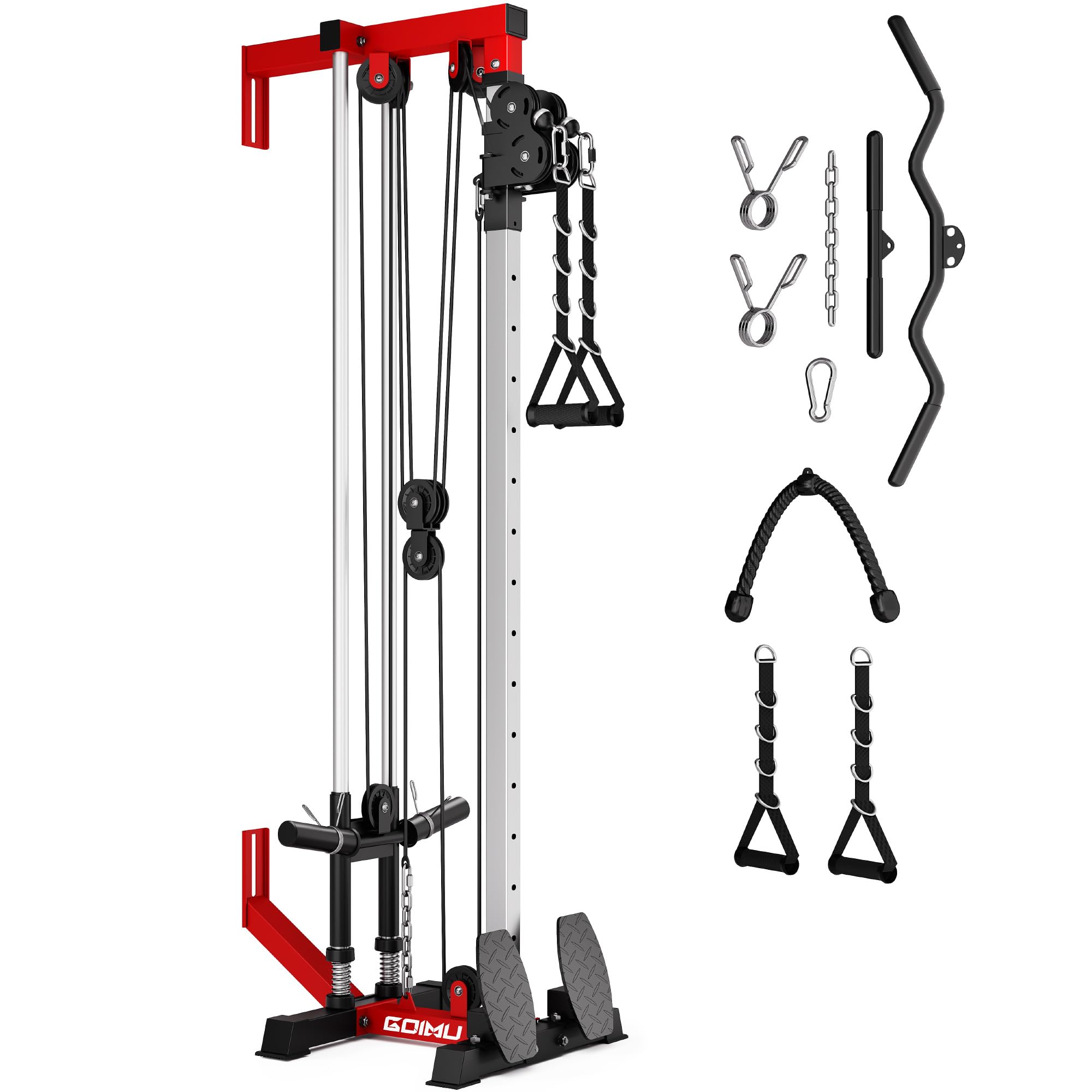
Goimu WM1 Cable Station

Goimu

Goimu WM1 Cable Station

  • Max Load 300 lb
  • Footprint 3.28 sq ft
  • Positions 17
  • Cable Ratio 1:1 and 2:1
Check Price on Amazon

The ratio switch is what sells this one. Clip the cable through the adaptor and the station runs at 2:1, so a plate pulls at half its weight, which turns a modest pile of plates into something you can use for rear delts, rotator work, and long endurance sets without wishing you owned fractional plates.

The rest is a serious wall unit: 17 height positions on the pulley carriage, a 14-gauge steel frame, a lat bar, T bar, rope, and a pair of handles in the box, and a 300-pound rating. It occupies 3.28 square feet of floor because the wall does the work.

The wall is also the catch. The listing specifies concrete or masonry, so a drywall garage needs blocking or a different station entirely, and that's worth deciding before you order. At 78.74 inches tall and 81.4 pounds, it's a two-person lift into position, and assembly is an afternoon rather than ten minutes.

Bottom Line

Worth the wall work: 17 positions and a 2:1 setting that doubles the range of a small plate collection, in barely three square feet.

Check Latest Price

How We Tested Home Gym Pulley Systems

We started by narrowing a long list of kits down to the ones with published working-load ratings, replaceable hardware, and an anchor type that matched a real space — a door, a wall stud, or a power rack. That left 12 systems, which we hung and used for six months across a garage gym with exposed joists, a spare-bedroom doorway, and a squat rack in a basement. Every kit was installed solo, with a stopwatch running, from the moment the box opened to the first rep.

Installation separated the field fast. We noted whether the instructions assumed a second person, whether the included hardware fit standard stud spacing, and whether anything demanded a drill a renter wouldn't own. Once a system was up, we loaded it and ran slow, deliberate reps — pulldowns, face pulls, single-arm rows — watching for anchor creep, pulley block twist, and any sway that only showed up under load rather than at rest.

We measured usable cable travel with a tape instead of trusting the spec sheet, stretching each cable from the highest attachment point to full extension at the bottom of a rep, and we timed how long it took to swap between a bar, a single handle, and a rope. Over the six months we checked sheaths for fraying, straps for stretch, and pulleys for flat spots or squeaks, then compared carabiner quality and stitching against what each kit cost.

How to Choose

Start With What You Can Hang It From

Every pulley system is a lever on whatever holds it, so the mount decides more than the kit does. Four options cover this group: a strap over a beam or pull-up bar, a clamp bolted to a square-tube rack, a wall-mounted station, and a freestanding tower. Strap kits are the cheapest and most portable, and they are also the most dependent on your building.

The trap is assuming a wall mount solves a bad ceiling. The Goimu WM1 is specified for concrete or masonry, so a drywall garage needs blocking before anything else happens. Pick the mount you can actually install, then compare kits.

Match Cable Length to Your Ceiling

A pulley doesn't create range of motion, it redirects it. Your usable travel is roughly the distance from the pulley down to your hands, so an anchor at seven feet with a 90-inch cable can leave you shortening your stroke to keep the plate off the floor. Two fixes exist: a shorter second cable, or extension chains that take up length.

The Concho kit ships a 55-inch cable alongside its two 70-inch ones, the widest spread here. Measure from your anchor point to the floor, subtract your standing reach, and buy a system that offers a cable in that neighborhood.

Read the Load Rating, Then Discount It

Ratings here run from 280 to 800 pounds, and that number describes the hardware at its ceiling, not what you'll enjoy using. Cable work is usually light: a few plates covers pulldowns, pressdowns, and rows for most people. The parts that give first are carabiners, pin nuts, and pulley bearings, so a 350-pound kit with good hardware beats a bigger claim with thin fittings.

A 2:1 pulley setting, as on the Goimu WM1, halves the resistance you feel. That's a real advantage when your plate collection is small and every jump between plates is coarse.

One Pulley or Two, and What Comes in the Box

One pulley handles pulldowns, pressdowns, curls, and face pulls. A second pulley is what lets you do crossovers, work one arm at a time from two angles, or superset without re-rigging anything, and for a rack owner it is the upgrade worth paying for.

Attachments matter less than the count suggests. A lat bar, a rope, and a single handle cover almost everything, and a longer loading pin gives you more room for plates before the stack runs out of pin.

Frequently Asked Questions

Final Verdict

Start with the Concho if you have anything solid overhead. The 55-inch cable and extension chains mean it fits the ceiling you actually have rather than the one in the photos, and 350 pounds covers everything short of serious stack work.

If your rack is the anchor point and you want two-sided cable work, the SERTT dual kit is the better buy. If there's nothing overhead at all, the Goimu LS01 tower is where the money goes.