Cardio Machines

Best Fitness Trampolines of 2026

A fitness trampoline looks like a toy right up until the first time you spend 20 minutes on one and notice your heart rate is up, your knees don't hurt, and you never once checked the clock. That's the whole pitch: cardio that feels like play, doable in a living room corner between meetings or while a toddler naps upstairs. I've kept one in my home since a bad knee ended my running habit, and over the past eight months my team and I have put 11 of them through daily use — assembling, folding, jumping, and handing the handles to everyone who walked through the door.

The thing first-time buyers get wrong is assuming the mat matters most. Bounce comes from the spring or bungee suspension underneath it, and a stiff, jarring rebound is usually why a trampoline ends up folded in a closet by March. The ones that survived our test space stayed quiet and stable at speed, went together without a second set of hands, and were fun enough that people actually chose them over a run. The picks below are the ones we'd buy again.

Best Overall

Our Score 9.4/10
JumpSport 250 Rebounder

JumpSport

JumpSport 250 Rebounder

  • Frame Height 13 inches
  • Bounce System 30 elastic cords
  • Jumping Surface 36 inches
  • Weight Capacity 250 lb
Check Price on Amazon

Soft, near-silent bounce on arched no-tip legs — the easiest rebounder to live with daily.

Bouncing on the JumpSport 250 is quieter than you expect a trampoline to be. The 30 elastic cords take the landing with a soft shush instead of the metal clang of a spring bed, and the mat gives just enough that a twenty-minute session reads as gentle work rather than impact. In a small room, a shared building, or in front of the television, that difference is most of the purchase.

Steadiness is the other half of why this is our default. The legs arch outward instead of dropping straight down, so an off-center landing pushes the frame into the floor rather than tipping it, and the whole thing stays where you put it while you find a rhythm. At 22 pounds it's light enough to shift between rooms between sessions, and the frame is warranted for life, with two years on the cords and the mat.

The bounce is deliberately soft, and that's the thing to be sure about before you order. A firm deck that snaps back underfoot is a different animal — the JumpSport 350 PRO is this same frame with cords you can set firm or extra firm. There's also no handlebar in the box; JumpSport sells one separately, and if you already know you want a bar to hold, the BCAN SP2 and BT4 include adjustable ones.

Setup is the least dramatic of any pick here: the legs bolt on with the included Allen wrench and there's nothing to stretch, hook, or thread. The first session happens the day the box arrives, which is more than several rebounders here can say.

Bottom Line

The JumpSport 250 is what we hand to anyone who wants quiet, joint-friendly daily cardio and doesn't need a handrail to feel secure.

Check Latest Price

Best for Heavier Users

Our Score 9.4/10
BCAN BT4 Soft Land Pro

BCAN

BCAN BT4 Soft Land Pro

  • Frame One-piece 16-gauge steel
  • Handlebar 5 height settings
  • Bounce System Two bungee sets, six tension levels
  • Weight Capacity 500 lb
Check Price on Amazon

500 pounds of capacity and two bungee sets that mix into six firmness levels.

Five hundred pounds is what separates the BCAN BT4 from everything else here, and it isn't only a sticker on the box. The frame is a single piece of 16-gauge steel with thicker leg tubes and ten-turn threads, so a heavier jumper — or two adults sharing one machine — gets a deck that feels like it's staying exactly where you put it.

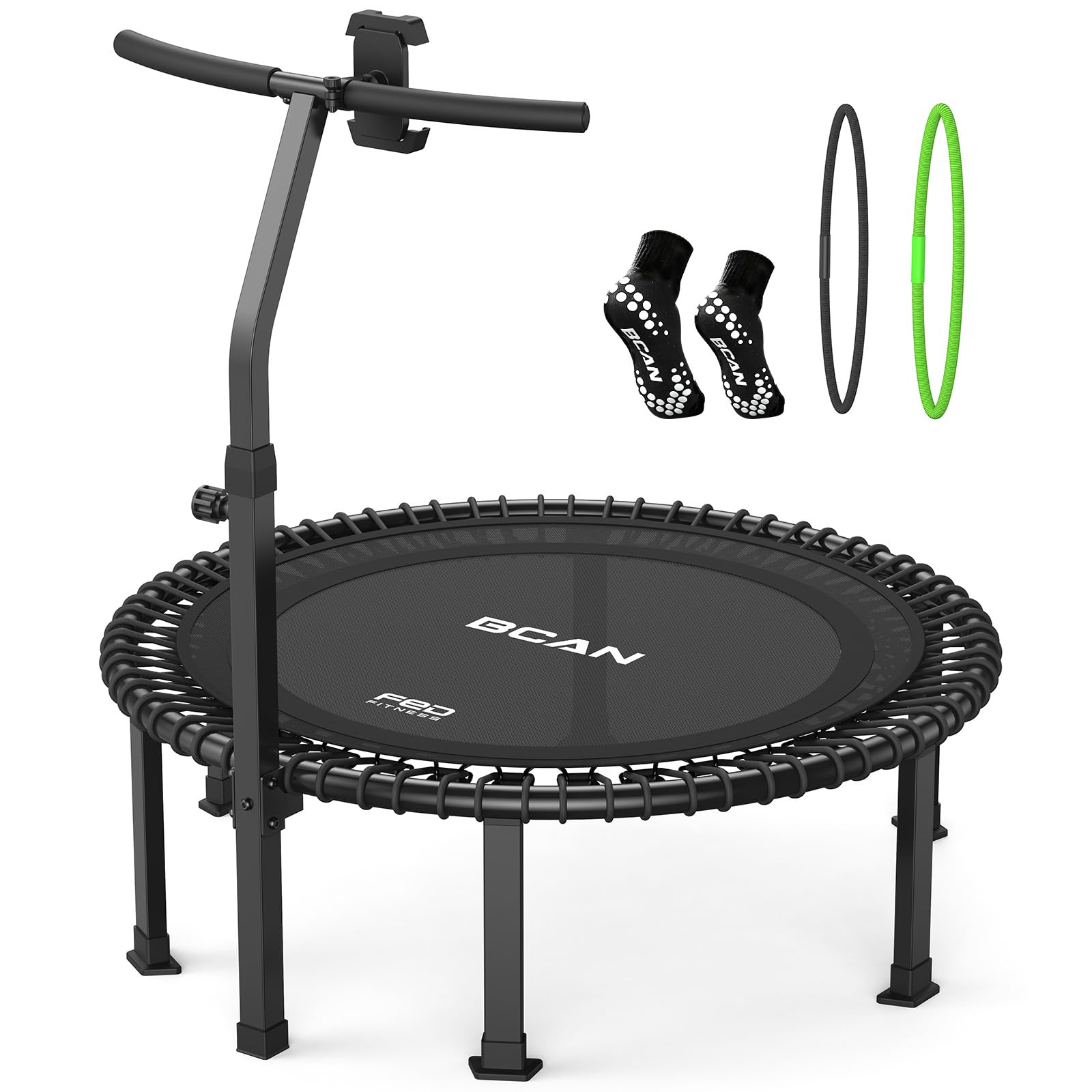
The bungees are the more interesting part. BCAN ships two sets: 38 lighter 8 mm cords already fitted, plus 22 firmer 9 mm cords, and you swap or mix them for six tension levels. In practice you can start soft while you build the habit and firm it up when the bounce starts feeling vague, without buying another machine. The latex cords are quiet, and the landing is softer than any spring model here.

The bar is a five-position handle with a foam grip, and a phone holder clips to the top — a small thing that turned out to matter more than we expected, since it puts a timer or a class at eye level instead of flat on the floor. Setup runs about fifteen minutes because every bungee arrives fitted; legs and handle are the whole job.

Bottom Line

For a heavier jumper or a household sharing one machine, the BCAN BT4 is the one to buy — 500 pounds of capacity and a bounce you can firm up as you improve.

Check Latest Price

Best Premium

Our Score 9.4/10
MXL FIT Bounce PRO

MXL FIT

MXL FIT Bounce PRO

  • Storage Half-fold, folding legs
  • Warranty 1 year
  • Bounce System 60 bungee connectors
  • Weight Capacity 400 lb
Check Price on Amazon

Arrives fully assembled, half-folds for storage, and runs nearly silent on 60 connectors.

The MXL FIT Bounce PRO turns up ready to bounce: bungees strung, frame together, legs folded underneath. There's no spring tool, no stretching, no second pair of hands — the build that most rebounders here ask for has already been done, and the first session happens as soon as you get it out of the box.

The bounce is why it earns a premium place. Sixty connectors wrap a 40-inch frame, roughly twice the count on most of the rebounders in this guide, and the effect is a short, smooth, near-silent stroke — the sort of thing you can do in a bedroom at six in the morning without waking the house. Capacity is 400 pounds, behind only the BCAN BT4.

It also half-folds and comes with a carry bag, which no other pick here offers, so it can go into a closet or the back of a car between seasons without being taken apart. The workout DVD and the online routine library give you something to follow if you've never reboundered before.

What you're buying is a rebounder that behaves like furniture: quiet, ready, and easy to move out of the room. If that's the shape of your setup, this is the best-realized version of it here. If the machine will live in one spot and never move, the softer JumpSport 250 does the same daily job with less ceremony.

Bottom Line

The MXL FIT Bounce PRO is for the buyer who wants a quiet, ready-to-use rebounder that moves out of the room when guests arrive, and doesn't mind paying premium money for it.

Check Latest Price

Best for a Firmer Bounce

Our Score 9.4/10
JumpSport 350 PRO

JumpSport

JumpSport 350 PRO

  • Frame Height 12.5 inches
  • Bounce System 36 adjustable cords
  • Jumping Surface 35 inches
  • Weight Capacity 300 lb
Check Price on Amazon

Our top pick's steady frame with cords you can set firm or extra firm.

Same 39-inch frame, same arched legs, same near-silent cord bounce as our top pick. The JumpSport 350 PRO differs in one place that matters: the cords. There are 36 of them in a four-knot layout, and you can set them firm or extra firm rather than accepting the soft landing the 250 gives you.

That adjustability is the whole argument for this one. A firmer bed returns more energy, so the bounce feels like a training tool instead of a cushion, and it holds up under a heavier jumper — 300 pounds here, against 250 on the 250. If you tried a soft rebounder and found it vague, this is the correction.

The rest is the JumpSport formula: a 35-inch jumping surface inside the 39-inch frame, 12.5 inches tall, 21.8 pounds, and a warranty running four years on the cords and the mat with a lifetime on the frame for home use. It arrives without a bar, same as the 250, so if balance is the reason you're shopping, the BCAN BT4's five-position handle is the easier answer.

Setting the tension means re-seating the cord loops in a different knot position rather than turning a dial, so it's a job you do once or twice as your fitness changes — not something to fiddle with between songs.

Bottom Line

If a soft deck feels mushy to you, the JumpSport 350 PRO is the fix: the same steady frame as our top pick with a bounce you can tighten.

Check Latest Price

Best with a Handlebar

Our Score 8.8/10
BCAN SP2 Rebounder

BCAN

BCAN SP2 Rebounder

  • Assembly 80% pre-assembled
  • Handlebar 3 height settings
  • Bounce System 32 springs
  • Weight Capacity 330 lb
Check Price on Amazon

A three-height handrail for balance plus a firm 40-inch spring deck that folds for storage.

The handlebar is what sells the BCAN SP2. It runs the full width of the frame with foam padding, so both hands fit comfortably, and it adjusts through three heights — enough that a shorter adult and a teenager can both find a grip that doesn't fold them in half. If you're new to rebounding, or coming back to exercise after a layoff, a bar like this is the difference between a nervous ten minutes and a habit.

Under the padding it's a conventional spring rebounder: 32 springs, a 40-inch frame, and a 330-pound rating that beats our top pick's. Springs return firmly and quickly, which suits anyone who finds a soft cord bounce vague, and the trade is noise — there's a squeak at faster tempos that a bungee bed doesn't have. It arrives 80 percent assembled, so the rest is legs, handle, and a few minutes with the wrench.

Where it gives ground is long-term composure. The legs thread into the base and work loose over weeks, so they want a check and a re-tighten; that's a two-minute job with the wrench you already have out, and it's the difference between a frame that feels solid and one that doesn't. Beyond that, this is the pick for someone bouncing a few times a week who wants a bar to hold — and for daily jumping, put the budget toward cords instead.

One practical note on storage: the quarter-fold only happens once the handlebar and the legs come off, so treat it as long-term stowage rather than a nightly routine. This is the kind of rebounder you leave standing in a corner and move twice a year.

Bottom Line

The BCAN SP2 is the pick for anyone who wants a handrail while they build confidence, and it doubles as a proper spring-bounce workout once you stop gripping it.

Check Latest Price

Best For Small spaces

Our Score 8.8/10
Stamina 36-Inch Rebounder

Stamina

Stamina 36-Inch Rebounder

  • Console Jumps, time, calories
  • Frame Size 36 inches
  • Bounce System 30 tension bands
  • Weight Capacity 250 lb
Check Price on Amazon

Thirty-six inches is the smallest frame here, and it's both the pitch and the catch. The Stamina fits in rooms where a 40-inch rebounder would crowd the furniture, and it also has the shallowest deck of the group — this is a gentle-movement machine, not one that throws you back into the air.

What it has that nothing else here does is a console. A small LCD tracks jumps, time, and calories, and it pairs with Stamina's free coaching app — a real nudge if you're the sort of person who needs a number to chase. Assembly needs no tools, the legs detach, and the whole thing slides under a bed.

The weight rating is the other thing to plan around. At 250 pounds it's fine for one lighter adult working alone and tight for a household where two people will share it, and the smaller deck leaves less room to land if you drift off-center. For a light user in a small apartment, though, that's an easy trade against a footprint and a jump counter nothing else here matches.

Bottom Line

For a corner of a small room where a 40-inch frame won't fit, the Stamina 36 earns its place — with a shallower bounce than anything else here.

Check Latest Price

Best For First rebounder

Our Score 8.4/10
Kanchimi 40-Inch Rebounder

Kanchimi

Kanchimi 40-Inch Rebounder

  • Warranty 1 year
  • Frame Size 40 inches
  • Bounce System 32 springs
  • Weight Capacity 330 lb
Check Price on Amazon

Foldable is the word to interrogate with the Kanchimi. It does fold, but only after the handlebar comes off and the frame is unbolted, which makes it a storage feature rather than something you collapse after each session. If the rebounder has to disappear into a closet nightly, this isn't the one.

What you get is a 40-inch spring deck rated to 330 pounds, with a padded handlebar, a closed spring cover so there's nothing sharp at ankle height, and a firm, springy return. The deck sits under ten inches off the floor, which makes stepping on easy, and the springs land harder and louder than the cord beds elsewhere in this guide.

Our read is that this is a sensible first rebounder and a risky daily one. The frame and springs are honest for the tier; what lets it down is finish at the joints, where a handle tube can arrive slightly out of alignment — dry-fit everything before you tighten a bolt. Buy it to find out whether rebounding sticks, and plan on replacing it if it does.

Bottom Line

The Kanchimi is for a first rebounder or a tight budget: a 40-inch spring deck with a handle, as long as you never plan to fold it away.

Check Latest Price

How We Tested 11 Fitness Trampolines Over Eight Months

We started with spec sheets and customer reviews for roughly 40 trampolines, then narrowed to 11 based on mat size, weight capacity, spring versus bungee suspension, folding design, and price, making sure the group spanned budget models and ones that cost as much as a month of studio classes. Each arrived flat-packed, and I timed assembly solo, from slicing open the box to the first bounce, with no second pair of hands.

Every trampoline then lived in a living room for at least three weeks of daily use: 20-minute interval sessions over lunch, slower 10-minute bounces in front of the TV, and a fair amount of unsupervised jumping from kids and one very enthusiastic Labrador. We watched whether the frame crept across the floor mid-session, whether the rebound felt springy or jarring when we picked up speed, and how loud the whole thing was — a detail that matters if you have downstairs neighbors or a sleeping baby. Once a week we folded and unfolded each one to see how easily the legs and frame came apart and whether they lined back up the same way.

Durability got its own accounting. After eight months we checked for stretched mats, frayed bungees, squeaky springs, and wobble in the legs, then weighed those findings against what each trampoline cost, since a budget model that still bounces true after months of daily use is the better value than a fancy one that rattles. We'll keep jumping on the standouts and update this list as they wear.

How to Choose

Springs or elastic cords

Spring beds return fast and firm. They're the budget route into a 40-inch deck, and the cost shows up as noise — a squeak at speed that tightening never quite cures — plus a harder landing. Cord beds spread the load across 30 to 60 connectors, which makes the bounce softer, quieter, and easier on joints; the JumpSport 250 and the BCAN BT4 are both built that way. Cords stretch and fray, though, so read the warranty as a durability claim: JumpSport covers its cords for two to four years, BCAN for one. For daily use in a shared building, choose cords.

Match capacity to the household

A weight rating is a ceiling, not a target. A frame that feels solid under one 150-pound adult can feel twitchy when a heavier partner takes a turn, so leave headroom — the 400- and 500-pound models here exist for shared households, not only for very heavy jumpers. Capacity and stability are separate questions, too. Threaded legs that screw into the base work loose with use; arched legs that bow outward resist tipping. If two adults will use one machine, buy for the heavier one.

Decide about a handlebar now

A bar is for balance, not for holding your weight, and it changes which machine you should buy more than any other option. Three to five height settings is the useful range, and the top setting should land near your waist — a bar you have to stoop to reach is worse than no bar at all. If you're returning to exercise or unsteady on your feet, buy one: the BCAN SP2 and BT4 include adjustable bars, and neither JumpSport does.

Measure the floor before you fall for a fold

A 40-inch frame needs a 40-inch circle plus room for your arms, and deck height — roughly 9 to 14 inches across these picks — decides how much of a step up you take every session. Folding is usually storage, not routine: on the BCAN SP2 and the Kanchimi the handle and legs come off first, so the fold is for long-term stowage. In an upstairs apartment, a cord bed is noticeably quieter for the people below.

Buy the warranty, not the bounce number

Springs, cords, and the webbing loops that anchor them are the consumables; mats and frames rarely fail first. That makes the warranty a durability claim worth reading: a lifetime frame with four years on the cords says something a 90-day parts policy doesn't. If you plan to jump most days, take the longest cord coverage you can and expect to replace the mat before the frame.

Frequently Asked Questions

Final Verdict

For most people, the answer is the JumpSport 250. The soft cord bounce and arched legs make a daily session quiet and steady, it's the least fussy thing here to put together, and the frame carries a lifetime warranty. It also arrives without a bar, which is the one reason to look elsewhere.

If a handrail is what gets you onto the mat, buy the BCAN BT4 instead: a five-position bar, 500 pounds of capacity, and a bounce you can stiffen as your fitness changes. Decide on the bar before anything else and the rest of the list sorts itself out.