Yoga & Mobility

Best Exercise Mats of 2026

An exercise mat has to do two opposite things at once: cushion the knees, hips, and spine that meet the floor, and stay firm enough that you trust it under a lunge. Go too thick and every balance pose turns into a slow wobble; go too thin and your joints start filing complaints by the second round. The right one disappears under you — you stop thinking about the mat and start thinking about the workout. That's what I was chasing when my team and I started testing.

Fourteen mats later, after about six months of daily use, I can tell you the millimeter count on the label is nearly meaningless on its own — density is what you actually feel, and a firm 6mm can beat a spongy 8mm every time. We rolled and unrolled each one until the edges either flattened out or curled for good, carried them to classes to see which straps held up, and put them through hot, sweaty sessions to find out which surfaces turned slick. The picks below are the ones that stayed put.

Best Overall

Our Score 9.4/10
BalanceFrom 1-Inch Exercise Mat

BalanceFrom

BalanceFrom 1-Inch Exercise Mat

  • Weight 2.2 lb
  • Material High-density foam
  • Thickness 1 inch
  • Dimensions 71 x 24 inches
Check Price on Amazon

A deep, supportive 1-inch mat for mixed floor work, stretching, and joint-friendly sessions.

One inch of high-density foam is the detail that decides this mat. In our floor sessions, that depth kept hips, knees, and elbows from feeling the hard floor without turning the surface into a squishy mattress. We think it is the best all-around choice here for a home exerciser who wants one mat for stretching, core work, Pilates, and light strength training. The 71-by-24-inch surface is roomy for most people, and the 2.2-pound roll is easy to move.

What we liked most is how the foam supports rather than swallows you. The double-sided texture gives some traction on dry floors, and the mat unrolls flat enough to stay put during a session. The trade-off is balance: at a full inch, standing poses feel less connected to the floor than they do on a half-inch mat. That is not a problem for floor work, but it is why we do not treat this as a dedicated yoga mat.

The included strap cinches the roll tightly, and the mat is light enough to carry from room to room without feeling like a chore. If you want one mat for a mixed home routine and value joint comfort over a thin, sticky yoga surface, this is the one we recommend first. It is the pick that stays by the couch or desk rather than in a closet.

Bottom Line

For a mixed home routine, this is the exercise mat we recommend first: deep, supportive foam and a light roll make floor work comfortable.

Check Latest Price

Best for Aerobics and Tumbling

Our Score 9.4/10
BalanceFrom 2-Inch Folding Mat

BalanceFrom

BalanceFrom 2-Inch Folding Mat

  • Weight 3 lb
  • Thickness 2 inches
  • Dimensions 72 x 24 inches
  • Folded Size 2 ft. x 2 ft. x 6 in.
Check Price on Amazon

A foldable 2-inch platform that cushions landings and stores in a closet.

Folded, this BalanceFrom mat is a two-foot square about six inches deep, with built-in handles. That footprint is the reason to choose it over a roll: it stands in a closet, slides under a bed, or leans against a wall without unrolling across the room. The 2-inch foam opens into a 72-by-24-inch platform, and the vinyl cover wipes clean after a sweaty session.

Where it earns its keep is high-impact or joint-sensitive floor work. The firm foam absorbs landings and takes pressure off knees and elbows during aerobics, tumbling, physical therapy, and mat-based strength. We also appreciated the three-panel fold: it opens flat and closes without fuss, and the hook-and-loop edges let you join a second mat if you want more coverage. This is a floor-work platform, not a yoga mat; the thickness blunts balance, and the vinyl is not a sticky yoga surface.

The 3-pound weight and handles make it easy to move from room to room, and the folded shape is easier to store than a long roll. We think it is the right pick for aerobics, kids' tumbling, or a home gym corner that has to clear out afterward. It is the kind of mat you can leave folded in a closet and forget about until the next session.

Bottom Line

Aerobics, tumbling, and joint-heavy floor work call for this folding mat; we like its thick, firm platform and easy closet storage.

Check Latest Price

Best Firm Folding Mat

Our Score 9.4/10
ProsourceFit Tri-Fold Mat

ProsourceFit

ProsourceFit Tri-Fold Mat

  • Weight 4.2 lb
  • Thickness 1.5 inches
  • Dimensions 72 x 24 inches
  • Folded Sections 3
Check Price on Amazon

A firm 1.5-inch tri-fold that stands up in small spaces and supports floor work.

If a two-inch folding mat feels like overkill, this 1.5-inch tri-fold is the middle ground. It opens to 72 by 24 inches, folds into three panels, and carries with two handles; the vinyl cover wipes clean and the foam is firm rather than squishy. That makes it a better fit for someone who wants a folding mat for stretching and floor work without the tumbling-mat depth.

The tri-fold design is the practical part. It stands on its edge in a closet, slides under a bed, and sets up faster than rolling a mat. We found the foam firm enough for planks, crunches, and stretching, and the surface stayed put on a hard floor during normal floor work. The handles are useful, too, because they let you carry it flat against your side instead of hugging a long roll.

We think this is the best firm folding mat here for small-space workouts. It suits Pilates, stretching, and bodyweight sessions, and it is easier to store than the thicker two-inch folding picks. The 24-inch width is standard, so anyone who likes to spread out during wide stretches should check that before buying.

Bottom Line

Small-space Pilates and stretching are the fit for this firm tri-fold, which we prefer when a two-inch mat feels too deep.

Check Latest Price

Best Budget

Our Score 9.2/10
CAP Barbell 1/2-Inch Mat

CAP Barbell

CAP Barbell 1/2-Inch Mat

  • Weight 2.16 lb
  • Material NBR foam
  • Thickness 0.5 inch
  • Dimensions 68 x 24 inches
Check Price on Amazon

A simple half-inch mat with a strap for basic stretching and light floor work.

The budget choice here is also the least complicated one. The CAP Barbell mat is a half-inch sheet of NBR foam with a textured surface, a 68-by-24-inch footprint, and a strap. It does not try to be a plush recovery pad or a sticky hot-yoga mat; it is a simple surface for stretching, light bodyweight work, and floor exercises.

At just under a kilogram, it is one of the easiest mats here to carry, and the foam rolls tightly enough to store in a closet or car trunk. The latex-free NBR is softer than a bare floor but firm enough that your hands and feet do not sink in. We found the strap useful, and the textured top gives some purchase on dry floors.

We recommend it for a first apartment mat, a spare mat for the car, or a light daily stretching routine. It is the mat we reach for when we want something simple to unroll and put away, and the included strap keeps it tidy between uses. The 68-inch length is the one spec to check if you are tall.

Bottom Line

Budget-minded stretching and light floor work are the reasons we keep this simple half-inch mat around.

Check Latest Price

Best for Sensitive Knees

Our Score 9.2/10
Gaiam 10mm Thick Mat

Gaiam

Gaiam 10mm Thick Mat

  • Weight 2.8 lb
  • Material NBR foam
  • Thickness 10 mm
  • Dimensions 72 x 24 inches
Check Price on Amazon

Plush 10mm foam takes pressure off knees, hips, and elbows during gentle sessions.

The first thing to know about this Gaiam mat is that it arrives with a smell. The 10mm NBR foam has a pronounced new-mat odor when unrolled, and it needs a few days in a ventilated room before it settles. Once it does, the cushioning is the story: the 72-by-24-inch surface is plush under knees, hips, and elbows, and the textured top gives some traction for dry floor work.

We liked it best for gentle stretching, mat Pilates, and recovery sessions where pressure relief matters more than precision. The foam is soft enough to feel kind on a hard floor, but it is not a hot-yoga mat; sweaty hands and standing balances are not where it shines. At 1.27 kilograms, it is still light enough to move between rooms, and the included strap keeps the roll together.

This is the mat we hand to someone with sensitive knees who wants a softer landing without moving to a folding gym mat. It is also a reasonable choice for physical therapy exercises at home, provided you give it that airing-out period first. The 24-inch width is standard, and the 72-inch length gives taller users room to lie down.

Bottom Line

Sore knees and gentle stretching are where this plush 10mm mat earns its place, provided you air it out first.

Check Latest Price

Best For Hard-floor cushioning

Our Score 9.2/10
Amazon Basics Extra Thick Mat

Amazon Basics

Amazon Basics Extra Thick Mat

  • Weight 2.2 lb
  • Material NBR foam
  • Thickness 0.5 inch
  • Dimensions 73.2 x 24.3 inches
Check Price on Amazon

On a tiled or concrete floor, a half-inch of foam changes the workout. This Amazon Basics mat is 73.2 by 24.3 inches, so it gives taller users a little more length than the standard 71- or 72-inch mats here, and the NBR foam is soft enough to take the edge off knees and elbows. It also weighs just 1 kilogram, which makes it easy to move.

The surface is textured, and the mat unrolls flat enough to stay put during stretching and light bodyweight work. We found the foam comfortable under hips and knees without feeling like a mattress, and the included strap is a useful addition rather than a throwaway. The 0.5-inch thickness is the balance point: enough cushion for floor work, not so much that you lose the floor.

Storage is simple. It rolls tightly, the strap keeps it closed, and the light weight means it can live in a closet or behind a door without complaints. We also liked that the longer length gives taller users room to lie down, though the 24.3-inch width is still standard rather than expansive.

We recommend this mat for hard-floor stretching, light strength work, and a spare mat that does not cost much. It is not the one we reach for in a high-impact session; the foam is better suited to controlled floor work. It is a sensible first mat for a hard floor, and the longer cut is a quiet advantage.

Bottom Line

Hard-floor stretching and light strength work are the job for this light, longer half-inch mat, and we like the extra length.

Check Latest Price

Best For Home gym floor

Our Score 9.2/10
ProsourceFit Puzzle Mat

ProsourceFit

ProsourceFit Puzzle Mat

  • Tiles 12
  • Coverage 48 square feet
  • Thickness 0.5 inch
  • Tile Size 24 x 24 inches
Check Price on Amazon

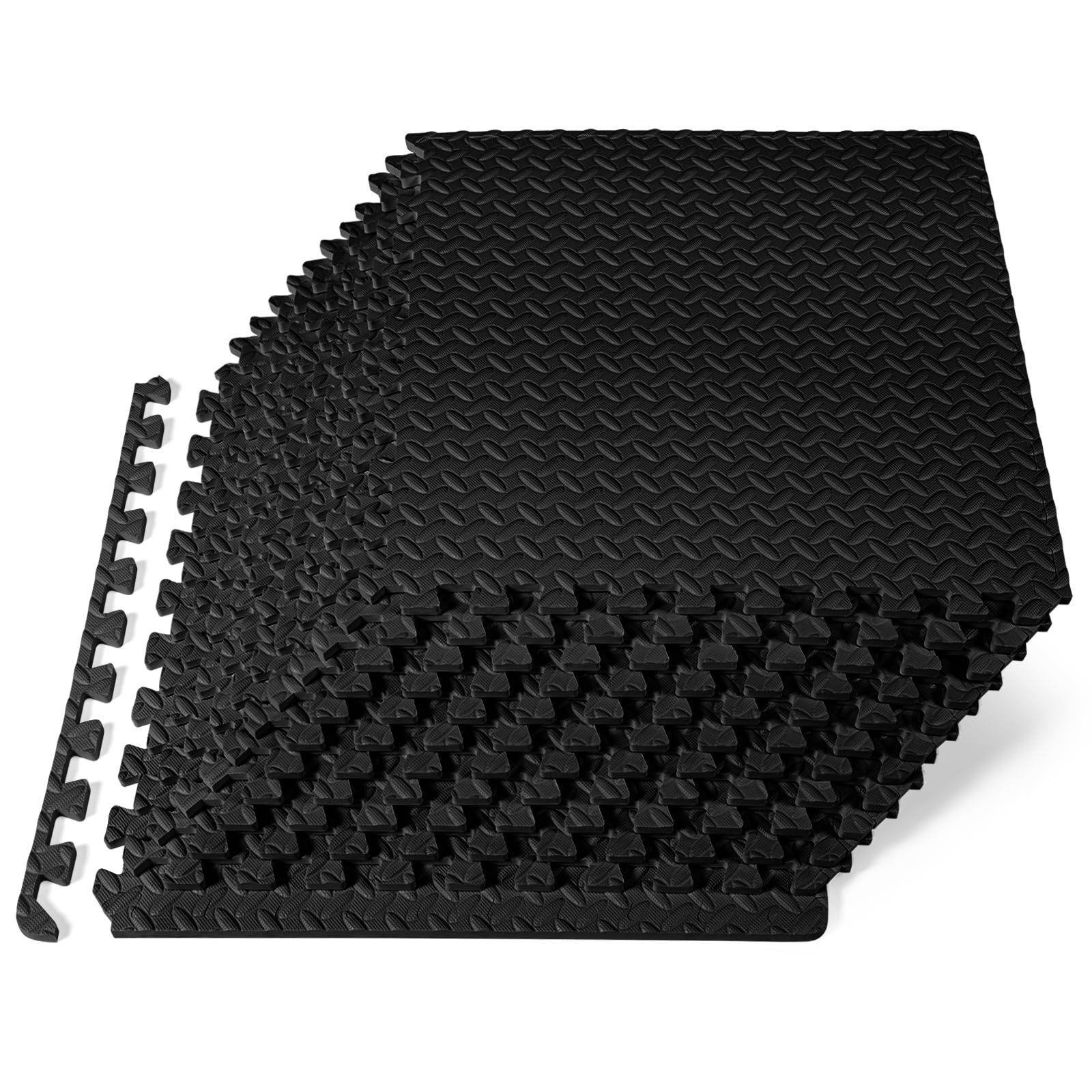
The number that matters here is 48 square feet. That is what 12 interlocking 24-inch tiles cover, and it changes the job from a mat you roll out to a floor you build. The EVA foam is 0.5 inch thick, the set includes border pieces, and the whole thing weighs 9.3 pounds. For a garage, basement, or spare room that needs a workout surface, that coverage is the appeal.

Assembly is straightforward: the tiles connect like puzzle pieces, and the border pieces finish the edge. We liked that the set can be cut to fit around equipment or a doorway, and that it disassembles just as quickly when the room has to do something else. The water-resistant surface wipes clean, which matters on a floor that sees shoes, pets, and dust.

This is not a yoga mat, and it is not meant for fast, sweaty movement. It is a floor-coverage product: better for bodyweight work, stretching, and a dedicated home-gym corner than for a vinyasa flow. The 0.5-inch foam is also not a landing pad for tumbling.

We recommend it for a home gym floor or a playroom that doubles as a workout space, not as the only mat in a yoga bag. The 12 tiles give you room to arrange a rectangle or an L-shape, and the border pieces make the result look finished. It is the pick when coverage matters more than portability.

Bottom Line

For a dedicated home-gym floor, we recommend this 48-square-foot tile set, but it is not a yoga mat.

Check Latest Price

Best For Basic stretching

Our Score 9.0/10
Fitvids 1/2-Inch Mat

Fitvids

Fitvids 1/2-Inch Mat

  • Weight 1.8 lb
  • Material Foam
  • Thickness 0.5 inch
  • Dimensions 71 x 24 inches
Check Price on Amazon

The Fitvids mat is the value play here: a half-inch foam surface, a 71-by-24-inch footprint, and a strap, all at the low end of the group. We think it is a sensible first mat for someone who wants cushioning without spending much, and the light 1.8-pound roll is easy to carry to a class or stash in a closet.

The foam is soft under knees and hips, and the double-sided texture gives some grip on dry floors. It rolls up quickly, and the strap holds the roll securely enough to carry by the handle. The 71-inch length is standard for a taller user, and the 24-inch width is the usual yoga-mat size.

Where it fits best is basic stretching, mat Pilates, and light bodyweight work at home. It is also a good mat to keep as a spare for guests or to take to a park workout, because you will not fuss over it. The 1.8-pound weight is the detail that makes it easy to grab on the way out.

Bottom Line

As a first mat for basic stretching, this lightweight, low-cost roll makes sense to us.

Check Latest Price

How We Tested 14 Exercise Mats Over Six Months

We started by rounding up every mat we could find in the middle of the market — the band where most people actually shop — and then cut the list by reading spec sheets for thickness, material, dimensions, and weight, plus what buyers were complaining about after a few months of ownership. That left 14 mats, from thin travel styles to thick cushion-heavy ones, in standard and long lengths.

Each mat moved into my real routine: morning flows on the living room rug, sweaty classes at a studio where the floor gets genuinely slick, strength work on a concrete basement floor, and a couple of hotel rooms where I unrolled one over carpet. I dropped into downward dog within the first minute of every session to see whether my hands crept forward, held tree pose to check for squish underfoot, and stayed in low lunges long enough to judge whether my knees were actually cushioned or just barely covered.

Thickness and comfort turned out to be separate questions. I measured every mat with calipers out of the box, then again after two months of daily rolling, and several had compressed noticeably where hands and feet land. I carried each one by its own strap on a ten-minute walk to class and noted which dug into my shoulder or dragged on the ground. Durability got checked by wiping each mat down weekly and watching for flaking, stretching, or a top layer peeling away from the base. At the end, I set cost against how each mat felt on day one versus month six, since a cheap mat that lasts beats an expensive one that sheds.

How to Choose

Match Thickness to the Workout

Thickness is not a comfort score; it changes how the mat behaves. A half-inch mat gives enough padding for stretching and bodyweight work while keeping you close enough to the floor for balance. An inch is better for sore hips, knees, and elbows during mat Pilates or core work, but it can feel tippy in standing yoga. A two-inch folding mat is a different tool: it is for aerobics, tumbling, and physical therapy, not for a flow. Start with the workout you do most, then add cushion only where you need it.

Read the Surface and Foam

Two mats can be the same thickness and feel completely different. NBR foam is soft and cushioning, but it can be slick when you sweat and it can tear at high-wear spots. PVC surfaces are often stickier and thinner, which suits yoga but offers less joint relief. EVA puzzle tiles are firm, wipe-clean, and good for floor coverage, though they are not a grippy yoga surface. Test a mat with dry hands and, if you sweat heavily, bring a towel; grip changes once moisture is involved.

Choose Roll, Fold, or Tile by Your Room

The storage format matters as much as the foam. A roll is the most portable: it goes in a car, a closet, or a gym bag, and it is the right shape if the mat moves between rooms. A tri-fold or panel mat stands up in a closet and sets up faster, which suits a living room that has to clear out. Interlocking tiles are for a dedicated corner or garage floor, not for a class. Measure the spot where the mat will live before you choose; a folded mat can be easier to store than a long roll.

Check Length, Width, and Weight

Most mats here are 24 inches wide and 68 to 73 inches long. If you are much over six feet, start at 72 inches; if you do wide stretches, 24 inches is standard but not generous. Weight matters when the mat leaves the house: the lightest rolls here are around 2 pounds, while a 48-square-foot tile set weighs over 9 pounds. Pick a mat you can actually move and store, because the best one is the one you will unroll.

Frequently Asked Questions

Final Verdict

If you want one mat for a mixed home routine, the BalanceFrom 1-Inch is the one we recommend first. Its foam is deep enough for stretching, core work, and mat Pilates, and the 2.2-pound roll is easy to move and store. For a simpler half-inch surface at a lower price, the CAP Barbell mat is the practical alternative; for aerobics and tumbling, choose the BalanceFrom folding mat instead.