Strength & Weights

Best Deadlift Jacks of 2026

A loaded deadlift bar is a stubborn thing: the plates want to stay put, the bar won’t roll where you need it, and changing them between sets turns into a wrestling match at ankle height. A deadlift jack is the fix—it lifts the bar just enough to slide plates on and off without tipping the whole setup or testing your patience. The catch is that these tools live or die by small details: how easily they slide under the bar, whether they stay planted when loaded, and how much abuse they take in a home gym.

I’ve used a few jacks that felt clever for a week and wobbly by the second month, so I was curious which ones would hold up. We put 11 deadlift jacks through eight months of regular deadlift sessions—loading, stripping, and storing them between workouts—and the differences in sturdiness, ease of use, build quality, and overall value were obvious. A good jack should feel like a helpful piece of gym equipment, not a balance challenge. The picks below are the ones I’d happily keep in my own gym.

Best Overall

Our Score 9.6/10
RitFit Deadlift Jack

RitFit

RitFit Deadlift Jack

  • Handle Non-slip grip
  • Assembly None required
  • Footprint 16.93"L x 7.87"W
  • Weight Capacity 660 lb
Check Price on Amazon

A wide PVC base and 660-pound capacity make plate changes feel routine.

The RitFit is rated to 660 pounds, and it puts that rating on a base about 17 inches long and 8 inches wide with a PVC layer where it meets the floor. That footprint is the whole story: in our testing the jack planted itself as the sleeve came up rather than skating out from under the bar, which is exactly the moment a flimsy stand gives you trouble. Of the single jacks here, this is the one we hand to a friend without a caveat.

The handle is covered in a non-slip grip and sits at a height that lets you lean your weight down onto it instead of pulling up with your arms — a small thing that matters on the last set of a session as much as the first. Nothing needs assembling. It comes out of the box, slides under the sleeve, and works, and the metal is thickened right where the bar sits, so the groove is not the part you worry about.

At a little over four inches tall it slides under a bench or tucks against the upright of a rack, and it is light enough to carry in one hand between the platform and the shelf. What it does not do is lift both sleeves: you load one end, then walk around. For a bar you change a few times a workout that is a fair trade, and the two-stand set further down is the answer if it is not.

Bottom Line

We recommend it as the default jack for a home gym: 660 pounds of capacity on a base wide enough to stay put while you load.

Check Latest Price

Best For Lighter 660-pound pick

Our Score 9.6/10
Mikolo Deadlift Jack

Mikolo

Mikolo Deadlift Jack

  • Warranty 2 years
  • Footprint 8.3"D x 4.3"W x 17.3"H
  • Jack Weight 4.3 lb
  • Weight Capacity 660 lb
Check Price on Amazon

Line the Mikolo up next to our top pick and you have to check the label. Both are rated to 660 pounds, both sit on a PVC base with a diamond tread, both arrive assembled with a non-slip handle and no hardware to sort through. The Mikolo does it all in 4.3 pounds.

The similarity is the point, and in our testing it mattered less which of the two was under the bar than whether one of them was. If the RitFit sells out, or you want less weight to move between the floor and the shelf, this does the same work for a little less. The treaded base spreads the load across the floor rather than concentrating it on a metal edge, and the handle is shaped for a full-hand pull rather than a fingertip one.

A two-year manufacturer warranty is the longest coverage of any jack here, and on a design this light that coverage is part of what you are buying: a metal frame with PVC underneath, and a builder willing to stand behind it longer than anyone else in this group.

Bottom Line

We point to it as the lighter route to the same 660-pound job, backed by the longest warranty in this group.

Check Latest Price

Best Value

Our Score 9.4/10
Yes4All Deadlift Jack

Yes4All

Yes4All Deadlift Jack

  • Footprint 19.75"D x 14.75"W x 4.72"H
  • Bar Contact UHMW padded plate
  • Jack Weight 8.1 lb
  • Weight Capacity 600 lb
Check Price on Amazon

UHMW padding and a rubber-covered handle at a budget-friendly price.

The Yes4All is the jack for the lifter who wants the tool to disappear into the corner of the garage and be there when it is needed. It is a simple A-frame in anti-corrosion stainless steel, 19.75 by 14.75 inches where it meets the floor, with a UHMW pad where the bar lands. Eight pounds of steel means you are not carrying it far — and it also means the thing does not wander when the bar comes down.

We put it just behind the RitFit, and the gap is not about the everyday work: 600 pounds of capacity and a padded contact plate handle routine plate changes without complaint. It is about what happens over a lot of them. The plastic around the bar can crack at the base, and the frame can tip if a bar drops into the groove off-center. Neither is a reason to walk away — set it down squarely, glance at the contact plate now and then, and it does the job.

The built-in handle has a rubber cover, so moving it out of the way is a one-hand job, and the UHMW padding is the detail that protects your knurling rather than chewing it. There is a one-year warranty too, which is worth having on a tool that lives on the floor and takes the occasional dropped plate.

Bottom Line

We recommend it for a garage gym that changes plates on the floor often: 600 pounds of capacity, UHMW padding, and a handle that makes it easy to shift.

Check Latest Price

Best Full-Size

Our Score 9.2/10
Titan Fitness Full Barbell Jack

Titan Fitness Full

Titan Fitness Full Barbell Jack

  • Footprint 42.5"W x 18"D
  • Jack Weight 30 lb
  • J-Cup Height 10 inches when raised
  • Weight Capacity 900 lb
Check Price on Amazon

Lifts both sleeves at once and holds 900 pounds without leaving its spot.

At 42.5 inches wide and 30 pounds, the Titan is not a gadget you tuck beside the squat rack — it is a piece of gym equipment with a permanent address. The frame straddles the bar, the notched J-cups come up around both sleeves at once, and they rise to a 10-inch cup height with an opening of 2.25 inches square.

Lifting both sleeves together is the reason to give up the floor space. The bar stays level, plates come off square instead of tilting toward the floor, and you never walk around the bar between changes. It is rated to 900 pounds, far past anything a home lifter will load, and the notches give the bar somewhere to sit rather than relying on a balance point.

What comes with the size is friction. It ships as parts and takes a wrench and some patience to put together, it does not fold or hang, and it costs several times what the compact jacks do. If your bar lives on a platform in a garage and you never want to bend over to load it again, none of that matters. This is the most capable jack here, and we do not think it is close.

Bottom Line

We recommend it for a garage gym with floor space to spare and a bar that never leaves the platform; the full frame lifts both sleeves at once.

Check Latest Price

Best for the Gym Bag

Our Score 9.2/10
BRTGYM Deadlift Jack

BRTGYM

BRTGYM Deadlift Jack

  • Bar Gap 2 inches
  • Footprint 4.5"D x 17.7"W x 10"H
  • Jack Weight 5.7 lb
  • Weight Capacity 600 lb
Check Price on Amazon

5.7 pounds with a rubber-sleeved handle, light enough to carry anywhere.

Weight is the number that decides whether a jack travels, and at 5.7 pounds the BRTGYM is the one here that goes in the car without a second thought. It is 17.7 inches wide and only 4.5 inches deep, so it slides into a gym bag or hangs on a hook, and the pullback handle is wrapped in rubber so it does not chew your hand on the way out of the car.

What it gives up is capacity — 600 pounds, at the low end of this group — which is still more than most lifters will ever put on a bar. The 2-inch gap takes both 1-inch and Olympic sleeves, and the UHMW padding means knurling comes out of the cradle unmarked. In our testing it was the jack we stopped noticing, which is the best thing you can say about a loading tool: it does its job, then gets out of the way.

Bottom Line

We keep it for the lifter who trains at a commercial gym: 5.7 pounds, a 2-inch gap that takes any bar, and UHMW padding in the cradle.

Check Latest Price

Best Pair

Our Score 9.2/10
Lovind Deadlift Jack Stands

Lovind

Lovind Deadlift Jack Stands

  • Bar Fit 1-inch and 2-inch bars
  • Padded Hook 2.5 inches wide
  • Number Of Jacks 2
  • Weight Capacity 600 lb
Check Price on Amazon

Two jacks lift both sleeves so the bar stays level while you load.

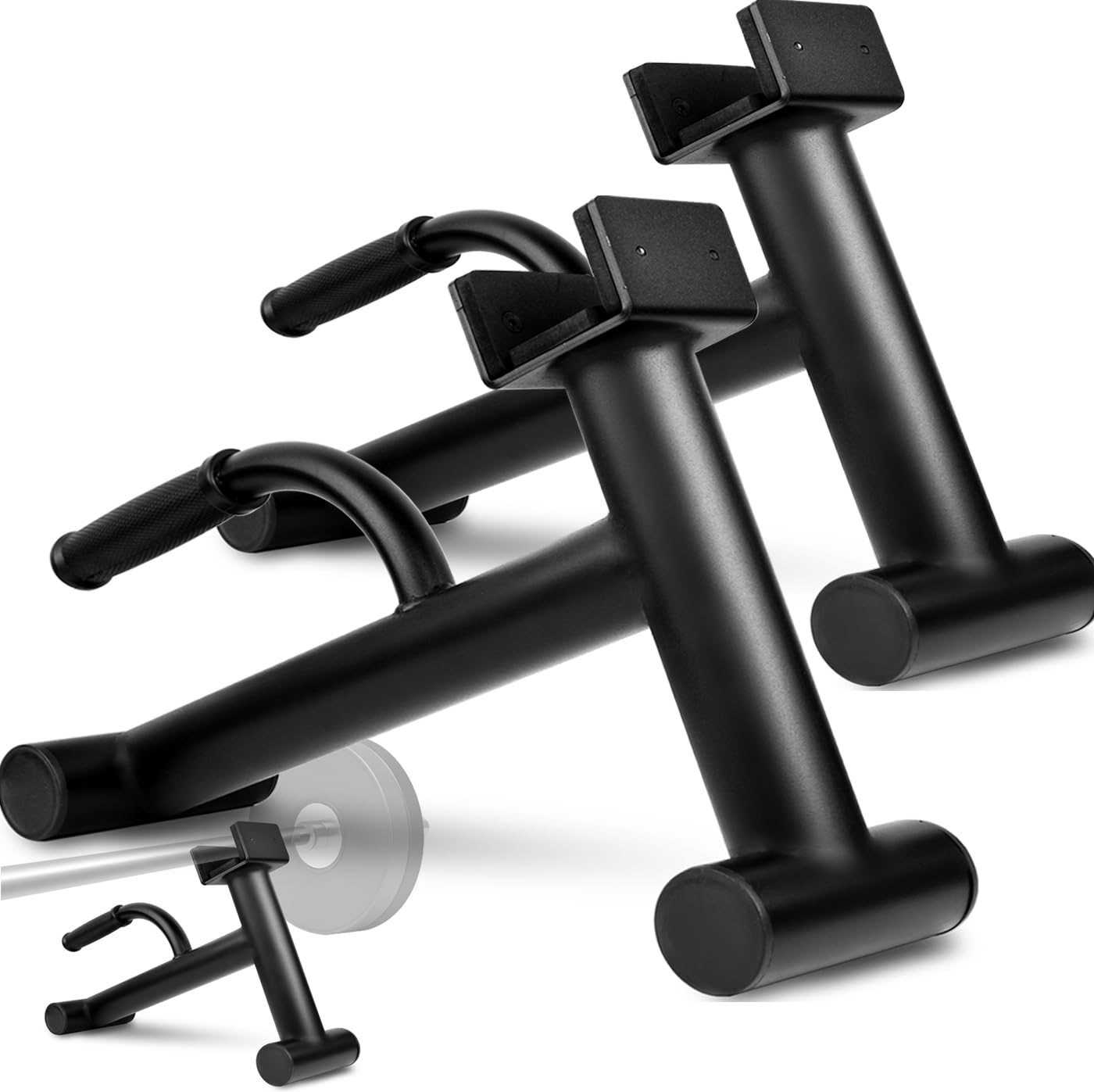
Two jacks in one box changes the job. Put one under each sleeve and the bar comes up level, which means plates slide on square instead of tilting toward the floor while you hold the bar steady with one hand. That is the Lovind's entire argument, and it is a good one if you load a bar on the floor several times a week.

The stands are carbon steel with a 2.5-inch padded hooking grip that takes both 1-inch and Olympic bars, and the handles are wrapped in rubber for a grip that survives sweaty hands. They arrive assembled, which is more than we can say for the full-size frame here, and the padding at the hook is the part that keeps your knurling intact.

Where a pair earns its keep is the lift itself: with a stand on each sleeve you are never balancing a loaded bar on a single point, and the plates come off without the seesaw. We prefer it to any single jack here for a bar that lives on the platform — the loading is that much calmer.

Bottom Line

We recommend the pair for a home gym where the bar lives on the floor: two stands keep it level while both your hands are on plates.

Check Latest Price

Best For Storing in a bag

Our Score 9.2/10
POWER GUIDANCE Wooden Barbell Jack

POWER GUIDANCE Wooden

POWER GUIDANCE Wooden Barbell Jack

  • Material Wood
  • Footprint 16.8" / 4.7" / 1.2"
  • Jack Weight 2.3 lb
  • Weight Capacity 700 lb
Check Price on Amazon

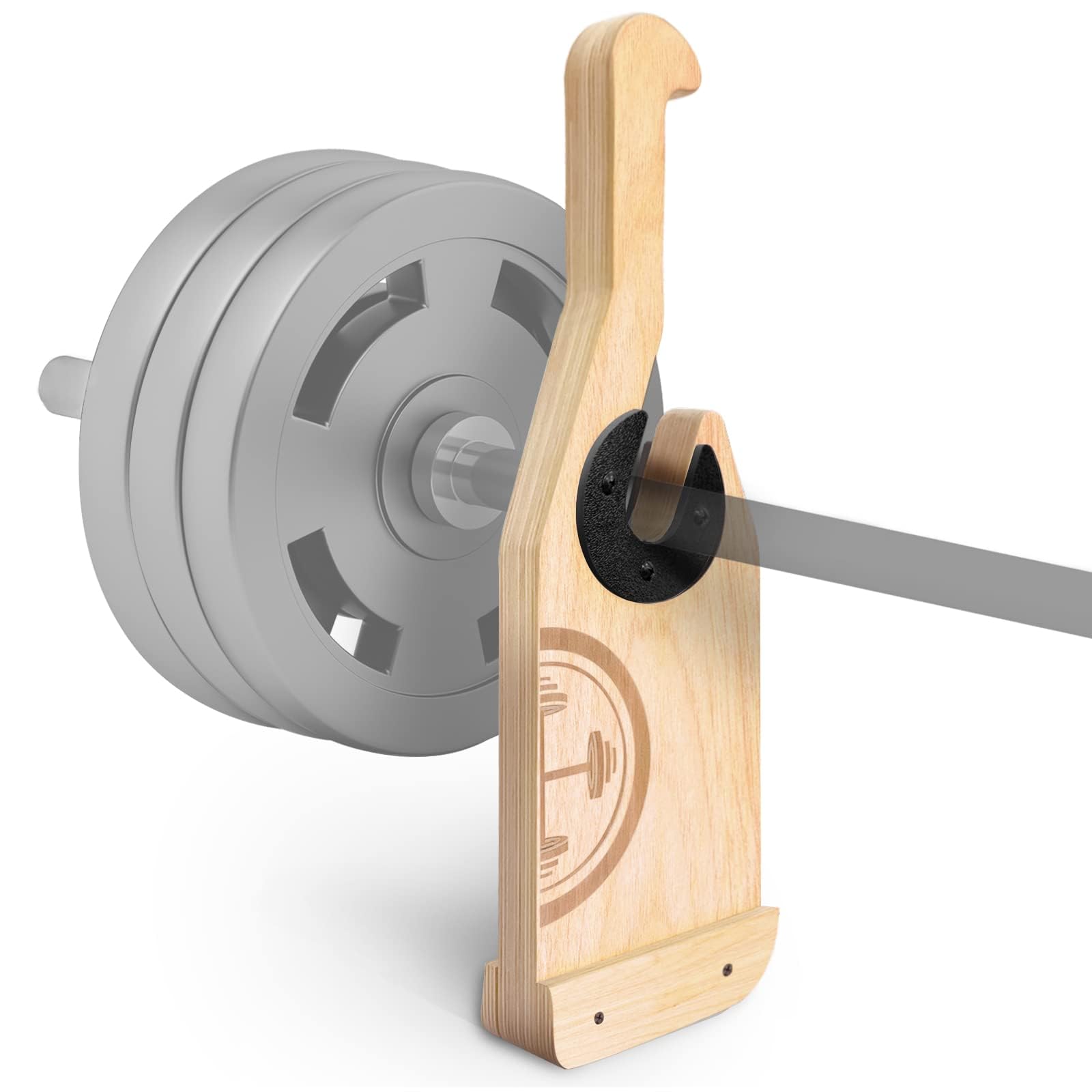
The question with a wooden jack is whether it stays put under a heavy bar, and with the POWER GUIDANCE the honest answer is that it depends on how you set the bar down. The body is 1.2 inches thick and weighs 2.3 pounds, and a stand that light will rock if a sleeve lands in the groove off-center. Seat the bar gently and it is stable; drop it in and you will feel the movement.

What the wood buys you is portability and a finish you do not mind leaving out. The body runs 16.8 inches long with a widened base, an arc cut into the underside for leverage, and a groove reinforced with a wear-resistant gasket where the bar sits. The handle is angled so your hand falls where the pull is strongest.

It is the lightest jack in this group by a wide margin — thin enough to slide behind a door, light enough for a gym bag — and the sanded finish means no splinters when you grab it. It is also rated to 700 pounds, the highest of the compact jacks here, so the low weight is about the material rather than a weaker tool.

Where we land is that this is a good jack for a lifter who loads on a platform at home and wants something that stores out of the way, and a good one to keep in the car for the gym you do not own. If you throw plates at a bar in a hurry, the steel bases here will feel steadier in the hand.

Bottom Line

We recommend it for a lifter who loads on a platform and wants a jack that stores on a shelf or rides in a bag.

Check Latest Price

How We Tested Deadlift Jacks

I started by gathering the deadlift jacks that kept showing up in home gym forums and retailer listings, then narrowed the field by footprint, handle or lever length, stated capacity, finish, and replacement-part availability. Price mattered, but only as part of value: a jack that saved money but flexed under a loaded bar was not going to make the cut. The final shortlist was 11 jacks, and I used each one for eight months in a home gym setup on rubber mats and a wooden platform.

Testing happened on deadlift days, usually in the morning before work and on longer weekend sessions. I rolled each jack into position with the bar loaded, checked whether it slid under the sleeves without me having to lift the bar by hand, and noted whether the bar sat level once raised. Then I stripped and reloaded plates, paying attention to whether the jack stayed put, whether it tipped or walked across the mat, and whether the handle or pedal was easy to reach with chalky hands.

At the end of each session I stored the jack where it would live in a home gym, which exposed the awkward ones—wide bases, sharp edges, handles that caught on plates. Over eight months I watched for scratches, bent arms, loose pivots, worn rubber, and welds that started to flex under heavier loads. The jacks that held up were the ones that felt solid before the bar ever left the floor; the ones that didn’t either wandered during loading or made me nervous when the bar came down.

How to Choose

One Jack or a Pair

Most jacks here lift a single sleeve, which means you load one end, walk around, load the other, and accept that the bar sits at an angle in between. That is how most people train and it works fine. A pair, like the Lovind set, stands under both sleeves and keeps the bar level, which is nicer when you are sliding plates on with both hands and no one spotting you.

The price of the pair is storage. Two stands need twice the hook or twice the shelf, and each one is a little bulkier than a single compact jack. If your bar lives on the platform and never travels, two is the calmer setup. If the jack rides in a car or a gym bag, one is the practical answer.

Match the Rating to the Bar You Load

Every jack here is rated somewhere between 600 and 900 pounds, and any of those numbers covers a home lifter's heaviest pull. The rating becomes a real comparison when you move from a compact jack to a full-size frame: the 30-pound Titan's 900 pounds is about how the frame is built, not marketing.

One trap worth knowing: a listing can quote two capacities in different places, and the Titan's page does exactly that. Plan around the lower figure and treat the higher one as decoration.

How the Bar Is Held

The contact point separates a clean lift from a fiddly one. Look for a groove wide enough for both 1-inch and 2-inch sleeves — 2 inches is the common gap here, 2.5 on the Lovind — and for padding where the bar lands. UHMW plastic and PVC protect knurling; bare or poorly finished metal does not, and a padded groove also keeps the bar from rolling while you reach for a plate.

Wipe grit out of the groove every so often. That, rather than the bar itself, is what wears padding down and eventually cracks it.

Footprint, Weight, and Where It Lives

Measure before you buy the big one. The compact jacks run about 17 inches long and a few inches tall, which is what lets them slide under a bench or sit on a shelf; the Titan is 42.5 inches wide and 30 pounds and wants a permanent spot beside the platform.

Weight tracks the same way. A 2.3-pound wooden jack goes in a backpack, while 8 pounds of steel stays home. Buy for where the jack will live most weeks, not for the one afternoon a month it goes somewhere else.

Frequently Asked Questions

Final Verdict

Buy the RitFit. It has the steadiest base of the compact jacks here, a 660-pound rating that covers any bar you will load at home, and nothing to assemble — the plate changes you make fifty times a week simply get easier.

If you want both sleeves up at once, the Lovind pair is the upgrade worth making. If the bar never leaves the platform and you have the floor space, the Titan's full frame is a different class of tool altogether.