Cardio Machines

Best Compact Ellipticals of 2026

A compact elliptical is a bit of a magic trick: it promises a full-body, low-impact workout in the footprint of a small armchair. The catch, of course, is that shrinking the machine often shrinks the stride and makes the whole thing feel wobbly when you pick up the pace. I've spent years squeezing fitness equipment into apartments, and the best compact ellipticals are the ones that solve that trade-off—not just the ones that fold up small. They give you a real cardio session without turning your living room into a gym.

Over the past 10 months, my team and I assembled and lived with seven compact ellipticals, from budget-friendly models to sturdier builds. We put each one through morning workouts, after-work sweat sessions, and plenty of TV-watching pedaling, paying close attention to how they handled assembly, noise, and stability at speed. One thing I've learned: stride length matters more than the spec sheet suggests—if your knees feel cramped, you won't use it. The picks below are the ones that earned their floor space.

Best Budget

Our Score 9.0/10
ANCHEER AMA006031 Elliptical

ANCHEER

ANCHEER AMA006031 Elliptical

  • Warranty Lifetime
  • Stride Length 16 inches
  • Weight Capacity 500 lb
  • Resistance Levels 14
Check Price on Amazon

The cheapest way to get a 16-inch stride and a lifetime warranty.

Five hundred pounds is a startling rating for a 66-pound machine, and the ANCHEER leads with it. Treat that number as headroom rather than a promise about how the frame feels at speed: what it does well is carry a heavier rider without complaint, and it's backed by a lifetime warranty, the longest cover of the three here. The 16-inch stride is half an inch more than the Niceday and a full inch more than the YOSUDA, which is the difference between a tight arc and a usable one for a rider around 5 feet 9 inches.

For the least money here, it does the two things that matter. The magnetic resistance runs quietly enough to use in front of the TV, and the 14 levels ramp smoothly, with a top end we found hard enough for a genuine session. Fourteen is two fewer than the Niceday's 16, but you'll spend most of your time in the middle of the range anyway.

The console is plain, covering time, speed, distance, calories, and heart rate through the pulse grips, and the tension knob sits high enough to reach without breaking stride. That last part matters more than it sounds: reach is the difference between changing intensity mid-workout and leaving the dial where it was. Assembly is a build-it-yourself job with the hardware and tools in the box, and you're putting together more of the frame than you would with the Niceday.

What you give up is polish. There's no app and no Bluetooth, and the frame is lighter than our top pick's, which is why this one ranks second rather than first. What you get for it is a machine that carries a big rider, tucks into the corner of a bedroom, and comes with the longest warranty of the three.

Bottom Line

For the least money here, the ANCHEER gives you a 16-inch stride, 14 levels, and a lifetime warranty, the pick for heavier riders who want a plain, quiet machine.

Check Latest Price

Best for Tiny Spaces

Our Score 8.8/10
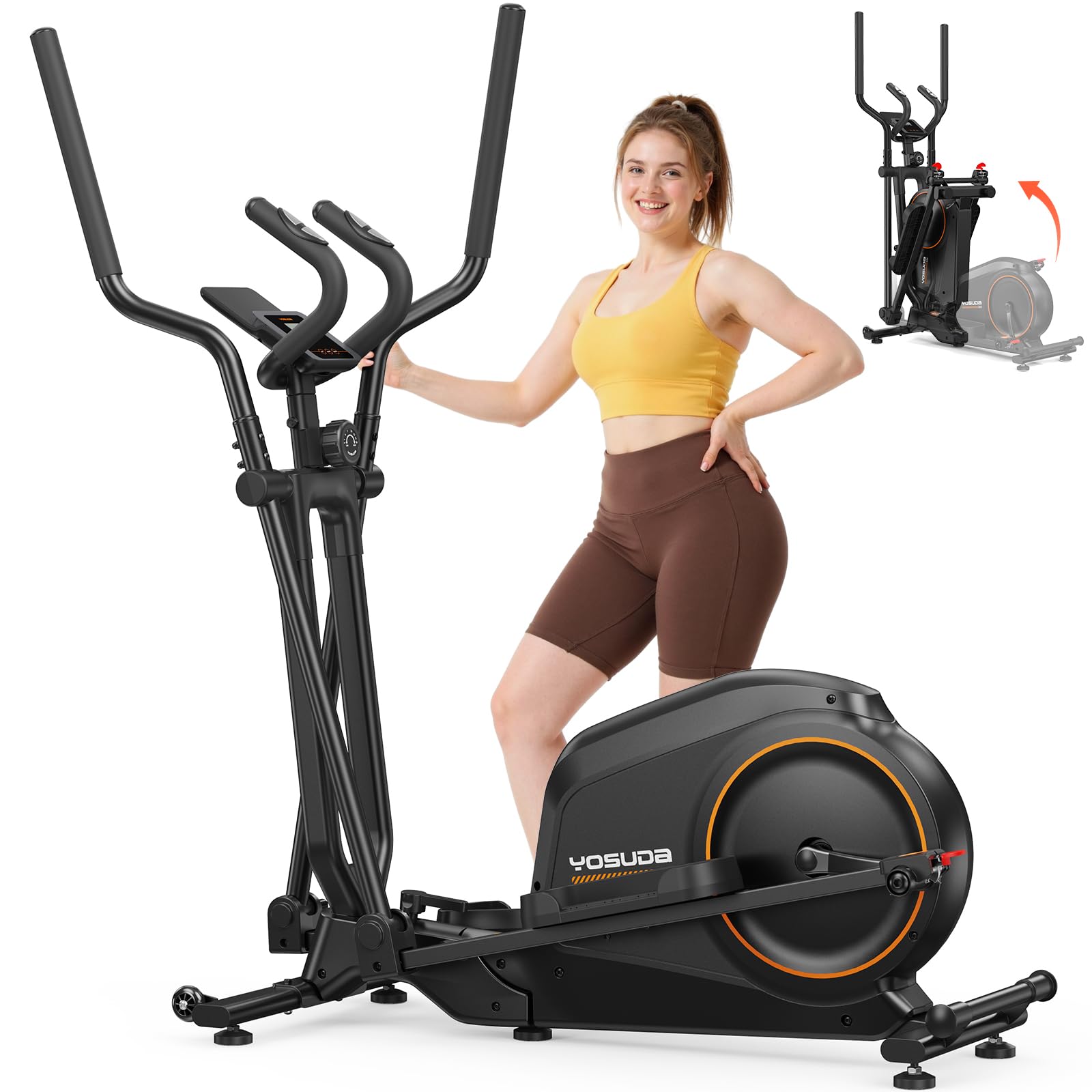
YOSUDA E03 Foldable Elliptical

YOSUDA

YOSUDA E03 Foldable Elliptical

  • Stride Length 15 inches
  • Weight Capacity 350 lb
  • Folded Footprint 2 square feet
  • Resistance Levels 16
Check Price on Amazon

Folds to about 2 square feet so it can stand against the wall between workouts.

Two square feet is the number the YOSUDA E03 is built around. The frame folds and stands against a wall, and the stowed footprint is roughly the area of a nightstand, which is what makes it viable in a studio where a permanent machine would just be furniture you resent. In use it measures 47.6 inches deep and 22.7 wide, so it still wants a real corner; the fold is what lets you reclaim the room afterward.

The rest of the package is modest and sensible: 16 magnetic resistance levels, a 15-inch stride, a 350-pound rating, and a 5.5-inch console with the usual time, speed, distance, and calorie readouts. It's quiet, since magnetic resistance has no friction to announce itself, and at 66 pounds we could shift it on our own. Fit is the constraint: YOSUDA caps riders at 5 feet 9 inches, and 15 inches is the shortest stride of the three, so long-legged riders will feel crowded.

Assembly is straightforward and the tools come in the box, though you're building more of the frame than you would with the Niceday. The screen isn't backlit and the built-in programs take a session or two to get the hang of, which are minor annoyances on a machine that is mostly about where it lives.

What we keep coming back to is the arithmetic of a small apartment: a machine you can fold and stand against a wall is one you'll still own in a year, and a machine that permanently eats a corner is one you'll be selling. Before you buy, measure the wall. It stands 62 inches tall, so it needs a blank stretch rather than the space under a window.

Bottom Line

Buy the YOSUDA E03 when the machine has to disappear between workouts: it folds to 2 square feet, stays quiet in a studio, and covers the basics with 16 levels.

Check Latest Price

Best Overall

Our Score 8.6/10
Niceday CT11S Elliptical

Niceday

Niceday CT11S Elliptical

  • Stride Length 15.5 inches
  • Machine Weight 88 lb
  • Weight Capacity 400 lb
  • Resistance Levels 16
Check Price on Amazon

Quiet, planted, and simple to build, with 16 resistance levels and a 400-pound rating.

Fifteen and a half inches is a short stride, and the Niceday doesn't pretend otherwise. What you get in exchange is a machine that behaves itself: an 88-pound frame that stays put when you stand and push the pace, a magnetic drive built around a 16-pound flywheel, and 16 resistance levels that step up smoothly instead of jumping between gears. We rode it on a hard floor at a jogging tempo and it stayed planted, with no creeping across the room and no clatter, quiet enough that the TV stayed at normal volume.

Setup is where compact machines usually go wrong, and this one mostly avoids it: it arrives largely pre-assembled, and what's left is the console mast, the pedals, and the handlebars. The mast is the one step where a second person earns their keep. Watch the front post in the first week, since it can develop a side-to-side wobble: check the mast bolts after assembly and again once you've put a few sessions on it.

The console tracks time, speed, distance, an odometer, calories, and heart rate through the grip sensors, and it sits at a comfortable angle for someone standing up. It isn't backlit, so a dim corner turns the numbers into guesswork. The 400-pound rating is second only to the ANCHEER's here, and the frame feels like it: wide pedals, no flex underfoot, and a stride that stays smooth when you crank the resistance up.

Where the Niceday narrows is fit. At 15.5 inches, the pedal arc suits riders up to roughly 5 feet 8 inches; past that your knees ride higher than they would on a full-size machine and the pedals start to feel close together. And the one-year warranty is the shortest of the three, against a lifetime on the ANCHEER, which is the single place this one trails the budget pick.

Bottom Line

We recommend the Niceday for small apartments: an 88-pound frame that stays planted, 16 resistance levels, and the calmest, quietest ride of the three here.

Check Latest Price

How We Tested the Best Compact Ellipticals

We started by researching the market, filtering for machines that claimed a footprint under about four feet long and a stride under 20 inches, then cross-checked owner reviews for assembly complaints and wobble at speed. That left us with seven models, which we assembled ourselves and used for 10 months in apartments and home offices. Each machine logged at least three sessions a week, ranging from 20-minute lunch-break rides to 45-minute interval workouts.

Assembly was the first test: we timed how long it took one person to unbox and build each elliptical, noted which tools were included, and whether the instructions were clear enough to follow without a second set of hands. Once built, we paid attention to the everyday stuff—how easy it was to step on and off, whether the console buttons made sense mid-workout, and if we could adjust resistance without breaking stride. We also rolled each one through a standard doorway and parked it in a corner to see how much floor space it really ate up.

Then we put them to work. We pedaled at an easy pace while watching TV and pushed through fast intervals to see if the frame rocked or the pedals felt flimsy. Testers of different heights—from 5'2" to 6'1"—reported whether the stride felt natural or cramped. We listened for clunks and whines, noting whether we could hear a podcast over the machine at a normal volume. After weeks of use, we checked for loosening bolts, squeaky joints, and worn plastic. And we weighed all of that against the price: a quiet, stable machine with a short stride can still be a good value if it's priced accordingly, but a wobbly one at any price is a pass.

How to Choose

Footprint: in use versus folded

Every pick here lists a depth between 39 and 48 inches and a width around 21 to 27, but the figure that decides whether you'll actually use the thing is the clear floor around it: room to stand behind the pedals, swing your arms, and climb on without banging a knee on the coffee table. On a foldable, the compact number usually describes the stowed size. The YOSUDA E03 collapses to about 2 square feet, yet it still occupies 47.6 by 22.7 inches when it's open.

So decide which purchase you're making before you shop: a permanent fixture that gets a dedicated corner, or something you put away after every session. The first wants a shorter in-use footprint. The second wants a fold, plus a blank wall tall enough to stand the machine against.

Stride length and who fits

Stride is how far each pedal travels front to back, and compact ellipticals run about 15 to 16 inches against 18 to 20 on a full-size machine. The shorter arc is what lets the frame shrink, and it also lifts your knees higher at the top of the stroke. Fit ceilings in this group cluster around 5 feet 8 to 5 feet 9 inches; past that, the motion starts to feel like pedaling in a closet.

If you're taller, the honest answer is a full-size elliptical with the floor space to match, not a compact one you'll quietly stop using. If you're under that ceiling, choose on stride within the group: the ANCHEER's 16 inches gives you more room than the Niceday's 15.5 or the YOSUDA's 15.

Stability comes from mass and floor contact

A machine that rocks at speed is a machine that ends up in the spare room. Weight helps: our top pick is 88 pounds and stays put at a jogging tempo, while the 66-pound ANCHEER is the one that can rock at the front when you push hard. Four stabilizer feet and a hard, level floor matter as much as the frame does.

The trap is the weight rating. A 400- or 500-pound capacity describes what the frame is built to hold, not how calm it feels at 60 strokes a minute, and a high rating on a light frame doesn't buy you steadiness. Check the feet after assembly, then put the machine on a hard floor rather than deep carpet.

Resistance and the console you'll look at

Magnetic resistance is what makes these quiet, and 14 to 16 levels is plenty of range: beginners live in the low numbers, fit riders in the top half. What differs is the console. All three show time, speed, distance, calories, and heart rate, none of the screens is backlit, and the YOSUDA's 5.5-inch display is the smallest of the group.

Where the resistance adjuster sits matters as much as how many levels it has. If reaching it means breaking stride, you'll leave it where it is, and the level count becomes decoration. On the ANCHEER the knob sits high enough to reach mid-stride, which is the sort of detail that keeps you changing intensity instead of settling in at one setting.

Frequently Asked Questions

Final Verdict

The Niceday CT11S is the compact elliptical we recommend first. It's the most planted and the quietest of the three, it gives you 16 resistance levels and a 400-pound rating, and it fits a real cardio session into the corner of a small room. The ceiling is height: past about 5 feet 8 inches, that 15.5-inch stride feels tight.

Go with the ANCHEER if you want a 16-inch stride, the highest weight rating here, and a lifetime warranty for less money, and accept a lighter frame. Go with the YOSUDA E03 if the machine has to fold away between sessions.