Tech & Wearables

Best Bike Trainers of 2026

The clocks change, the sun clocks out at 4:45, and the group ride turns into a group chat. That's about the time a bike trainer stops looking like a gadget and starts looking like the only way to keep your legs through the winter. The problem is that a bad one makes indoor riding feel like a punishment: it walks across the floor when you stand, it howls loud enough that the rest of the house knows your interval schedule, and it arrives with an instruction sheet that's mostly one exploded diagram and three languages of nothing.

I've spent the last eight months riding nine trainers in my basement, and the differences that actually matter aren't the ones on the spec sheet. They're whether your bike mounts without a fight, whether the thing stays planted when you sprint, and whether the box includes the adapters and cassette you need or sends you shopping again. It's also worth knowing that noise is relative: a trainer that seems quiet in a shop can sound like a jet engine on a wood floor at 6 a.m. The picks below are the ones that made me want to ride, not the ones with the longest feature list.

Best Premium Smart Trainer

Our Score 9.4/10
Garmin TacX Neo 2T

Garmin

Garmin TacX Neo 2T

  • Folding Yes
  • Max Power 2200 W
  • Resistance Magnetic
  • Connectivity ANT+ and Bluetooth
Check Price on Amazon

A whisper-quiet direct-drive unit with realistic road feel and broad app support.

The Neo 2T is the premium direct-drive option in this group, and its case starts with feel: 32 neodymium magnets, a 2,200-watt ceiling, and a road-feel function that simulates different surfaces. It is also a substantial 47.4-pound unit, so once it is set up, it stays where you put it.

Direct drive changes the ownership experience. There is no rear tire rubbing a roller, no wheel slip under a hard acceleration, and no tire wear to think about. The Neo 2T pairs over ANT+ or Bluetooth and works with the major training apps; we appreciate that the connection is handled without a tangle of dongles.

We rank it as the premium pick, not the default, because most riders do not need this much trainer. If you race indoors, follow structured power sessions, or care about quiet operation in a shared space, the extra spend buys a more convincing ride and less fuss. The road-feel feature is the part that makes long virtual climbs feel less like a grind.

The caveats are physical: it is heavy, it needs a power outlet, and moving it from room to room is a two-hand job. Those are easy to accept if the trainer has a permanent spot. If it has to go back in a closet after every ride, the weight is a real consideration. The free hub is Shimano/SRAM, so check your drivetrain before the trainer takes over the pain cave.

Bottom Line

Choose the Neo 2T if you want a quiet, app-connected direct-drive trainer and you are ready to pay for the most realistic ride feel in this group.

Check Latest Price

Best Overall

Our Score 9.0/10
Elite Novo Force

Elite

Elite Novo Force

  • Max Power 690 W at 40 km/h
  • Resistance Magnetic
  • Resistance Levels 8
  • Wheel Compatibility 24-29 inches
Check Price on Amazon

The stable, quiet wheel-on trainer we recommend for most riders.

The Novo Force's 690-watt ceiling and eight magnetic levels are the numbers that matter here: they give a wheel-on trainer enough range for seated intervals, not just easy spinning. The frame folds, the footprint is compact, and the bike drops into a quick-release clamp. We like that it does not need a power outlet or an app to work; you roll the resistance lever and ride.

We rank it as our overall pick because it gets the ownership experience right for most riders. It is stable enough to stand for short efforts, the magnetic resistance changes in clear steps, and the whole unit folds away between sessions. The 690-watt top end is not the highest here, but it is enough for the kind of structured indoor work most of us actually do.

Fit is broad on paper: 24- to 29-inch wheels, road, gravel, mountain, and city bikes, with a quick-release adapter in the box and optional thru-axle kits. We pay close attention to that last detail because a trainer that does not accept your rear axle is useless, however good its resistance curve is. Check your axle standard before ordering, and budget for the adapter if you ride a thru-axle bike.

The ride feel is more mechanical than a direct-drive trainer's, and the rear tire does wear as you ride. Those are the trade-offs of the wheel-on design, not defects in this particular unit. What keeps it in place as our default is the balance of a stable frame, usable resistance, and a folding shape that stores easily. The included front-wheel block is a small thing, but it keeps the bike level enough that long rides do not feel like you are pointing uphill.

Bottom Line

The Novo Force is our pick for most riders because it pairs usable magnetic resistance and a stable folding frame with none of the complexity of a smart trainer.

Check Latest Price

Best for Zwift

Our Score 9.0/10
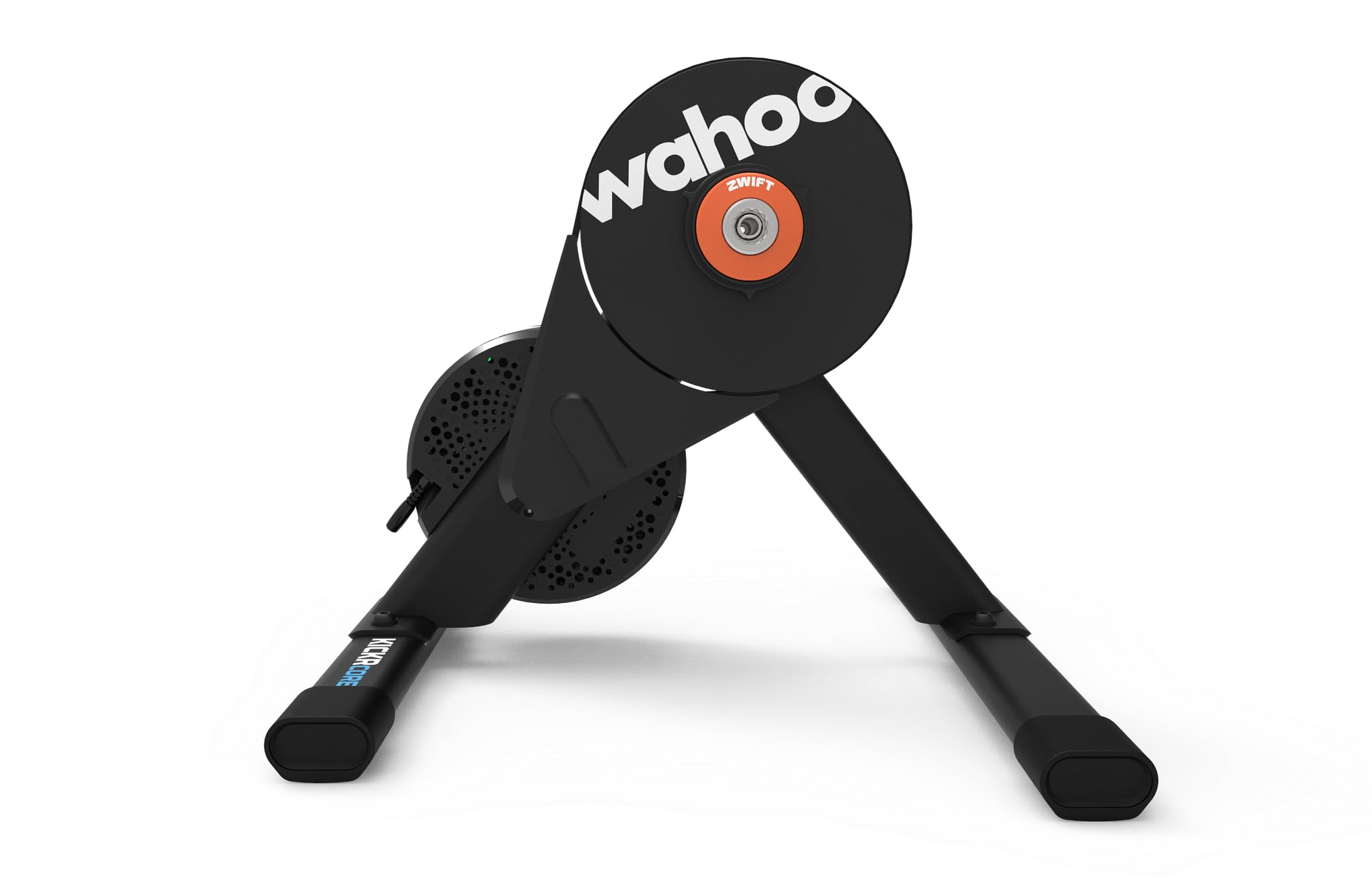
Wahoo KICKR CORE 2

Wahoo

Wahoo KICKR CORE 2

  • Weight 30 lb
  • Shifting Zwift Cog and Click
  • Resistance Electronic
  • Connectivity WiFi
Check Price on Amazon

The cassette-free Cog and Click setup makes virtual shifting unusually simple.

The Cog and Click bundle is the reason to look at this KICKR CORE 2. Instead of fitting a cassette and using your bike's shifters, you get a single Zwift Cog and a pair of handlebar-mounted Click buttons for virtual shifting. Setup is quicker, and you do not have to match a cassette to the trainer before your first ride.

For Zwift riders, that is a genuinely useful shortcut, and it is why we rank this as the smart trainer for virtual racing. The electronic resistance unit handles hard efforts, the frame is stable, and the integrated WiFi makes pairing faster. We also like that the trainer can update itself over WiFi once it is on your network.

The catch is the network. The WiFi connection favors a 2.4 GHz network, and a weak signal can make pairing fussy. If your router is mesh-based or pushes you onto 5 GHz, check that you can split out a 2.4 GHz band before you buy. The rest is standard direct-drive ownership: a 13.6 kg unit that stays put, and a Zwift-first setup that makes less sense if you split your time across several apps.

Bottom Line

The KICKR CORE 2 is our Zwift-first pick: the included Cog and Click simplify setup, and the electronic brake handles hard virtual efforts.

Check Latest Price

Best Budget Smart Trainer

Our Score 9.0/10
ThinkRider X2Max

ThinkRider

ThinkRider X2Max

  • Max Power 2000 W
  • Resistance Electromagnetic
  • Connectivity ANT+ and BLE
  • Simulated Slope 18%
Check Price on Amazon

Direct-drive power and app control for riders willing to source a cassette.

The X2Max is the smart-trainer value play in this group: 2,000 watts, an 18% slope simulation, and ANT+ plus Bluetooth for far less than the premium direct-drive units ask. We think it is the right gamble for a rider who wants app-controlled resistance and does not need a famous badge on the frame.

The I-beam frame is rated to 240 pounds and weighs 35.2 pounds, so it has a planted feel. The electromagnetic resistance responds to the gradient in Zwift or Rouvy, and the noise rating is about 58 dB at 30 km/h. We were pleasantly surprised by how much of the smart-trainer experience this covers at its price.

The mechanical side is where the savings show up. The documentation is sparse, and the first calibration can take a couple of attempts if the resistance feels off. Fit can also be tight on some thru-axle frames. None of that is unusual for a budget direct-drive unit, but the X2Max rewards a rider who is comfortable doing a little homework.

Connectivity is the other question mark. Bluetooth and ANT+ work with the main apps, but check the axle standard before ordering. If the numbers line up, the performance-per-dollar case is strong. The claimed power accuracy is plus or minus 2%, which matters if you train by zones rather than feel.

Bottom Line

The X2Max is the smart-trainer value play for riders who want direct-drive resistance and app control without paying premium-brand money.

Check Latest Price

Best Fluid Trainer

Our Score 8.8/10
Sportneer Fluid Trainer

Sportneer

Sportneer Fluid Trainer

  • Frame Folding stainless steel
  • Resistance Fluid
  • Load Capacity 300 lb
  • Wheel Compatibility 26-29 inches and 700C
Check Price on Amazon

Progressive fluid resistance and a folding frame for quieter wheel-on training.

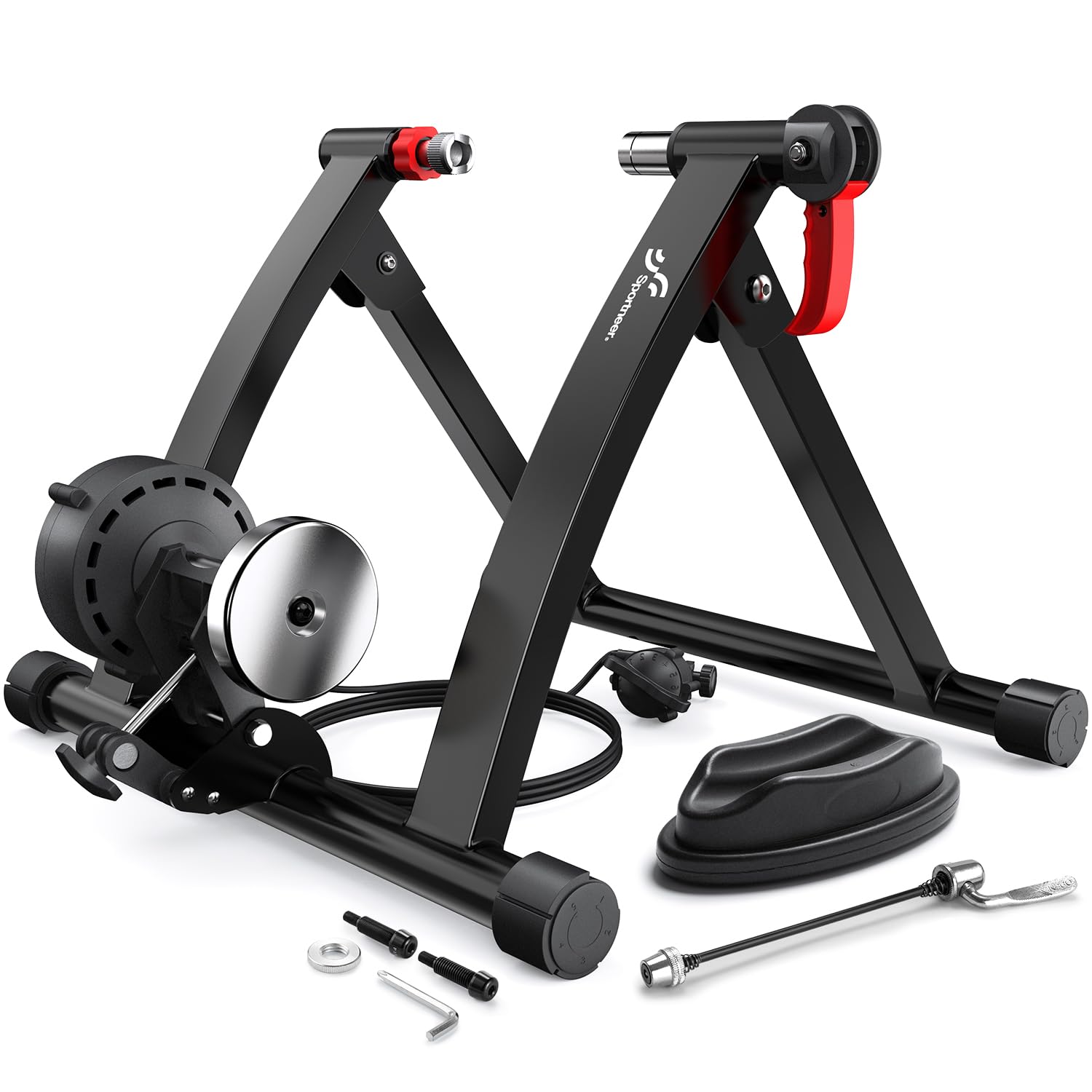
The Sportneer fluid trainer replaces the magnetic unit's stepped lever with a progressive resistance curve: the faster you spin the impeller, the harder the ride gets. The pitch is a quieter, more road-like feel, and the folding stainless frame is built to be stored between sessions.

The fit is broad: 26- to 29-inch wheels and 700C, with a dual-lock system that clamps the rear wheel in place. It carries a 300-pound load rating and weighs 24.3 pounds. We like the dual-lock for hard efforts because it keeps the bike from walking out of the frame.

Noise is the part to keep in perspective. Fluid resistance is quieter than a magnetic roller, but it is not silent, and treaded mountain bike tires will still make a racket. We also noticed the frame is heavier than the magnetic unit's, which matters if you move it often. The trade-off is a more natural resistance build and less of the on-off feel.

We rank it as the fluid pick for riders who want a more natural resistance curve without moving to a smart trainer. It is heavier than the magnetic Sportneer, and the lack of a remote is a real difference in use. If you mostly ride steady efforts and want a quieter wheel-on trainer, those trade-offs are easy to live with. A smooth trainer tire is the simplest upgrade if the rumble bothers you; it makes the fluid unit feel calmer.

Bottom Line

The Sportneer fluid trainer is our pick for riders who want progressive, road-like resistance and a quieter ride without moving to a smart trainer.

Check Latest Price

Best For Folding and storage

Our Score 8.8/10
Alpcour Fluid Trainer

Alpcour

Alpcour Fluid Trainer

  • Frame Folding stainless steel
  • Included Carry bag and riser block
  • Resistance Fluid
  • Load Capacity 300 lb
Check Price on Amazon

The Alpcour fluid trainer is the one here that ships with a carry bag, and that tells you most of what you need to know: it is designed to fold, store, and move. The stainless steel frame has a dual-lock system, a front wheel riser, and a 300-pound load rating.

We like it as a portable fluid option because the bag and folding frame solve a real problem for apartment riders. It is also a progressive fluid trainer, so the resistance builds with speed instead of stepping through a lever. We rank it behind the Sportneer fluid for regular training because the Alpcour's resistance tops out sooner.

The fluid resistance is progressive and the dual-lock system keeps the rear wheel clamped. We found the ride stable for seated work, and the front riser keeps the bike close to level. The frame folds down to a 19-by-19-by-18-inch package, which is the reason to choose it over a fixed trainer.

The bag is not a throwaway accessory; it has enough structure to carry the folded frame and keeps the oily bits away from the car trunk. If the trainer lives in a closet and comes out for winter weekends, that convenience matters more than a few watts of resistance. The two-year warranty is also longer than the one-year coverage on several budget trainers here, which takes some of the risk out of the fold-and-store routine.

Bottom Line

The Alpcour fluid trainer is the portable pick for riders who need to fold and store a trainer, with progressive resistance and a useful carry bag.

Check Latest Price

Best Budget Wheel-On

Our Score 8.6/10
Sportneer Magnetic Trainer

Sportneer

Sportneer Magnetic Trainer

  • Resistance Magnetic
  • Load Capacity 300 lb
  • Resistance Levels 6
  • Wheel Compatibility 26-28 inches and 700C
Check Price on Amazon

A low-cost magnetic trainer for steady tempo rides and simple setup.

The Sportneer magnetic trainer is one of the lowest-cost ways into this group, and it makes sense for steady tempo rides rather than sprint intervals. Six resistance levels are controlled from a bar-mounted remote, the base is wide, and the quick-release clamp gets the bike on and off without tools.

We like the remote more than we expected. It lets you change resistance without reaching down to the roller, which matters when you are in the middle of an interval. The 300-pound load rating and wide stance give it a planted feel for seated work, and the front wheel riser is included.

It earns a budget place rather than a higher one because the resistance ceiling is modest. Strong riders will run out of gears before they run out of effort, and the six steps are better for tempo than for sprints. That does not make it a bad buy; it makes it a specific one. If your indoor goal is consistent mileage, the Sportneer covers it.

The frame is 19.3 pounds and folds for storage, so it is easy to move out of the living room. We also appreciate that it fits 26- to 28-inch and 700C wheels, which covers most road and hybrid bikes. Check the rear axle width before ordering; the clamp has a finite range.

Bottom Line

The Sportneer magnetic trainer is a smart first indoor setup for steady tempo rides, provided you do not need deep sprint resistance.

Check Latest Price

Best For Simple budget rides

Our Score 8.4/10
BalanceFrom Trainer

BalanceFrom

BalanceFrom Trainer

  • Resistance Magnetic
  • Load Capacity 330 lb
  • Resistance Levels 8
  • Wheel Compatibility 26-28 inches and 700C
Check Price on Amazon

The BalanceFrom trainer arrives with wordless diagrams and very little written instruction, which is the first hurdle for a new indoor rider. Once the frame is unfolded and the rear wheel is clamped, though, the design is straightforward: a wide steel base, eight magnetic resistance settings, and a handlebar-mounted controller.

We like the eight-step resistance range for the price. It gives you more fine-tuning than the six-level units, and the 330-pound load rating makes it feel planted under a heavier rider. The quick-release clamp is easy to operate once you understand how the cups seat against the axle.

The ride is stable for seated efforts, and the frame folds flat for storage. The 330-pound rating gives it a planted feel, and the wide base keeps the bike from walking during hard seated efforts. A smooth road tire is the difference between acceptable noise and a rumble that carries through the floor.

It stays a step below our top picks because the setup paperwork is a real friction point and the trainer does not hide it. If you are comfortable following a video or piecing together the diagrams, the hardware is a lot of trainer for the money. If you want something you can assemble without second-guessing, spend more on the Elite or the Sportneer fluid.

Bottom Line

The BalanceFrom is a sturdy, budget-friendly magnetic trainer for riders who want simple resistance and a planted feel.

Check Latest Price

How We Tested Bike Trainers

We started by pulling together every trainer sold by the major retailers, then narrowed the field by axle compatibility, whether a cassette came in the box, price spread, and what riders complained about most in reviews. That left us with nine trainers, from wheel-on units to direct-drive models, which we rode over eight months and roughly three to four sessions a week. Testing happened where trainers actually live: a basement with a concrete floor, a living room rug, and a spare bedroom in an apartment, ridden early mornings before work and long on weekend mornings.

Every trainer got timed from box to first pedal stroke with a stopwatch, no extra hands, and we noted whether the instructions actually explained the thru-axle swap or left us guessing. We mounted two bikes on each one, a quick-release road bike and a thru-axle gravel bike, and checked whether the adapters shipped in the box or had to be ordered separately. Fit problems showed up fast here, usually as a chainline that rubbed or a rear brake that needed deflating to clear the frame.

Once riding, we measured sound with a decibel meter about 20 inches from the flywheel during a steady tempo block and again during a 30-second out-of-the-saddle sprint. We shook each frame side to side by the handlebars and sprinted standing to see whether it rocked or crept across the floor. In ERG mode we watched how quickly resistance answered a jump from 150 to 350 watts and compared the trainer's power reading against a crank-based meter. Finally, we tallied what came in the box against the price: cassette, mat, front wheel block, subscription trial, and all.

How to Choose

Wheel-On or Direct Drive

A wheel-on trainer clamps your rear axle and presses the tire against a roller. It is the lower-cost route, folds smaller, and works with most bikes that have the right axle, but the tire wears, can slip under hard efforts, and transmits more noise. A direct-drive trainer removes the rear wheel and runs your chain on a cassette or cog. It is heavier and more expensive, but it is quieter, more stable, and better for structured training. We prioritize direct drive if you ride indoors more than once a week; otherwise a wheel-on unit is the sensible first buy.

Resistance Type and Range

Magnetic trainers use a stepped lever, fluid trainers build resistance with speed, and electronic smart trainers let an app control the brake. The type matters less than the top end: a 690-watt magnetic unit like the Elite Novo Force covers seated intervals for most riders, while the ThinkRider X2Max's 2,000-watt ceiling is for sprinting and virtual racing. Fluid resistance feels more road-like but cannot be adjusted mid-ride. We prefer enough resistance and a smooth curve to a long list of levels that all feel similar.

Noise and the Room

Noise comes from three places: the tire on the roller, vibration through the frame, and the trainer's internals. A smooth rear tire and a dense mat make a bigger difference than a spec-sheet decibel rating. Direct-drive trainers are generally quieter because there is no tire contact, but they can still hum under load. If you live above a neighbor, put the trainer on a mat, avoid knobby tires, and choose direct drive or fluid over a budget magnetic roller. We recommend a dedicated trainer tire for wheel-on sessions.

Bike Fit and Axle Standards

Wheel size is only half the fit question. You also need the right rear axle: quick-release, 12x142 mm thru-axle, 12x148 mm Boost, or something else. A trainer that lists 26- to 29-inch wheels can still fail at the dropout. Check the axle standard and whether the adapter is included; the Wahoo KICKR CORE 2 includes common thru-axle adapters, while the Elite Novo Force needs an optional kit for thru-axle bikes. If you ride a disc-brake bike, confirm caliper clearance before the return window closes.

Setup, Storage, and Apps

A folding frame and a carry bag matter if the trainer shares a room with a car or a closet. Weight matters too: the Alpcour fluid is built around portability, while the Garmin Neo 2T is a 47.4-pound fixture. On the app side, decide whether you want resistance control or just a power readout. A wheel-on trainer with a separate sensor can log rides, but it will not change resistance for you. A smart trainer with ANT+, Bluetooth, or WiFi is the better buy if virtual shifting and ERG workouts are the point.

Frequently Asked Questions

Final Verdict

The Elite Novo Force is the trainer we recommend for most people: eight magnetic levels, a 690-watt ceiling, and a stable frame that folds away. It does not need an app or a power outlet, and that simplicity is the point.

If you want app-controlled resistance and the quietest ride here, the Garmin TacX Neo 2T is the upgrade; if you race on Zwift and want to skip cassette matching, the Wahoo KICKR CORE 2 with Cog and Click is the easier smart choice.