Outerwear & Layers

Best Base Layers for Running of 2026

A running base layer has one job: move sweat off your skin before it turns cold. Get it wrong and you spend the back half of a winter run either shivering or soggy — sometimes both. Get it right and the layer disappears, which is the highest compliment a piece of running gear can earn. The right one fixes that balance: it keeps you warm without turning clammy, and it sits close enough to wick without fighting you at the seams.

I've been running through cold mornings for years, and the gap between a good base layer and a bad one shows up around mile four, not in the first five minutes. Over the past six months, my team and I have tested 14 base layers on early road runs, long weekend efforts, and too many laundry cycles. We paid close attention to fit and sleeve length — a hem that rides up or a cuff that stops short can ruin an otherwise solid layer — along with warmth, comfort, quality, value, and whether the details earned their keep. The keepers are below.

Best Cold-Weather Bottoms

Our Score 9.4/10
Under Armour ColdGear Leggings

Under Armour

Under Armour ColdGear Leggings

  • Fit Compression
  • Type Full-length leggings
  • Fabric Line ColdGear
Check Price on Amazon

The warmest tights here, snug and slow to stretch out on winter runs.

Cold mornings are where the ColdGear tights separate themselves from the lighter pairs here. They're the heaviest leg layer in this group, and the difference shows up in the first few minutes of a run: your legs feel covered rather than merely contained. For winter mileage, this is the pair we recommend.

The fabric is thick without feeling stiff, and it keeps its shape instead of stretching out over a long day of wear. The cut is snug at the waist and down the leg, so it sits flat under shorts, which is how most runners will wear it from December through February. It doesn't go loose and baggy halfway through a season, which is the failure that turns a good tight into a bad one.

What you're paying for is cold-weather fabric and real compression, and both earn their keep once the temperature drops. On a mild morning they're too much — that's when a lighter tight earns its place in the drawer. Get them on a cold day and they're the warmest, most supportive leg layer in this group.

Bottom Line

For winter running, these are the tights we recommend: the warmest pair here, genuinely compressive, and slow to stretch out.

Check Latest Price

Best for Women

Our Score 9.4/10
baleaf Thermal Shirt for Women

baleaf

baleaf Thermal Shirt for Women

  • Fit Fitted, fleece-lined
  • Type Long-sleeve top
  • Cuffs Thumb holes
  • Gender Women's
Check Price on Amazon

Fleece-lined women's top with thumb holes and a cut that stays put.

Thumb holes look like a gimmick until you've run into a cold headwind with bare wrists. The baleaf top has them, and on a frosty morning they're the difference between a comfortable run and one you cut short.

The rest of the shirt is built for cold weather: a fleece lining that feels soft rather than scratchy, a fitted cut that doesn't ride up, and enough stretch to swing your arms freely. It washes without fuss, which matters for something you'll wear three times a week.

It works as a standalone top on a cold run and as a layer under a jacket, and the sleeves are long enough to cover the back of your hands once you pull the thumb holes on. For pickleball, dog walks and winter runs alike, it's the piece that gets grabbed first.

It's the only women's cut in this guide, and it earns the place on merit rather than as a token: warm, soft, and flattering enough that you'll wear it for errands as well as runs. Check the sizing before you order — it's the one thing worth planning around.

Bottom Line

The women's layer we recommend for winter running: warm, soft, and cut to stay in place, with thumb holes that earn their keep.

Check Latest Price

Best Overall

Our Score 9.2/10
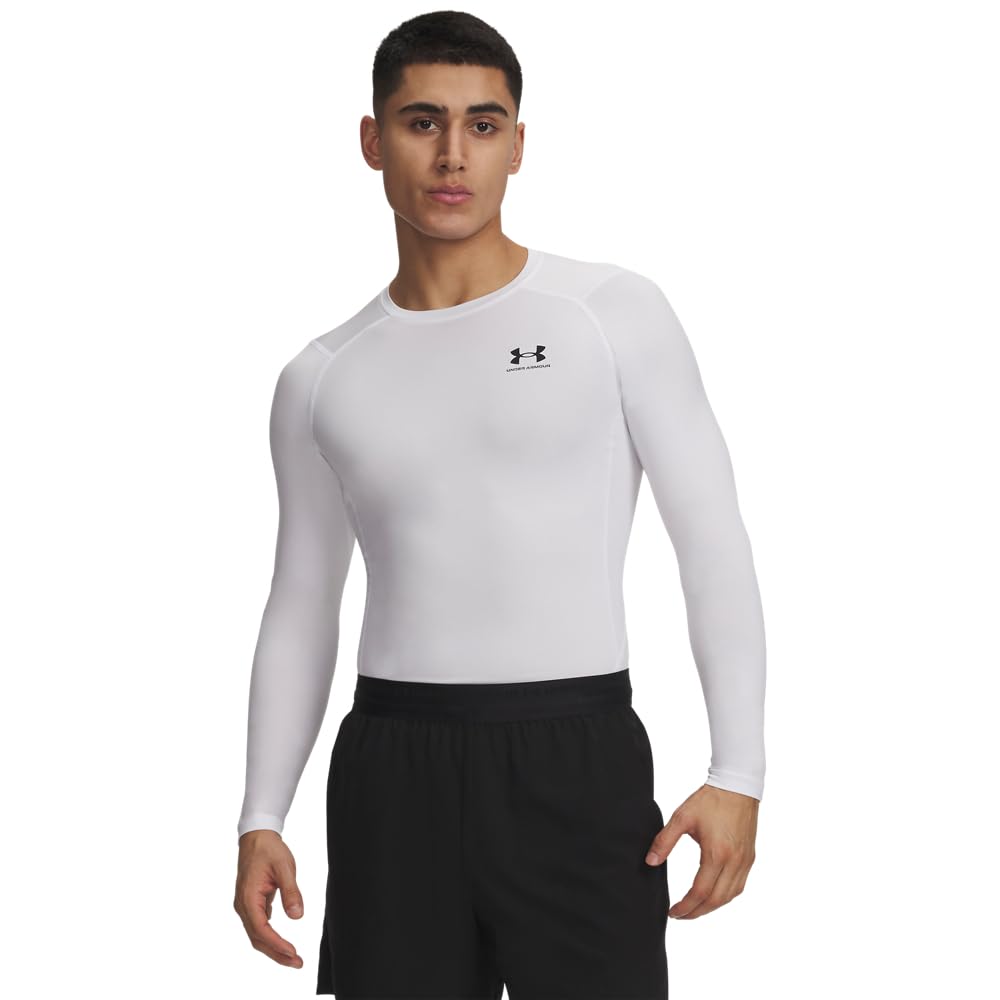
Under Armour HeatGear Long-Sleeve

Under Armour

Under Armour HeatGear Long-Sleeve

  • Fit Compression
  • Type Long-sleeve top
  • Fabric Line HeatGear
Check Price on Amazon

Thin compression top that sits flat under a vest and covers most of the year.

Few pieces of running kit earn their place as quietly as a thin long-sleeve base layer. Under Armour's HeatGear compression shirt is exactly that: a close-fitting synthetic top that sits flat under a vest or a shell, moves sweat off your skin, and never asks for attention mid-run. It's the sort of thing you buy once, wear constantly, and stop noticing.

That quiet competence is why it's our top pick. HeatGear is a compression cut, so the sleeves stay where you put them and the hem doesn't creep up, and there's no spare fabric to bunch under a pack strap. It works alone on a mild morning and as a first layer when there's a chill in the air, which covers more of the running year than any of the cold-weather pieces here. It's also the least expensive of the Under Armour layers in this group, which makes a second one easy to justify.

The limit is weight. HeatGear is a warm-weather fabric, and on a genuinely cold morning it's a starting point rather than the whole answer — that's the job of the ColdGear tights and the fleece-lined tops here. Buy it for the runs you do most of the year, then layer over it when the temperature drops.

Bottom Line

The base layer we recommend to most runners: close-fitting, quick to dry, and comfortable from spring through fall, with room to layer when it turns cold.

Check Latest Price

Best Cold-Weather Top

Our Score 9.2/10
DEVOPS Fleece-Lined 2-Pack

DEVOPS

DEVOPS Fleece-Lined 2-Pack

  • Fit Compression, fleece-lined
  • Type Long-sleeve top
  • Pack Count 2 pack
Check Price on Amazon

Fleece-lined warmth in a two-pack, ideal for steady miles in the cold.

Fleece lining changes the job a base layer does. Instead of sitting against the skin and moving sweat outward, the DEVOPS tops trap a layer of warm air and hold it there — exactly what you want on a dry, bitter morning, and less welcome once you're running hard.

The lining is soft rather than itchy, and the shirt is thin enough to wear under a jersey, a hoodie or a jacket without feeling like you've added a mid-layer. The compression fit keeps it close without restricting your arms, and it holds that fit through repeated washing.

It's the cold-weather top we recommend for runners who feel the chill, and the two-pack is the real argument: two shirts for less than a single technical top from the bigger brands here. The trade-off is breathability, since fleece holds heat and holds sweat with it.

Where it shines is anything short of a hard effort — steady winter miles, a cold sideline, a dog walk before sunrise. It isn't the layer for a tempo session in changeable weather, but of the warm options in this group it's the most warmth for the least money.

Bottom Line

The cheap route into cold-weather running: two soft, fleece-lined tops for less than one technical layer, best for steady miles rather than hard efforts.

Check Latest Price

Best Budget Bottoms

Our Score 9.2/10
Roadbox Compression Pants

Roadbox

Roadbox Compression Pants

  • Fit Compression
  • Type Full-length leggings
  • Pack Options 1, 2 or 3 pack
Check Price on Amazon

Soft, true-to-size tights sold in multi-packs, with a gentle squeeze.

The Roadbox tights are the least expensive bottoms in this group, and the fabric doesn't give that away. It's smooth and soft against the skin, closer to a second skin than the stiff synthetic you might brace for at this price.

The fit is the surprise. They run true to size, the waistband sits where you leave it, and they hold their place through a run — whether that's road miles, a bike commute or a gym session. They're warm enough for a cool morning without being a winter tight, which covers a lot of the calendar.

Where they fall short is coverage. The fabric is thin enough to be sheer, so plan on shorts over the top, and the compression is gentle rather than firm. Neither bothers us much at this price, and the multi-pack makes the value case on its own: on cost per layer, these are the strongest bottoms here.

Bottom Line

Buy these for a rotation of soft, true-to-size tights without spending much — and plan to wear shorts over them.

Check Latest Price

Best with Pockets

Our Score 9.2/10
Runhit Compression Pants

Runhit

Runhit Compression Pants

  • Fit Compression
  • Type Full-length leggings
  • Pockets Yes, phone-sized
Check Price on Amazon

Cool-morning tights with deep phone pockets and an easy, comfortable fit.

A phone pocket is the detail most running tights skip and the first thing you miss on a long run. The Runhit tights have them, deep enough to swallow a large phone and hold it steady, which is more than most of the bottoms here manage.

Comfort is the other reason they're on this list. The fabric is soft, wicks well and stays cool enough to wear in warm weather as well as on a cool morning, so they've become the pair we reach for when the forecast is somewhere in between. Nothing about them chafes or shifts, even on longer efforts.

Compression is on the gentle side, which suits runners who dislike being squeezed, and the fabric stays comfortable when the pace lifts. As an everyday pair with somewhere to put your keys and phone, they're the best-equipped tights in this group for the money.

Bottom Line

The pair we recommend for cool-morning runs when you want somewhere to put a phone: soft, comfortable, and easy on the wallet.

Check Latest Price

Best For Warm-weather budget

Our Score 9.2/10
TELALEO Compression Long-Sleeve

TELALEO

TELALEO Compression Long-Sleeve

  • Fit Compression
  • Type Long-sleeve top
  • Gender Men's
Check Price on Amazon

If the Under Armour top is the safe answer, the TELALEO shirt is the cheaper way to find out whether a compression layer suits you. Same idea — a long-sleeve synthetic top that sits close to the skin — with a softer, stretchier feel.

We rate it as the most comfortable of the budget tops and the most breathable: it works on a warm evening as readily as under a shell on a cold one, and it doesn't chafe. It's also the easiest of the budget tops to forget you're wearing, which is the whole point of a first layer.

What you give up is hold. The compression is gentle, closer to a snug athletic tee than a true compression garment, so runners who want a firm squeeze should look at the Under Armour. For everyone else, it's a lot of shirt for the money.

Bottom Line

A breathable, low-cost alternative to our top pick for warm-weather running, as long as you don't want a firm squeeze.

Check Latest Price

Best For Stocking up

Our Score 9.2/10
TELALEO 5-Pack Compression Pants

TELALEO

TELALEO 5-Pack Compression Pants

  • Fit Compression
  • Type Full-length leggings
  • Pack Count 5 pack
Check Price on Amazon

Five pairs of compression tights for less than one pair of the ColdGear is the pitch, and it's a good one. If your problem is that you run four times a week and hate laundry, this pack solves it for the price of a single premium tight — which makes it the smartest bulk buy in this group.

The tights are better than that price suggests: soft, smooth and snug, with a waistband that stays flat instead of rolling down mid-run. They wick well, and they hold their place through gym sessions as well as runs.

The fit asks for a compromise. The legs run short and snug, which works at average height and less so if you're tall or long-legged. For something you'll wear hard and wash constantly, that's a fair trade.

Bottom Line

Buy the pack if you want a week of tights for the price of one premium pair, and you're not especially tall.

Check Latest Price

How We Tested Running Base Layers

We started by pulling together a shortlist of base layers built for running rather than general outdoor wear, filtering by fabric weight, fiber blend, available sizes, and price. We ordered 14 in total, and for each one we started with our usual size, swapping to a size up only when the cut ran small or the sleeves stopped short of the wrist. That last part mattered more than we expected: a base layer can feel fine while standing still and still bunch at the forearm or ride up under a pack.

Testing ran for six months, from late fall through early spring. We wore them on 5:30 a.m. road runs in the low 30s, on longer weekend trail efforts, under rain shells, and on the treadmill when the weather turned. After each run we noted whether the fabric felt dry against the skin, whether seams rubbed at the shoulders or under the arms, and whether we were warm without overheating. We also checked the small stuff: thumb loops that stayed put, flatlock seams, tags, and whether the hem stayed down.

Every layer went through repeated wash cycles — at least 10 for the ones that stayed in rotation — and we looked for pilling, stretched cuffs, and fading. To judge value, we compared cost per wear against how often we reached for each one. The layers that scored best were the ones we forgot we were wearing, not the ones with the most features.

How to Choose

Fabric weight decides where a layer belongs

Running base layers fall into two families. The first is a thin synthetic that moves sweat and adds almost no warmth; the second is a brushed or fleece-lined fabric that traps heat for cold weather. The thin layer is the better default for anything above freezing, and for anyone who runs hard enough to sweat.

The trap is buying the warmest layer you can find. Fleece against the skin turns clammy once you're working, and you'll finish colder than you started. Match the weight to the conditions you run in, then add a shell over the top instead of buying a heavier base layer.

Fit matters more than the word compression

A base layer only works if it touches your skin; loose fabric can't move sweat anywhere. Compression cuts keep everything in place, but you don't need a true compression garment for running — a fitted top does the same job.

The practical trap is sizing. Most of the pieces here run small, and a few need a full size up, so if you're between sizes, take the larger one. A layer that's too tight restricts your arm swing and rides up at the hem, which is worse than a little slack.

Tops and tights solve different problems

Legs feel the cold first on a winter run, so a pair of tights usually buys more comfort than a heavier top. Tops matter more in wind and rain, where a thin base layer under a shell beats a warm top on its own.

The setup we come back to: tights under shorts in winter, a thin long-sleeve for spring and fall, and a fleece-lined top for the coldest, driest mornings. If you're buying one thing first, buy the tights.

The details that decide how often you wear it

Small features change how often a layer gets picked. A phone pocket saves you a waist belt; thumb holes keep your wrists covered when gloves are overkill; a long torso stays tucked under a pack.

Quantity matters too. Two or three base layers means you're never laundering on a rest day, and multi-packs make that affordable. Our preference is a couple of everyday layers plus one warmer option, rather than a single expensive piece washed every other day.

Frequently Asked Questions

Final Verdict

The Under Armour HeatGear long sleeve is the base layer we recommend to most runners, because most runs are mild and this top handles them without fuss. When winter is the point rather than the exception, step up to the ColdGear tights and a fleece-lined top — that's the combination we reach for once the temperature drops, and it covers legs and torso for less than a single premium jacket.

If budget is the deciding factor, the Roadbox and Runhit tights get you running for very little; just plan on shorts over the Roadbox pair and save the deep-cold miles for the heavier layers.