Recovery

Best Back Braces for Lifting, Tested of 2026

A back brace for lifting has a tradeoff baked into it: the stiffer the panel, the more support you get, and the more it feels like strapping a cutting board to your spine. Too soft, though, and you might as well wear a belt for looks. The right one gives your core something to push against, keeps your lower back from rounding out when you're tired, and stays put through the set. That's a narrow window, and fit and closure decide it far more than anything printed on the packaging.

Fit is also where most people go wrong, since these are sized by waist measurement rather than your pants size — measure at the navel, then check that the chart's range actually covers you. Over the past four months we've put 14 braces through heavy pulls, squats, carries, and one long moving weekend, and the ones that earned a spot all had a stiff back panel, a closure that stayed stuck and didn't fuzz out, and a price that didn't feel like a penalty. The list below is what survived.

Best Budget Leather

Our Score 9.4/10
Jaffick Leather Belt

Jaffick

Jaffick Leather Belt

  • Closure Buckle
  • Material Double-sided leather
  • Thickness 7 mm
  • Back Panel 6 inches
Check Price on Amazon

Six inches of double-sided leather and a buckle closure at the value end.

Six inches of double-sided leather with a suede lining and seven millimeters of thickness is more belt than the price bracket usually buys. The width is the first thing you notice: it covers a broader strip of the lower back than the four-inch belts here, and the suede sits against your skin instead of a raw leather edge, which matters on a belt you'll wear for a whole session.

The closure is a traditional buckle on an adjustable strap, and that's a quiet advantage. There's no hook-and-loop to peel, nothing that goes soft after a few months of heavy use, and the tension stays exactly where you set it. If you've had a Velcro belt let go mid-lift, this is the antidote.

Where it earns its place is as the leather option for someone stepping up from nylon who isn't ready to spend on competition gear. You get the stiffness and feedback of leather, enough width to cover the lumbar spine, and a fastening system with no wear-out part. That combination is why we keep it near the top of the leather picks rather than buried in the middle of the list.

One thing to sort out before you click buy: this belt is sized on true waist measurement, and the chart is unforgiving. The small starts at 21 inches, the medium tops out at 29.5, and the large runs 30 to 36. Use a soft tape at the navel and ignore the size on your jeans, because guessing here means a belt you can't close.

Bottom Line

Our pick if you want leather stiffness and six inches of coverage on a budget — just measure your waist before you order.

Check Latest Price

Best Leather for Powerlifting

Our Score 9.4/10
Gymreapers Leather Belt

Gymreapers

Gymreapers Leather Belt

  • Weight 1.2 lb
  • Closure Buckle and hook-and-loop
  • Material Leather
  • Back Panel 4 inches
Check Price on Amazon

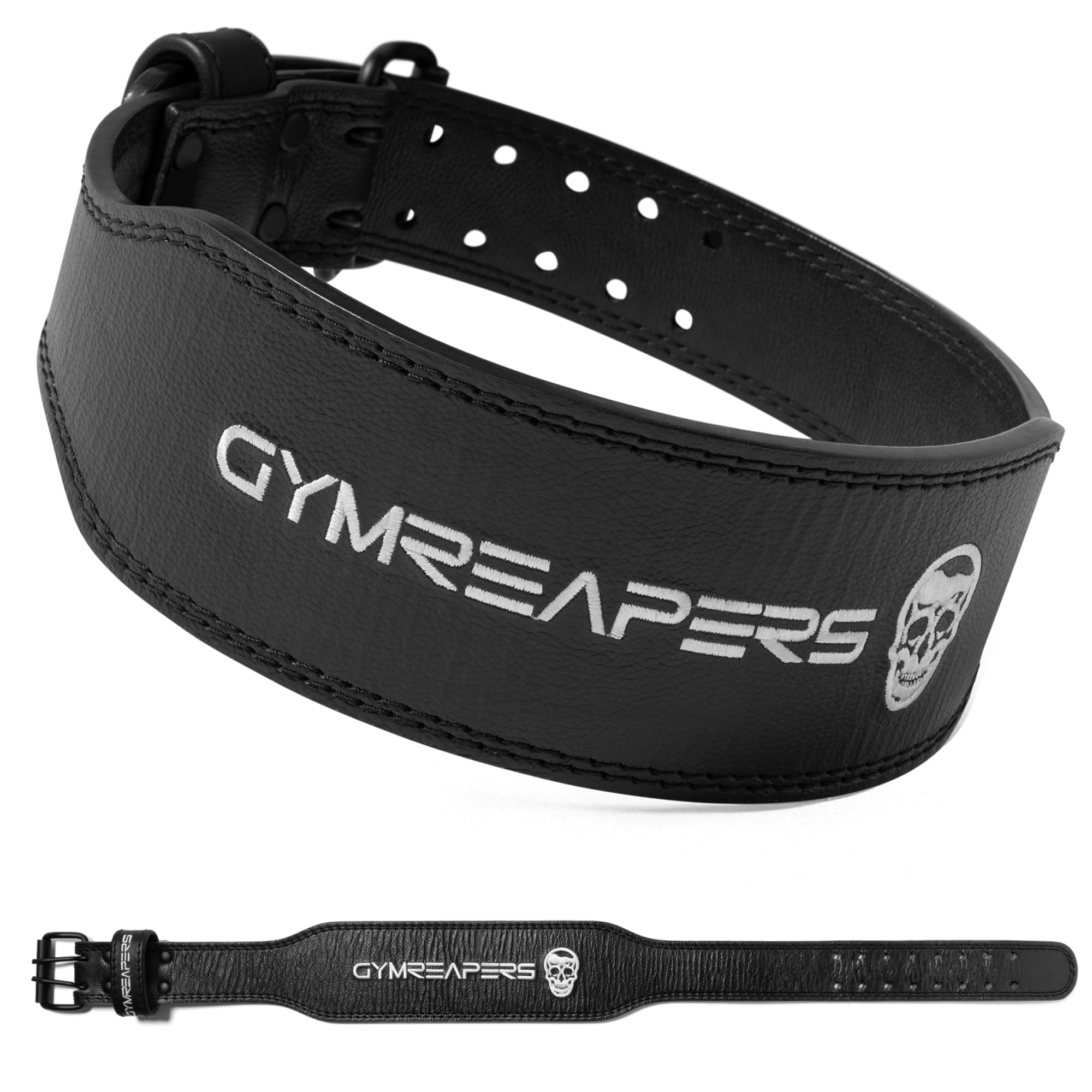
A four-inch leather belt that feels like competition gear and packs small.

Four inches wide, 1.2 pounds, cut from leather: this is the shape most powerlifters picture when they picture a belt, and the Gymreapers version is the closest thing to competition gear in this group. It's also the one that most clearly asks you to commit — leather, a buckle, and no fabric strap to hide behind.

The details back the shape up. A buckle holds tension without a latch to release, the neoprene backing keeps the leather from digging into your sides, and it rolls up small enough to live in a gym bag without taking over. At 1.2 pounds it's light enough to keep on for a whole session rather than saving it for one heavy set.

Inspect it when it arrives. The finish is the uneven part of this belt — side panels can come creased or cracked out of the box — so give it a look while returns are still simple. Past that it's a straightforward object: leather, a buckle, and a backing that holds its shape.

What earns it a spot is the feel. This is the belt we reach for when we want leather feedback in a four-inch profile that doesn't interfere with the bar path, and it's the most expensive pick here. For a lifter who squats and pulls heavy several times a week, that money goes into the material rather than the branding.

Bottom Line

The leather belt we reach for when the session is built around squats and deadlifts and we want competition-style feedback.

Check Latest Price

Best Value

Our Score 9.2/10
RDX Auto Lock Belt

RDX

RDX Auto Lock Belt

  • Sizing L, 38 in waist
  • Closure Auto-lock roller buckle
  • Material Polyester
  • Back Panel 6.5 inches
Check Price on Amazon

The widest back panel among the gym belts here, with an auto-lock that ratchets tight.

Six and a half inches of padded back support is the widest panel among the gym belts in this group, and it changes what the belt feels like to wear. Where a four-inch belt asks you to brace against a strip, this one covers a stretch of the lumbar and lower thoracic spine, which is why it suits deadlifts and front squats, where a narrow belt can leave the top of your back feeling exposed.

The closure is an auto-lock roller buckle that tightens like a ratchet, and of the padded belts here we rate it the best for lifters who want the belt to do more of the work — you crank it down, it stays, and you're not resetting it between sets. The contoured taper is what keeps it wearable: six and a half inches at the front and back, narrower at the sides so it clears your hips when you sit into a squat, with a mesh-faced neoprene that breathes better than the solid nylon belts in this lineup.

What it won't do is feel like leather. The body flexes where a broken-in leather belt stays rigid, and that's a comfort win on volume work and a different feel when you're grinding out a single. At the low end of the price range, that's a trade we're happy to make for a belt this wide.

Bottom Line

We point lifters here when they want more back coverage than a four-inch belt gives, without paying leather money for it.

Check Latest Price

Best Overall

Our Score 9.0/10
Element 26 Self-Locking Belt

Element

Element 26 Self-Locking Belt

  • Weight 9.7 oz
  • Closure Self-locking metal buckle
  • Material Nylon
  • Belt Width 4 inches
Check Price on Amazon

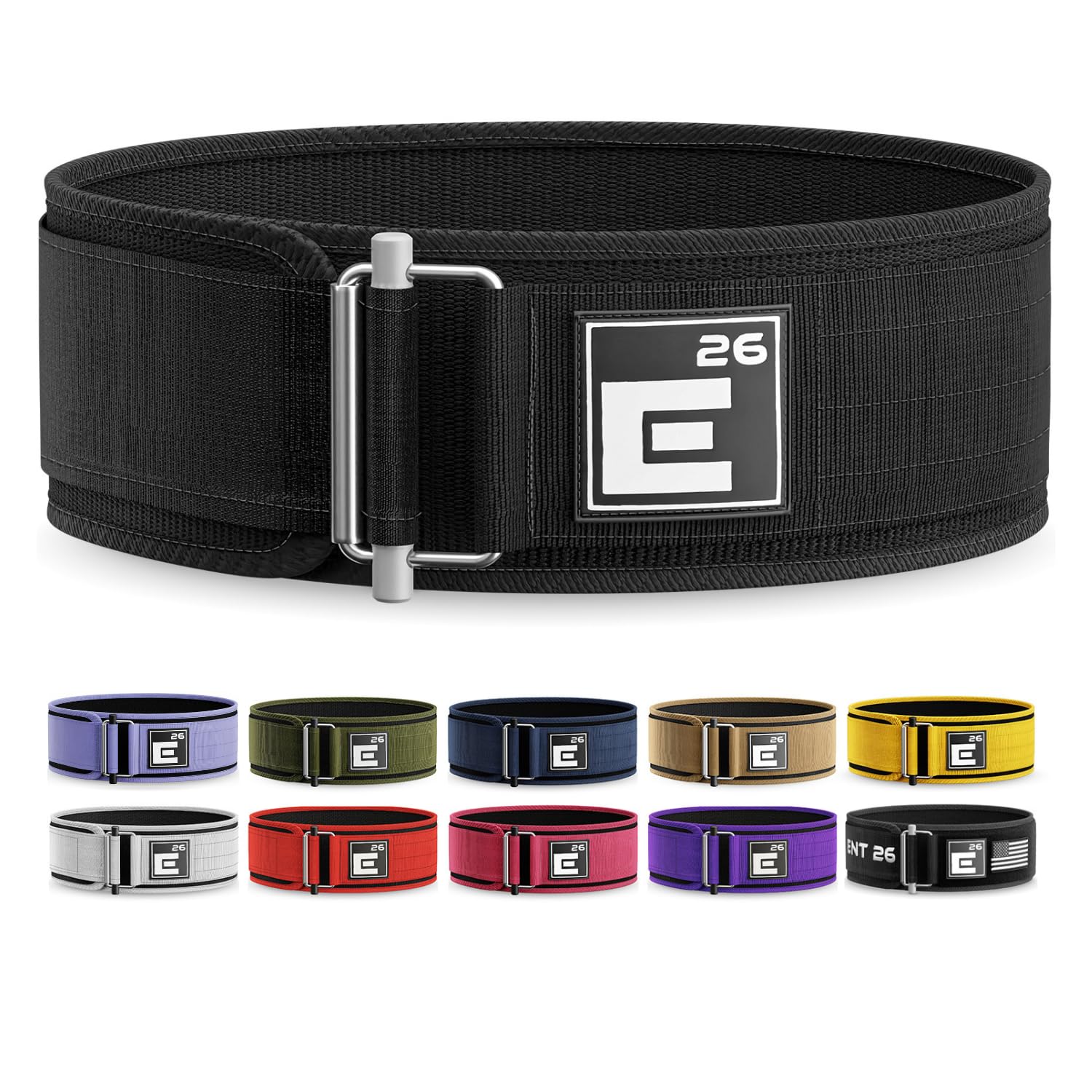
A metal self-locking latch and a four-inch nylon panel that stay put through heavy squats.

The latch is why this belt sits at the top of our list. Element 26 uses a full metal self-locking buckle instead of relying on hook-and-loop alone, so once it's set the belt holds through a squat or a pull, and a lever releases it when the set is done. Nothing about that is flashy, but it removes the specific worry that comes with a Velcro-only belt — that it lets go somewhere in the middle of a rep.

Four inches of nylon is the other half of the design. That's the classic powerlifting width: enough panel across the lower back to brace against, contoured enough that it doesn't jam into your ribs at the bottom of a squat. Compared with the six-inch belts here you do give up coverage. If you want a wall of support front and back, the RDX or either Ergodyne is the better fit; if you want the belt to disappear under a shirt and let you move, this is the one.

Sizing is where buyers get into trouble. The chart runs small, and the medium is listed at an 89-centimeter waist, so measure around your belly at the navel with a soft tape rather than ordering your pant size, and go up if you land between two sizes.

What keeps it in rotation for us is how little ceremony there is around it: 275 grams, soft enough to roll up and stuff in a gym bag, and none of the stiffness a new leather belt brings. You put it on, you lift, you take it off.

Bottom Line

For most lifters this is the belt we recommend without a caveat: a metal latch that holds, a four-inch panel that lets you move, and no break-in.

Check Latest Price

Best for All-Day Work Lifting

Our Score 9.0/10
Ergodyne ProFlex 1600

Ergodyne

Ergodyne ProFlex 1600

  • Closure Hook and loop
  • Material Elastic
  • Back Panel 9 inches
  • Suspender Straps Detachable
Check Price on Amazon

Nine inches of elastic with grip webbing and suspenders for a full shift.

Nine inches of elastic, a high-cut front panel, and a set of detachable suspenders: the ProFlex 1600 is built for a shift, not a set. The problem it solves is the one that sends people back to the truck — a support that rides up every time you bend, so you spend the day hitching it back down instead of working.

Of the work braces here, this is the one we rate highest for a full day of lifting and carrying. The rubber track webbing on the inside is the reason: it grips your shirt and holds the belt in place, which makes the suspenders a backup rather than a necessity. Nine inches covers the whole lumbar region, and the contoured front is cut high enough that you can still bend and squat without the panel folding into your stomach.

The suspenders are the part to manage. They slide off your shoulders when you're bent over for long stretches, so take them off for driving or overhead work — the belt holds on its own once the webbing has grip — and clip them back on for a day of repeated lifting.

Bottom Line

Nine inches of elastic and grip webbing make this the brace we trust for a full day of lifting, carrying, and bending.

Check Latest Price

Best For Mixed training

Our Score 9.0/10
Gymreapers Quick Locking Belt

Gymreapers

Gymreapers Quick Locking Belt

  • Closure Quick-locking metal buckle
  • Material Nylon
  • Thickness 0.25 inches
  • Back Panel 4 inches
Check Price on Amazon

A quarter-inch thick, with a metal quick-lock buckle and a four-inch panel, this is the slimmest gym belt in the group. If a six-inch padded belt feels like strapping on a mattress, this is the opposite experience: it sits close, disappears under a shirt, and doesn't fight your setup between movements.

We like it for sessions that mix lifting with conditioning — cleans, thrusters, carries — where you're taking the belt on and off between movements. The latch opens and closes fast, the belt stays where you put it, and you're not fiddling with a strap while your heart rate comes down. For a straight powerlifting session, the Element 26 and the Gymreapers leather belt do more at about the same money.

Two things to weigh. It runs small, so measure at the navel and size up if you're between ranges rather than trusting the chart. And the build is lighter than the wider belts here, which reads as comfort in a circuit and as less substance when you're loading up for a single.

Bottom Line

A slim, fast-latching belt we like for mixed training days, provided you size it right and aren't chasing a one-rep max.

Check Latest Price

Best For High-volume sessions

Our Score 9.0/10
RitFit 6-Inch Belt

RitFit

RitFit 6-Inch Belt

  • Shape Contoured taper
  • Sizing XL, 43 to 51 in waist
  • Closure Hook-and-loop with steel buckle
  • Back Panel 6 inches
Check Price on Amazon

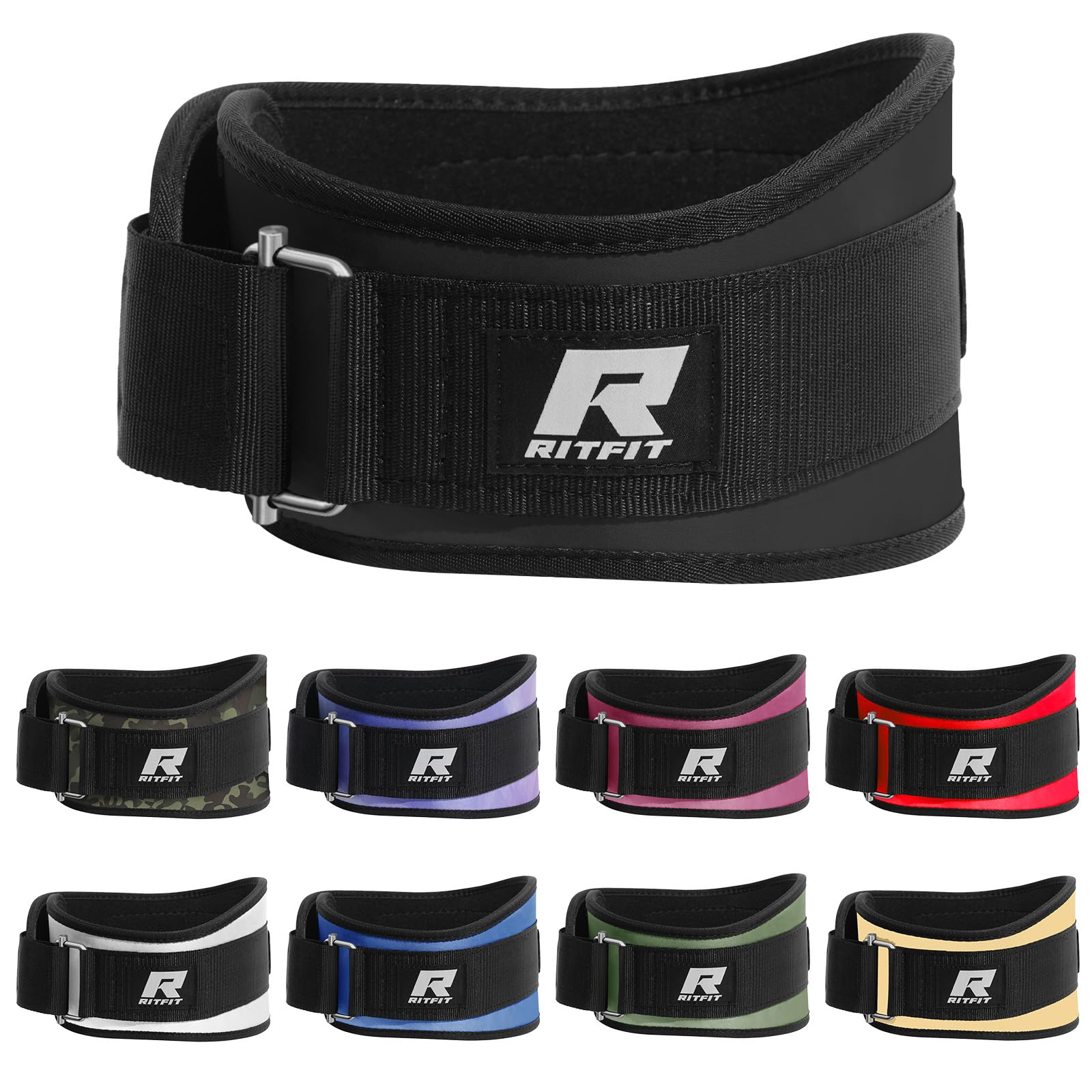
The RitFit is contoured: six inches wide across the front and back, tapering at the sides so it clears your hip bones. That cut is why it doesn't dig in when you sit back into a squat, and it's the main reason this belt works for people who find a straight-cut six-inch belt to be too much material around the middle.

The closure pairs a wide hook-and-loop strap with a stainless steel buckle, so you set the strap once and then cinch for tension. It adjusts one-handed, and the XL is listed for 43 to 51 inches, which covers a lot of the bigger lifters the narrower belts leave out. Sizing runs small, though, so check the waist range rather than assuming your jeans size.

Where it lands for us is volume work. For high-rep squats, rows, and a long session of accessory lifts, a soft six-inch belt that adjusts with one hand is genuinely pleasant to wear, and it sits at the low end of the price range. For heavy singles we still prefer a latch or a buckle on its own, because the hook-and-loop is the part that ages first.

Bottom Line

RitFit's tapered six-inch panel is what we put people on for high-volume work, where a softer belt beats a stiff one.

Check Latest Price

Best For Occasional lifting

Our Score 9.0/10
Ergodyne ProFlex 1650

Ergodyne

Ergodyne ProFlex 1650

  • Closure Single-strap hook and loop
  • Material Elastic
  • Back Panel 7.5 inches
  • Suspender Straps Detachable
Check Price on Amazon

The ProFlex 1650 is the least expensive brace in this group, and it's built to that brief: a 7.5-inch all-elastic body, a single five-inch strap closure, and a pair of detachable suspenders. For occasional lifting — a move, a delivery day, a weekend of yard work — that's a lot of support for a small outlay.

It's easy to live with. The single strap closes with one hand and adjusts while you're wearing it, the elastic moves with you instead of fighting your bend, and the polypropylene stays hold the shape of the back panel so it doesn't roll up. The suspenders do most of the work of keeping it at the right height on your back.

The catch is longevity. The stays are sewn into the elastic, and with daily wear they can work their way through the fabric, while the elastic itself goes slack over months of use. Treat it as a brace for a season or for occasional jobs rather than a permanent piece of kit.

For a homeowner lifting furniture twice a year, or a worker who wants a spare in the truck, that trade is fine and the price is the point. For a job where the brace is on eight hours a day, step up to the ProFlex 1600 — the rubber track webbing keeps it in place and the nine-inch body covers more ground.

Bottom Line

The brace we suggest for occasional heavy jobs, where a low outlay matters more than surviving years of daily wear.

Check Latest Price

What We Put These Back Braces Through

We started by pulling together roughly 40 braces sold for lifting and reading the spec sheets closely, because the details that matter are buried there: the waist range each size actually covers, whether the closure is hook-and-loop across the full strap or just a patch at the end, how tall the back panel is, and what the thing costs. We dropped anything that only came in small, medium, and large, anything sized only in jeans sizes, and any brace whose straps were stitched down at a single point rather than across the panel. Fourteen made the cut.

Testing ran four months, and each brace got at least two weeks of real use: three lifting sessions a week built around deadlifts, squats, and heavy carries, plus a Saturday spent hauling boxes and furniture during a move. We measured our waists at the navel and matched that to each chart, then noted where the brace landed — a panel that crept up toward the ribs by the third rep got marked down, and so did a front edge that dug in when we hinged over to reach the bar.

Every brace went on and off 50 times so we could watch the closure, and we checked after each session whether the hook side had fuzzed, curled, or stopped biting. We pulled the straps to the same tension each time to see if they stretched or frayed at the edges. Stiffness got judged by whether the panel held its shape through a set but still let us bend to pick up a plate, and we factored price in at the end by comparing the stitching and the panel against what the brace cost.

How to Choose

Gym Belt or Work Brace? Start With the Job

A gym belt is four to six inches tall, made of nylon or leather, and closed with a latch or buckle. It's stiff on purpose, so you can push your abs out against it and stabilize the spine for a squat or a deadlift. A work brace is elastic, seven to nine inches tall, and often carries suspenders: it's built to stay in place through hours of bending, carrying, and reaching rather than to hold a maximal brace for a single rep.

Buying one for the other job is the most common mistake in this category. A nine-inch elastic brace is comfortable all day but gives under a heavy squat, and a four-inch competition belt will dig into you on a shift of loading pallets. If you do both, buy for the task you do most and add the second one later.

How Much Back Coverage You Actually Want

Height across the back runs from four inches to nine, and more isn't automatically better. Four inches is the competition profile: it covers the lumbar spine, clears your ribs and hip bones, and lets you squat deep without the panel buckling. Six to six and a half inches covers more of the lower and mid-back, which many lifters prefer for deadlifts and front squats.

Past seven inches you're in work-brace territory, where height is about staying put during a shift rather than bracing against a barbell. A contoured cut — wide at the front and back, tapered at the sides — is worth looking for if you've found straight-cut belts dig into your hips.

Closures: What Holds the Tension

Four fastenings turn up here, and they trade speed against security. A self-locking metal latch engages under load and releases with a lever — the fastest, and the one we trust most under a heavy bar. A roller auto-lock tightens like a ratchet and is nearly as quick. A traditional buckle is slower to set but has nothing to peel apart.

Hook-and-loop on its own is the one to watch. It's the part that softens first, and when it loses grip the belt goes with it. If you lift heavy often, choose a belt with a latch or a buckle backing up the strap rather than relying on fabric alone.

Nylon, Leather, or Elastic

Nylon is ready to lift straight out of the bag and flexes with you, which suits cross-training and anyone who doesn't want a break-in period. Leather is stiffer, gives you something solid to brace against, and takes a few sessions to shape to your back — both leather belts here arrive firm. Elastic is the most comfortable for hours of wear and the least supportive under a maximal load.

Match the material to how long the belt will be on your body, not to how it looks in the listing. An eight-hour shift and a five-set squat session put completely different demands on the same piece of gear.

Sizing: Measure Your Waist, Not Your Jeans

This is where most returns begin. Every belt here is sized on waist measurement and the charts don't agree with each other — several run small, while the RDX runs large. Run a soft tape around your belly at the navel, keep it level, and compare that number with the range printed for the size you're considering.

If you land between sizes, choose the size whose stated range contains your measurement rather than guessing up or down. A belt that's too big can't be cinched tight enough to brace against, and one that's too small won't close at all.

Frequently Asked Questions

Final Verdict

Buy the Element 26 if you want one belt that covers squats, deadlifts, and everything around them. The metal latch is what separates it: it holds tension without hook-and-loop, and it releases in a second.

If you want more panel across your back, the RDX gives you six and a half inches for less money. And if your lifting happens on a job site rather than a platform, the Ergodyne ProFlex 1600 is the brace we reach for — grip webbing, suspenders, and nine inches of coverage that stays where you put it.