Recovery

Best Athletic Tape of 2026

Athletic tape asks for two things that fight each other: it has to stay exactly where you put it through sweat, a shower, and a full night's sleep, then peel off without taking skin with it. Too sticky and you're left with a red rectangle and a wince; too weak and you're re-wrapping your ankle between quarters. I've taped my own ankles before pickup games for years, and over four months our team put 14 rolls through the wringer to find the ones that hold a joint or a dressing without creating a new problem.

One thing first-time buyers don't always know: stretch and stick are separate decisions. Cotton tape with almost no give is for locking a joint down, while the stretchier stuff is for compression and for holding gauze over a blister, and using one where the other belongs is why tape gets a bad name. The picks below cover both jobs, and every roll earned its place on support, comfort, and what you actually get for the money.

Best Overall

Our Score 9.4/10
Leukotape P Strapping Tape

Leukotape

Leukotape P Strapping Tape

  • Width 1.5 in
  • Adhesive Waterproof, aggressive
  • Tape Type Rigid strapping
  • Roll Length 15 yds
Check Price on Amazon

The tape that outlasts sweat, showers, and a full day of wear.

The adhesive on Leukotape P bites hard. That's the first thing to know about this rigid zinc oxide strapping tape: a 1.5-inch wrap around an ankle is still exactly where you put it after a sweaty session, a shower, and a day in boots. Nothing else here grips like it.

That grip is why it takes the top spot. Nearly every disappointment with athletic tape comes down to the same failure — the edges lift, the wrap loosens, and the support you paid for quietly disappears. Leukotape doesn't do that. We taped ankles before runs and heels before long walks, and the roll that stays put is the one that turns tape from a chore into actual protection. It tears by hand too, which matters more than it sounds when you're halfway through a wrap and don't want to go hunting for scissors.

It's also the tape we pack for feet. A strip over a heel or a hot spot before a long walk prevents the blister rather than covering one, and that's the more useful job. Keep one roll in a daypack and another in the gym bag and you may find you stop reaching for blister pads entirely.

What it isn't is elastic. There's no stretch here for kinesiology-style muscle support, and a single 15-yard roll won't cover a team. If you want a joint locked down and a tape you can forget about until the session ends, those are exactly the right things to give up.

Bottom Line

If you want tape that's still doing its job at the end of a long session, this is the roll we hand people first.

Check Latest Price

Best Multi-Roll Kit

Our Score 9.4/10
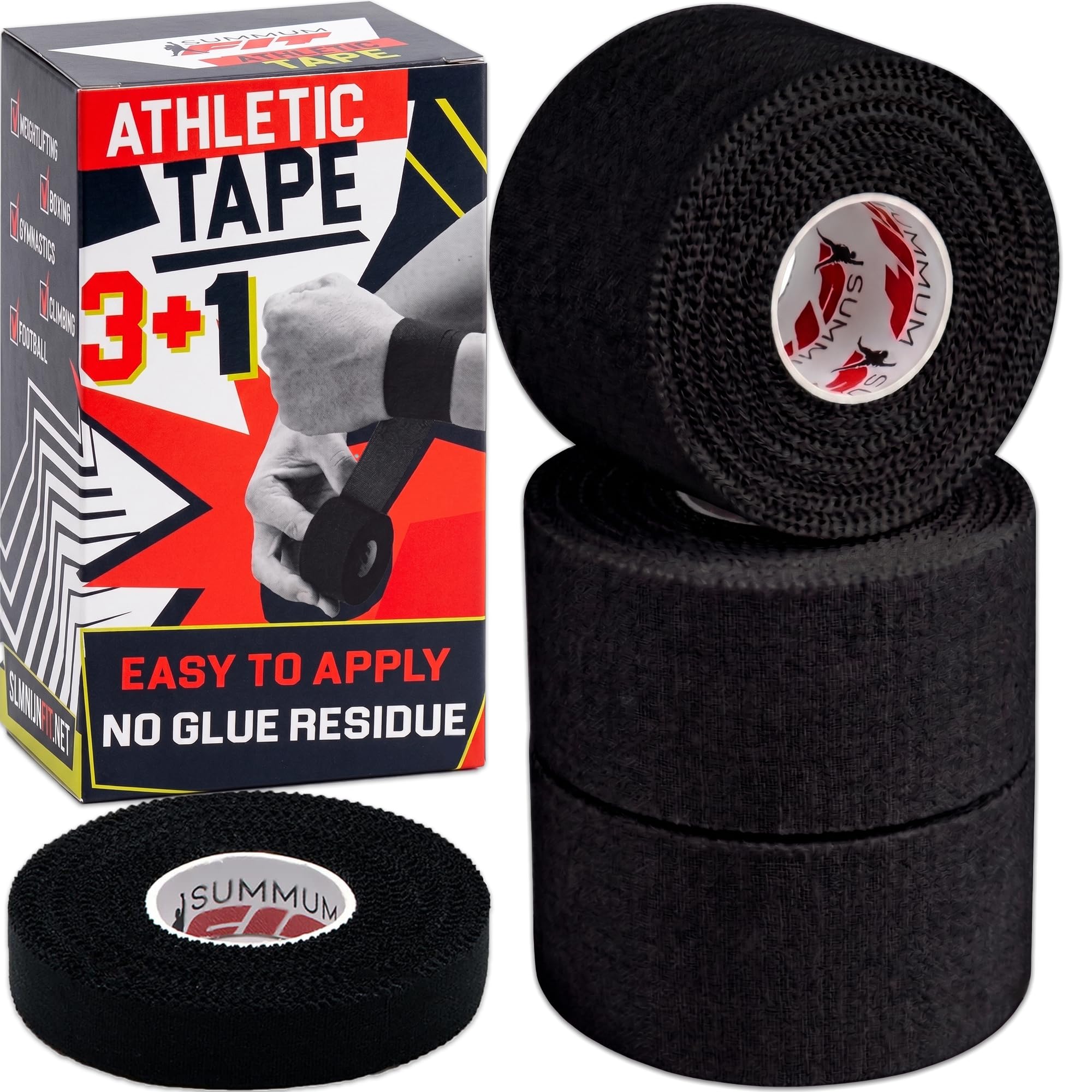
Summum Fit 3+1 Athletic Tape

Summum

Summum Fit 3+1 Athletic Tape

  • Edge ZigZag easy-tear
  • Latex Latex-free
  • Tape Type Rigid
  • Kit Contents 3 rolls 1.5 in x 33 ft plus 1 roll 0.5 in x 33 ft finger tape
Check Price on Amazon

Three full rolls plus a narrow finger roll keep a gym bag stocked.

Three rolls of 1.5-inch tape at 33 feet each, plus a narrower half-inch roll for fingers: the Summum Fit set is the one we hand to a coach, a parent taping a kid's wrists, or anyone who goes through tape faster than a single roll allows.

The zigzag edge is the detail we appreciated most. It tears cleanly by hand without the long stringy tail some cotton rolls leave dangling, so a wrap stays neat when you're working fast. The black finish hides gym grime and looks a little sharper than standard white, if that matters to you.

It's rigid tape with a zinc oxide adhesive and a latex-free formula, so it does the ankle-and-wrist job rather than the kinesio one. On hands and wrists it held through a full workout; on skin that was damp or freshly moisturized, the edges gave up sooner. Prep it like any other tape and it behaves.

The narrow roll is what makes the set. Most multi-packs give you three identical rolls and leave you tearing a wide strip down the middle for a jammed finger. Here the finger roll is already the right width, which is the piece nobody else includes.

Bottom Line

Buy the set if you tape other people as well as yourself — three full rolls and a finger roll for a budget outlay.

Check Latest Price

Best Uncut Kinesiology Roll

Our Score 9.2/10
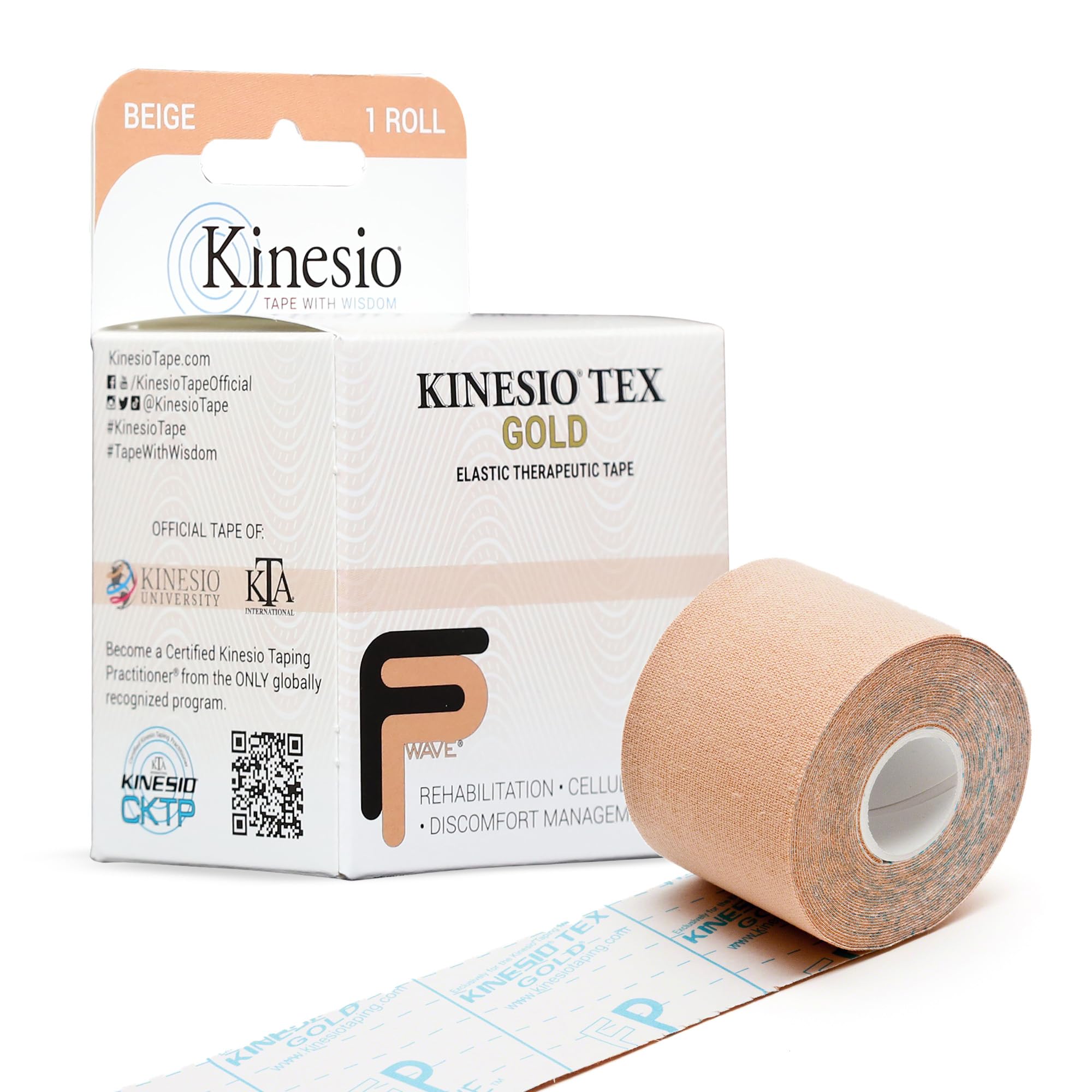
Kinesio Tex Gold FP

Kinesio

Kinesio Tex Gold FP

  • Width 2 in
  • Material 100% polyester
  • Tape Type Elastic kinesiology
  • Roll Length 16.4 ft
Check Price on Amazon

Cut your own lengths and shapes from the original kinesiology roll.

A 16.4-foot roll you cut yourself is only worth it if you actually cut shapes, and Kinesio's Tex Gold FP earns its place when a joint needs something other than a straight strip — a Y around a knee, a fan across a shoulder. This is the original kinesiology tape, 2 inches wide and 100% polyester, with a stretch that feels more like a second skin than a bandage.

For a cranky knee or a tendon that complains, this is the roll we reach for, and the difference shows up the next morning on the stairs. The polyester holds its stretch rather than bagging out mid-application, which makes it easier to apply at consistent tension — the thing that separates kinesiology tape that works from tape that just sits there.

The catch with an uncut roll is scissors, and the ends can soften over a day of movement if you stretch the tape all the way out to the edge. Cut with rounded corners and leave an inch of unstretched tape at each end, and it stays put far longer than a strip applied under tension at the tips.

At 2 inches wide it suits a thigh, shoulder, or back better than a finger — for fingers, the rigid tapes above are the tool. Buy it for control over shape and length; skip it if you want to peel and go.

Bottom Line

For a cranky knee or a tendon that complains, this uncut roll is worth the scissors and the extra minute of cutting.

Check Latest Price

Best Kinesiology Tape for Beginners

Our Score 9.0/10
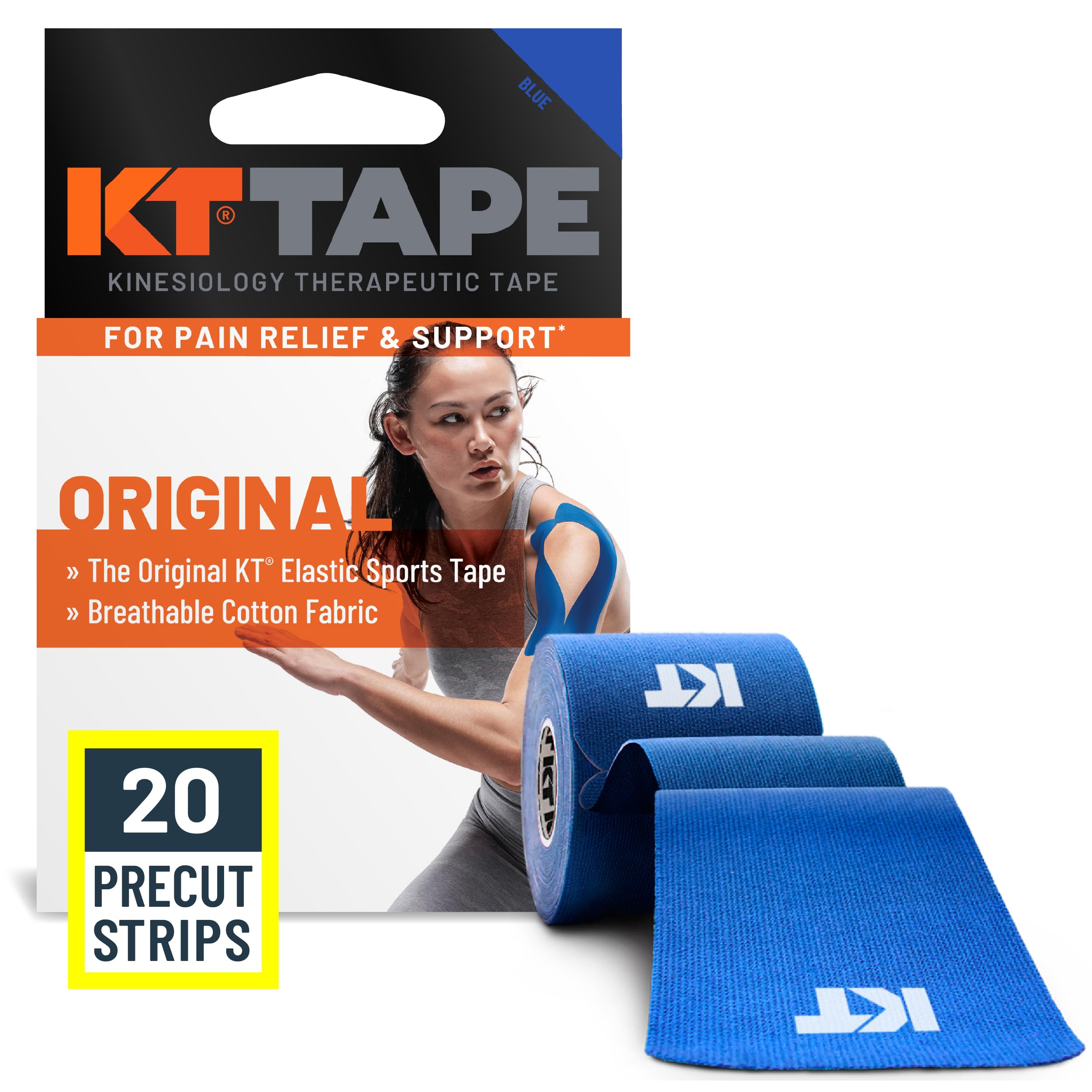
KT Tape Original Cotton

KT

KT Tape Original Cotton

  • Strips 20 precut, 10 in
  • Material Cotton
  • Tape Type Elastic kinesiology
  • Wear Time 1 to 3 days
Check Price on Amazon

Precut strips take the guesswork out of a first kinesiology application.

Twenty strips, already cut to 10 inches, with rounded corners: KT Tape's Original cotton roll is built for the person taping themselves for the first time, and we think it's the friendliest introduction to elastic taping here. Peel, place, rub, done. No scissors, no guessing at length, no half-cut strip curled up on the floor.

The cotton stretches enough to support a knee or a shoulder through its full range, which is the point of kinesiology tape: it should help without clamping the joint. We used a strip on a shoulder before overhead work and on a knee for a run, and it did what elastic tape is meant to do — a little lift, a little reminder, no restriction.

Prep decides how the day goes. Wipe the area with alcohol, let it dry completely, then rub the tape briskly once it's down so the adhesive warms and grabs. On clean, dry, hair-free skin it holds a day or two, showers included. Over lotion or sunscreen the corners start lifting within the hour, and that's a skin problem rather than a tape problem.

Against the uncut Kinesio roll further down this list, you're trading control for speed — no measuring, no cutting, and a strip already shaped for a knee or a shoulder. For most people taping at home a few times a week, that's the better trade.

Bottom Line

The easiest elastic tape to learn on, and the one we point most people to for a first knee or shoulder wrap.

Check Latest Price

Best for Clean Removal

Our Score 9.0/10
Hampton Adams Athletic Tape

Hampton

Hampton Adams Athletic Tape

  • Tear By hand
  • Adhesive Low-residue
  • Material 100% cotton
  • Tape Type Rigid
Check Price on Amazon

Peels off clean and tears by hand, with no scissors mid-wrap.

Where Leukotape leaves a sticky ghost behind, this Hampton Adams roll peels off almost clean, and that alone makes it the tape we keep on hand for fingers, wrists, and anyone who dreads the post-practice scrub. It's a rigid 100% cotton tape with a low-residue adhesive, and it tears by hand without scissors or a cutter.

Fingers are where it earns its place: climbing, volleyball, a jammed thumb. A roll lives in a bag, pulls one-handed, and doesn't turn into a fight. Wrists and ankles are fine too, and it stays put under a sock or a lifting strap instead of rolling up at the edge halfway through a set.

What we trusted most is the way it wraps. The cotton has just enough friction that layers grab each other instead of sliding, so a wrist ends up glove-tight without you hauling on it. It's the closest thing here to what a trainer wraps an ankle with, and it costs about what the cheapest elastic rolls do.

Bottom Line

The rigid roll to buy if you hate the scrub after practice — it peels clean and still wraps a wrist firmly.

Check Latest Price

Best For Precut kinesio strips

Our Score 9.0/10
GJUMP Precut Kinesiology Tape

GJUMP

GJUMP Precut Kinesiology Tape

  • Rolls 2
  • Strips 40 precut
  • Tape Type Elastic kinesiology
  • Wear Time 3 to 5 days
Check Price on Amazon

Forty precut strips across two rolls, with rounded corners that resist catching on clothing: GJUMP's tape is built so you don't have to think much, which is exactly what you want before a 6 a.m. run.

The strips are a useful length for a knee, foot, or elbow without trimming, and the rounded corners genuinely do cut down on the peeling that starts at square edges — a small detail that decides whether a strip survives a sock. It's latex-free, water-resistant, and breathable enough that we forgot it was there by mid-morning.

Where it gives ground is the tack. Strong adhesion keeps a strip exactly where you placed it, and it also means sensitive skin can start itching by the second day. If you've reacted to adhesive before, patch-test a short strip on your forearm first. Rounded corners and a hard grip are a good pair — this just isn't the tape for delicate skin.

For a weekend athlete taping one knee twice a week, 40 strips is close to a season's supply, and that's the case for buying it.

Bottom Line

A solid precut elastic tape for weekend use, as long as your skin tolerates a strong adhesive.

Check Latest Price

Best Value Kinesiology Tape

Our Score 8.8/10
Hampton Adams Kinesiology Tape

Hampton

Hampton Adams Kinesiology Tape

  • Format 2 uncut rolls
  • Adhesive Latex-free, water-resistant
  • Material Cotton blend
  • Tape Type Elastic kinesiology
Check Price on Amazon

Two uncut rolls for about the price of one premium roll.

Two uncut rolls of cotton-blend kinesiology tape have stayed in our bags longer than any single roll here, mostly because nobody has to ration them. They're water-resistant, latex-free, and cut to whatever length the job needs.

The stretch is moderate — enough to support a shoulder or a shin without feeling like a compression sleeve. The adhesive is the sweat-resistant, water-resistant kind that survives a shower as long as the skin underneath was clean to begin with, which is true of every elastic tape on this page.

Edges are where it struggles. On a shoulder moving through a full range, the corners start to roll after a day, and once one lifts the rest follows. Cut longer strips than you think you need and anchor both ends on dry, unlotioned skin, and you'll get two or three days out of a wrap.

What settles it is the arithmetic: two full rolls for about what one premium roll costs, with the same latex-free, water-resistant brief. If you tape a couple of times a week and don't need precision shapes, this is the value pick — the tape you can afford to be generous with.

Bottom Line

The elastic tape we buy when we want to tape often without thinking about cost, and it holds up well enough to keep doing it.

Check Latest Price

Best For Bulk gym-bag tape

Our Score 8.8/10
ADMITRY Athletic Tape 5-Pack

ADMITRY

ADMITRY Athletic Tape 5-Pack

  • Rolls 5
  • Material Natural cotton, latex-free
  • Roll Size 1.5 in x 10 yds
  • Tape Type Rigid
Check Price on Amazon

Five rolls of 1.5-inch by 10-yard white cotton for the smallest outlay on this page: ADMITRY's set is the tape you buy when tape is a consumable and you'd rather not think about the bill.

It's latex-free natural cotton with a reasonably strong adhesive, and it does the basic job on wrists, ankles, and gym hands. The white surface takes a pen if you're labeling a wrap, which sounds trivial until you're retaping the same wrist three times a day and lose track of which strip went on when.

The cotton is thin, and we mean that as information rather than complaint: on a wrist or a finger it wraps flat and doesn't bulk up under a glove, but a bigger joint like an ankle wants two layers before it feels like real support. Expect to use more tape than a heavier strapping roll requires.

What you're buying here is volume, not finesse. As a stock-the-kit bag for a school gym, a first-aid drawer, or a club that burns through rolls, it makes obvious sense; for a joint that has to stay locked through a two-hour match, pay more for a zinc oxide strapping tape.

Bottom Line

Buy it to stock a gym bag or a first-aid drawer, not to lock down a joint that has to survive a match.

Check Latest Price

How We Tested Athletic Tape Through Sweat, Showers, and Overnight Wear

We started with research, not rolls. Every tape we could find that published real specs, things like width, adhesive type, latex-free or not, rigid versus elastic, went on a list, and anything that existed only as a mystery listing got cut. That left 14 tapes, all bought at retail so no one could send us a hand-picked batch.

The four months that followed happened mostly out of gym bags. I wrapped my ankles before pickup basketball twice a week, a teammate taped thumbs and wrists at the climbing gym, and one tester ran with a strip under each arch and two toes taped against blisters. We also slept in it and showered in it, since that's usually where adhesive gives up.

After every session we looked at the edges: lifted by the 45-minute mark or still sealed, bagging at the heel, curling at the wrist. Removal got the same attention. Some strips came off dry, others after a shower, and we noted which ones pulled hair, left grey residue, or kept skin pink for an hour. Anyone can stick on day one, so we judged durability by whether roll five behaved like roll one.

Ease of use came down to a stopwatch. I timed a one-handed ankle wrap on each roll and noted which ones fed off the spool without twisting or tearing ragged. For support and pain relief, two testers with sore arches ran with a strip and reported whether the ache dulled by mile three or stayed exactly the same. Value was arithmetic: usable yards against what we paid, plus how much we lost to a frayed cut edge.

How to Choose

Rigid or Elastic Comes First

Rigid zinc oxide tape, the kind Leukotape, Hampton Adams, Summum Fit, and ADMITRY make, locks a joint and holds it there. That's what you want on an ankle you don't trust, a wrist with a history, or a heel that blisters on every long walk. Elastic kinesiology tape lifts the skin slightly and supports a muscle through its full range without clamping anything, which suits a cranky knee or a shoulder that has to keep working.

The trap is expecting one to do the other's job. No amount of careful wrapping turns an elastic roll into an ankle stabilizer, and a rigid roll won't move with you through a swim or a run. Decide which job you have before you look at price or brand.

Adhesion Is Mostly a Prep Problem

The most common frustration with any tape is an edge that lifts, and most of the time the skin is the problem, not the tape. Lotion, sunscreen, sweat, and hair all sit between the adhesive and the surface it needs to grab. Wipe the area with alcohol, give it half a minute to dry, and apply without stretching the last inch at either end.

Then rub the tape firmly to warm the adhesive and let it set. Rounded corners help more than they should. On thin or creased skin, a light underwrap gives the adhesive something to hold without dragging at the skin underneath, and it makes removal far kinder.

Width, Length, and What a Roll Really Costs

Match the width to the joint. At 1.5 inches you can wrap an ankle, a wrist, or a finger without bulk; 2-inch rolls suit thighs, shoulders, and backs. Then look past the sticker price to what's actually in the box, because a 10-yard roll disappears quickly when you tape daily, while three 33-foot rolls and a narrow finger roll last a season.

Precut strips cost more per inch but save time, waste, and bad measuring. We suggest buying precut to learn on and switching to uncut rolls once you know the lengths you use. Count rolls and yards, not dollars.

Skin Tolerance and When to Stop

Adhesive reactions come with the category rather than one brand: rigid and elastic tapes alike leave some people red and itchy, and the strong zinc oxide rolls are the most aggressive of the lot. Patch-test a short strip on your forearm for a day before taping a knee or a shoulder, and never tape over broken skin, an open blister, or a rash.

If a taped area starts to burn, itch persistently, or blister, take the tape off and leave the skin alone for a few days. Good support isn't worth an open wound, and no tape on this list is the only option for your joint.

Frequently Asked Questions

Final Verdict

Buy Leukotape P if you want one roll that holds a joint through sweat, water, and a long day. It grips harder than anything else here, it doubles as blister protection on a heel, and the trade is a sticky cleanup and no stretch. For a weak ankle or a wrist that needs real restriction, that's the right trade.

If you want elastic support rather than immobilization, start with KT Tape's precut strips, which remove the measuring and cutting that trip up most first attempts. And if residue is the thing you can't stand, the Hampton Adams rigid roll peels away clean where Leukotape leaves a film.